Snowbellleaf Tickclover Herb
- Chinese
- 广东金钱草
- Pinyin
- Guang Dong Jin Qian Cao
- Latin
- Desmodii Styracifolii Herba
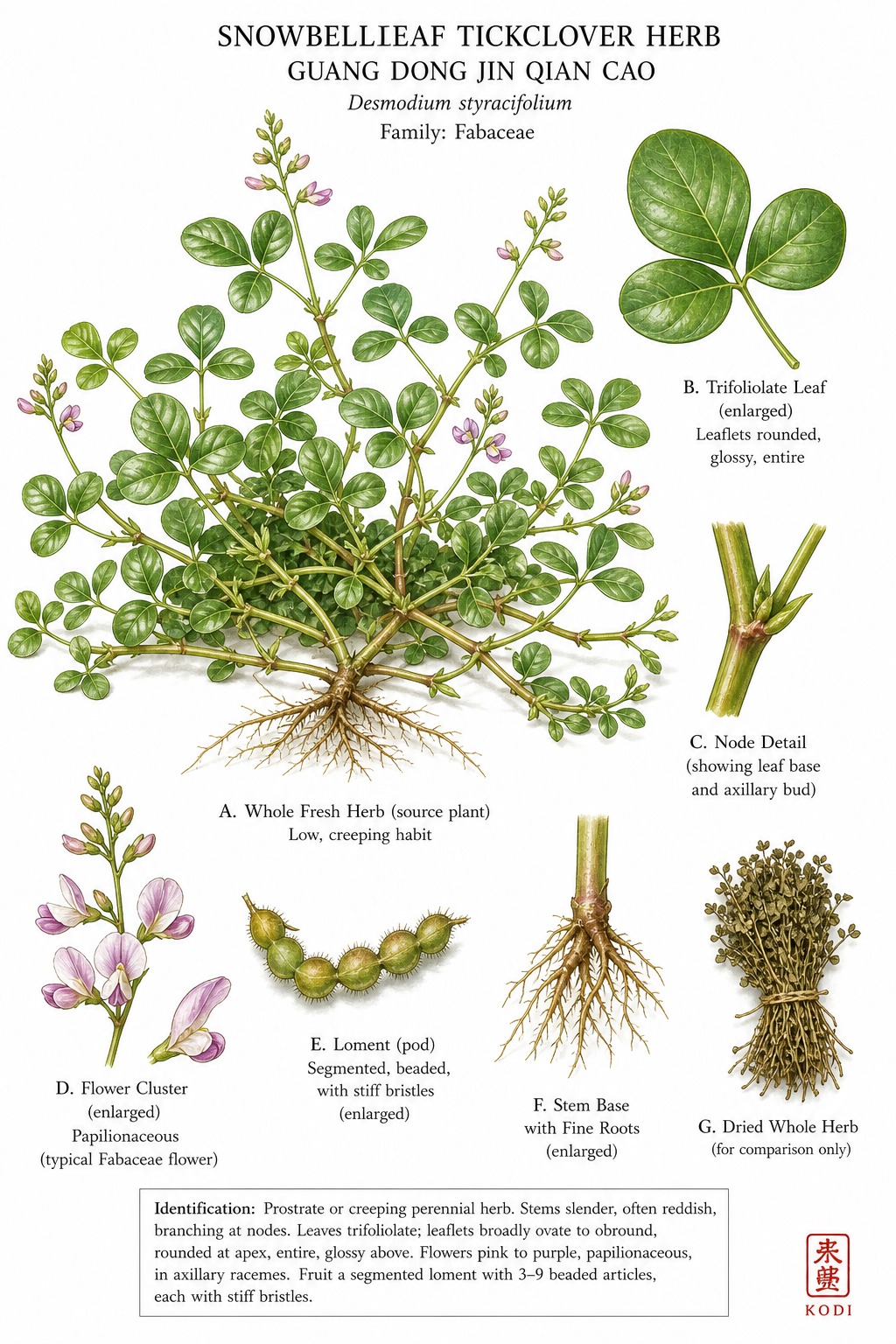
Known in TCM as Guang Dong Jin Qian Cao (广东金钱草), this sweet and bland, cool herb enters the Liver, Kidney, and Bladder. Traditionally, it clears damp-heat and promotes urination ... this Guangdong Jin Qian Cao lane is classically used for hot painful urination, stone strangury, gravel, and dark scanty urine, most often applied for urolithiasis, urinary tract infection, and jaundice. Modern research has identified Schaftoside among its active constituents.
Also Known As
Latin: Desmodii Styracifolii Herba | Pinyin: Guang Dong Jin Qian Cao | Chinese: 广东金钱草
TCM Properties
- Taste
- sweet, bland
- Temperature
- cool
- Channels
- Liver, Kidney, Bladder
Traditional Use
Primary Actions
- Clears damp-heat and promotes urination ... this Guangdong Jin Qian Cao lane is classically used for hot painful urination, stone strangury, gravel, and dark scanty urine.
- Facilitates stone passage ... regional practice especially values Desmodium styracifolium for urinary and biliary stone patterns.
- Clears damp-heat jaundice and related hepatobiliary irritation ... it is also used when yellowing, bitter taste, and lower-burner heat occur together.
Secondary Actions
- This page belongs to the Desmodium styracifolium branch of the broader Jin Qian Cao naming family and should not be flattened into the already-live Lysimachia or Glechoma pages.
- Botanical identity matters because different regional herbs circulate under Jin Qian Cao-related names while sharing only partial clinical overlap.
Classic Formulas
- Shi Lin Tong and related stone-expelling prescriptions ... Desmodium-based Jin Qian Cao is a classic principal herb for damp-heat calculi.
- San Jin style pairings with Hai Jin Sha and Ji Nei Jin ... a common urinary-stone strategy.
- Damp-heat jaundice combinations with Yin Chen and Zhi Zi ... hepatobiliary heat-clearing logic.
Classical References
- Hong Kong comparison materials distinguish Herba Desmodii Styracifolii from Herba Lysimachiae while noting that both are used for lithiasis and hepatobiliary disease.
- Traditional usage in southern China strongly links Guang Dong Jin Qian Cao with stone and strangury patterns rather than treating all Jin Qian Cao sources as interchangeable.
Modern Research
Active Compounds
- Schaftoside
- Flavonoid-rich fractions
- Polysaccharides
- Phenolic constituents
Studied Effects
- A 2024 review summarized the botany, ethnopharmacology, phytochemistry, and pharmacology of Desmodium styracifolium, reinforcing the herb's long association with nephrolithiasis and damp-heat disorders (PMID 38317880).
- Total flavonoids of Desmodium styracifolium reduced hydroxy-L-proline-induced calcium-oxalate urolithiasis in rats, supporting one of the clearest experimental bridges to its traditional stone use (PMID 28567512).
- Different polarity fractions of Desmodium styracifolium showed antilithic effects in experimentally induced urolithiasis models, adding broader support for stone-oriented activity (PMID 26123751).
PubMed References
- Desmodium styracifolium: Botanical and ethnopharmacological insights, phytochemical investigations, and prospects in pharmacology and pharmacotherapy. (2024)
- Total flavonoids of Desmodium styracifolium attenuates the formation of hydroxy-L-proline-induced calcium oxalate urolithiasis in rats. (2018)
- Antilithic effects of extracts from different polarity fractions of Desmodium styracifolium on experimentally induced urolithiasis in rats. (2015)
Safety & Interactions
Contraindications
- Marked deficiency-cold without damp-heat or stone patterns
- Excessive urination or fluid depletion
Cautions
- Correct botanical identification matters because several distinct herbs circulate under Jin Qian Cao-related names.
- Stone-expelling use should not substitute for urgent care when urinary obstruction, fever, or severe uncontrolled pain is present.
Conditions
- Urolithiasis Research ★★★★☆ JSON
- Urinary Tract Infection Traditional ★★★☆☆ JSON
- Jaundice Traditional ★★★☆☆ JSON
- Cholecystitis Traditional ★★☆☆☆ JSON
Frequently Asked Questions
What is Snowbellleaf Tickclover Herb used for?
Snowbellleaf Tickclover Herb is traditionally used to Clears damp-heat and promotes urination ... this Guangdong Jin Qian Cao lane is classically used for hot painful urination, stone strangury, gravel, and dark scanty urine., Facilitates stone passage ... regional practice especially values Desmodium styracifolium for urinary and biliary stone patterns., Clears damp-heat jaundice and related hepatobiliary irritation ... it is also used when yellowing, bitter taste, and lower-burner heat occur together.. Research has investigated its effects on: A 2024 review summarized the botany, ethnopharmacology, phytochemistry, and pharmacology of Desmodium styracifolium, reinforcing the herb's long association with nephrolithiasis and damp-heat disorders (PMID 38317880).; Total flavonoids of Desmodium styracifolium reduced hydroxy-L-proline-induced calcium-oxalate urolithiasis in rats, supporting one of the clearest experimental bridges to its traditional stone use (PMID 28567512)..
What are other names for Snowbellleaf Tickclover Herb?
Snowbellleaf Tickclover Herb is also known as Guang Jin Qian Cao, Desmodium styracifolium herb, Desmodium. In TCM: 广东金钱草 (Guang Dong Jin Qian Cao); Desmodii Styracifolii Herba.
Is Snowbellleaf Tickclover Herb safe during pregnancy?
The safety of Snowbellleaf Tickclover Herb during pregnancy has not been established. Consult a qualified healthcare provider before use.
What are the contraindications for Snowbellleaf Tickclover Herb?
Snowbellleaf Tickclover Herb should not be used in: Marked deficiency-cold without damp-heat or stone patterns; Excessive urination or fluid depletion. Consult a qualified healthcare provider before use.