Snake Bile
- Chinese
- 蛇胆汁
- Pinyin
- She Dan Zhi
- Latin
- Fel Serpentis Liquidum
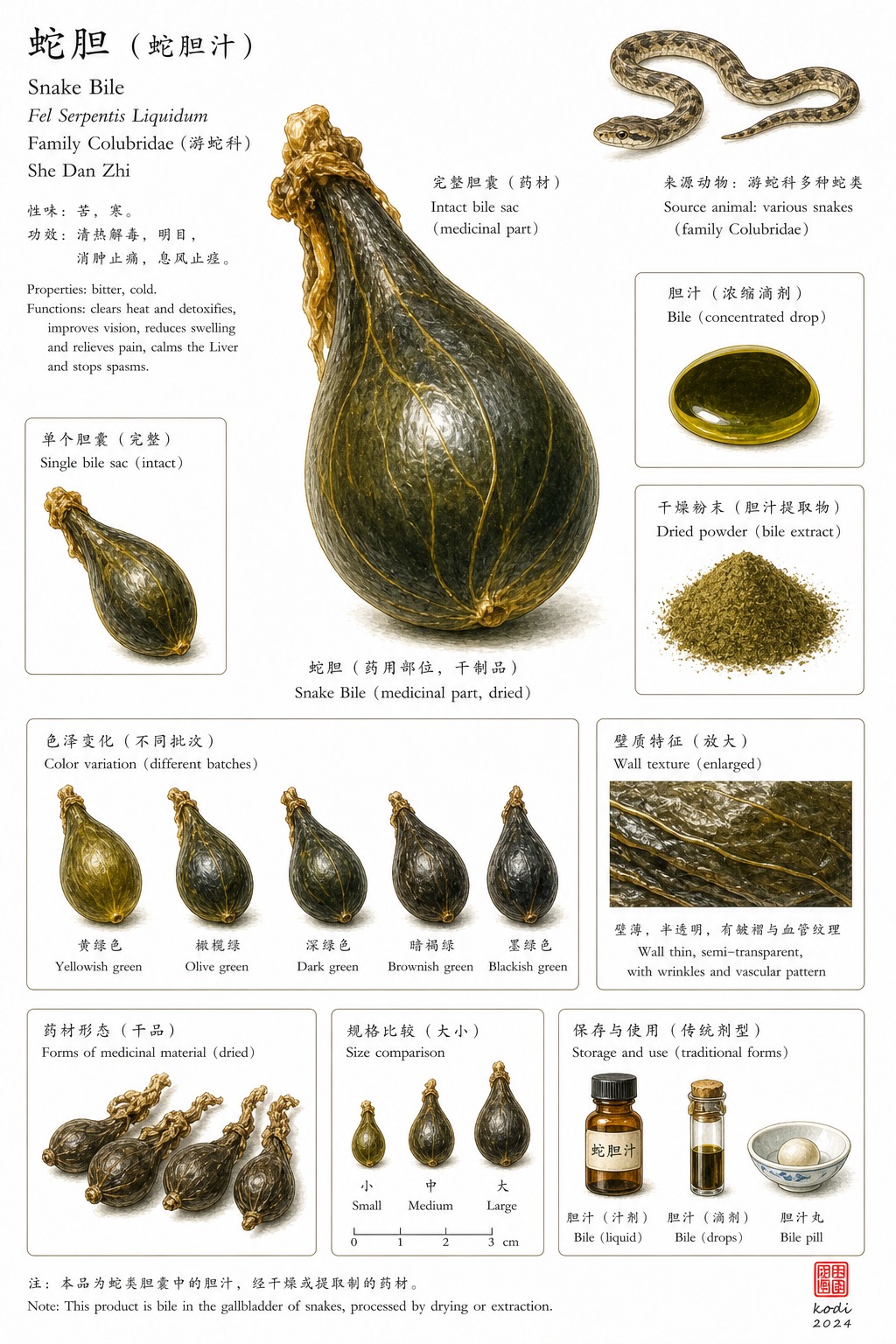
Known in TCM as She Dan Zhi (蛇胆汁), this bitter and sweet, cold herb enters the Lung, Liver, and Gallbladder. Traditionally, it clears phlegm-heat and relieves cough or wheezing when thick heat-phlegm obstructs the Lung, most often applied for productive cough, wheezing, and blurred vision. Modern research has identified Complex among its active constituents.
Part used: Bile
Also Known As
Latin: Fel Serpentis Liquidum | Pinyin: She Dan Zhi | Chinese: 蛇胆汁
TCM Properties
- Taste
- bitter, sweet
- Temperature
- cold
- Channels
- Lung, Liver, Gallbladder
Traditional Use
Primary Actions
- Clears phlegm-heat and relieves cough or wheezing when thick heat-phlegm obstructs the Lung.
- Clears Liver and Gallbladder heat and benefits the eyes in older use for red eyes or diminished visual clarity linked to internal heat.
- Dispels wind-dampness and alleviates pain in some rheumatic or channel-obstruction presentations.
Secondary Actions
- She Dan Zhi belongs to the potent animal-bile medicinal family and should be understood as a strong, high-risk historical drug rather than a routine supplement.
- Modern interest focuses heavily on bile-acid profiling, authentication, and toxicology, which matches the real-world safety concerns around this material.
Classic Formulas
- Heat-phlegm cough and wheeze combinations ... the main respiratory lane for snake bile.
- Eye and liver-heat support within famous proprietary formulas such as the `Pian Zi Huang` family tradition ... an important historical context.
- Wind-damp and channel-obstruction use in some regional animal-medicine traditions ... a secondary but recurring indication set.
Classical References
- Traditional summaries describe She Dan as cold, bitter, and often sweet in secondary taste descriptions, with strong heat-clearing and phlegm-resolving action.
- Its indications extend from cough and asthma to eye complaints and toxic-heat disorders.
- The same classical reputation that made medicinal bile valuable also explains why modern toxicology and authentication questions are central.
Modern Research
Active Compounds
- Complex bile-acid mixtures characteristic of snake species
- Steroidal bile constituents with species-dependent profiles
- Analytical markers used for authentication and toxicologic differentiation
Studied Effects
- A 2003 toxicology study analyzed bile-acid composition in snake bile juice and directly demonstrated toxicity of snake bile acids in rats, making it essential context for modern safety framing (PMID 14659461).
- A 2019 analytical study differentiated snake bile from various genera by HPTLC-QTOF-MS, underscoring the importance of source authentication in trade and research (PMID 30424826).
- A 2024 mass-spectrometry study further identified bile acids in snake bile through hydrogen/deuterium exchange methods, showing how contemporary work centers on precise chemistry rather than casual medicinal use (PMID 39305539).
PubMed References
- Bile acid composition in snake bile juice and toxicity of snake bile acids to rats. (2003)
- Differentiation of Various Snake Bile Derived from Different Genus by High-Performance Thin-Layer Chromatography Coupled with Quadrupole Time-of-Flight Mass Spectrometry. (2019)
- Identification of bile acids in snake bile by hydrogen/deuterium exchange mass spectrometry and quantitative structure-retention relationship analysis. (2024)
Safety & Interactions
Contraindications
- Pregnancy
- Cold deficiency patterns
- Liver or kidney disease
- Any unsupervised internal use of unverified animal bile material
Cautions
- Snake bile has real toxicology literature and should not be normalized as a casual respiratory or liver remedy.
- Authentication matters because chemical profiles vary by species and poor-quality material can be dangerous.
- Adverse effects may involve hepatotoxic, renal, and gastrointestinal injury.
Conditions
- Productive Cough Traditional ★★★☆☆ JSON
- Wheezing Traditional ★★★☆☆ JSON
- Blurred Vision Traditional ★★☆☆☆ JSON
- Joint Pain Traditional ★★☆☆☆ JSON
Frequently Asked Questions
What is Snake Bile used for?
Snake Bile is traditionally used to Clears phlegm-heat and relieves cough or wheezing when thick heat-phlegm obstructs the Lung., Clears Liver and Gallbladder heat and benefits the eyes in older use for red eyes or diminished visual clarity linked to internal heat., Dispels wind-dampness and alleviates pain in some rheumatic or channel-obstruction presentations.. Research has investigated its effects on: A 2003 toxicology study analyzed bile-acid composition in snake bile juice and directly demonstrated toxicity of snake bile acids in rats, making it essential context for modern safety framing (PMID 14659461).; A 2019 analytical study differentiated snake bile from various genera by HPTLC-QTOF-MS, underscoring the importance of source authentication in trade and research (PMID 30424826)..
What are other names for Snake Bile?
Snake Bile is also known as She Dan, Snake bile juice. In TCM: 蛇胆汁 (She Dan Zhi); Fel Serpentis Liquidum.
Is Snake Bile safe during pregnancy?
Snake Bile is not recommended during pregnancy.
What are the contraindications for Snake Bile?
Snake Bile should not be used in: Pregnancy; Cold deficiency patterns; Liver or kidney disease; Any unsupervised internal use of unverified animal bile material. Consult a qualified healthcare provider before use.