Small Centipeda Herb
- Chinese
- 鹅不食草
- Pinyin
- E Bu Shi Cao
- Latin
- Herba Centipedae
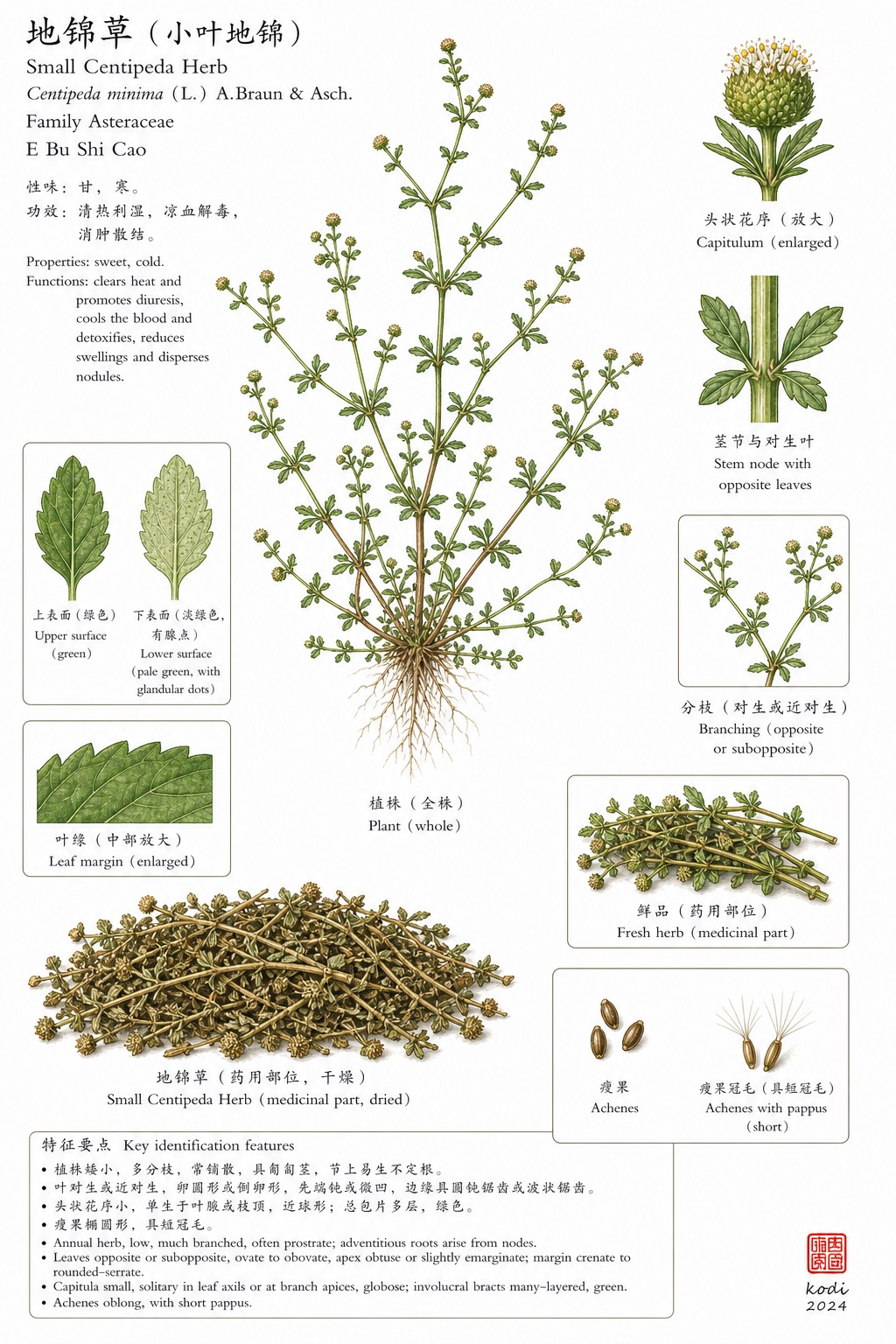
Known in TCM as E Bu Shi Cao (鹅不食草), this pungent, warm herb enters the Lung and Liver. Traditionally, it disperses wind-cold and powerfully opens the nasal passages, making it one of the most specific herbs for nasal congestion, rhinitis, and sinus obstruction, most often applied for sinusitis, common cold, and cough. Modern research has identified Volatile-oil among its active constituents.
Part used: Whole herb
Also Known As
Latin: Herba Centipedae | Pinyin: E Bu Shi Cao | Chinese: 鹅不食草
TCM Properties
- Taste
- pungent
- Temperature
- warm
- Channels
- Lung, Liver
Traditional Use
Primary Actions
- Disperses wind-cold and powerfully opens the nasal passages, making it one of the most specific herbs for nasal congestion, rhinitis, and sinus obstruction.
- Resolves phlegm and stops cough when cold-type phlegm blocks the Lung and breathing passages.
- Brightens the eyes and removes visual obstruction in older use for red eyes or superficial corneal films.
- Resolves toxicity and reduces swelling when applied externally to boils, sores, traumatic swelling, or bites.
Secondary Actions
- E Bu Shi Cao is much more specific to the nose and upper airways than many other warm exterior herbs, and its strong ascending action explains why it is often used intranasally in traditional practice.
- This herb can be quite stimulating locally, which is part of its effectiveness but also part of its caution profile.
Classic Formulas
- Nasal-opening modifications to Cang Er Zi San or Bi Yan Wan ... the most familiar practical use for stubborn congestion and sinusitis.
- Wind-cold respiratory pairings with Xin Yi Hua and Cang Er Zi ... the classic upper-airway strategy.
- Fresh-herb external application or powder insufflation ... older topical methods for swelling and severe blockage.
Classical References
- Traditional herbology describes E Bu Shi Cao as pungent and warm, entering the Lung and Liver to disperse wind-cold and unblock the nose.
- Classical and modern herb manuals consistently place its strongest indication in nasal obstruction rather than general fever clearing.
- Its old reputation for making the patient sneeze captures the herb's penetrating, upward-directing action.
Modern Research
Active Compounds
- Volatile-oil fractions from Centipeda minima
- Sesquiterpene lactones and related anti-inflammatory constituents
- Bioactives studied for histamine, NF-kB, and JAK-STAT pathway modulation
Studied Effects
- A 2021 study examined mechanisms by which Centipeda minima from different geographic areas treated allergic rhinitis, directly supporting the herb's best-known traditional use (PMID 34010591).
- A 2019 network-pharmacology study explored how Flos magnoliae and Centipeda minima may work together for allergic rhinitis, reflecting the classic nasal-opening pairing logic (PMID 31216904).
- A 2025 study identified neocnidilide and 6-gingerol as key bioactives in fresh and dried Centipeda minima with distinct Th1/Th2 modulation relevant to allergic rhinitis therapy (PMID 40943597).
PubMed References
- Mechanism of allergic rhinitis treated by Centipeda minima from different geographic areas. (2021)
- Pharmacology mechanism of Flos magnoliae and Centipeda minima for treating allergic rhinitis based on pharmacology network. (2019)
- Neocnidilide and 6-Gingerol as Key Bioactives in Fresh and Dried Centipeda minima: Distinct Th1/Th2 Modulation via NF-kB/JAK-STAT Pathways for Allergic Rhinitis Therapy. (2025)
Safety & Interactions
Contraindications
- Dry heat or Yin-deficiency cough without cold-phlegm or nasal obstruction
Cautions
- Direct nasal use can be strongly irritating, so traditional insufflation methods should not be improvised casually.
- The herb may irritate the stomach in sensitive people, especially at higher doses or with concentrated extracts.
Conditions
- Sinusitis Traditional ★★★★☆ JSON
- Common Cold Traditional ★★☆☆☆ JSON
- Cough Traditional ★★★☆☆ JSON
- Pharyngitis Traditional ★★☆☆☆ JSON
Frequently Asked Questions
What is Small Centipeda Herb used for?
Small Centipeda Herb is traditionally used to Disperses wind-cold and powerfully opens the nasal passages, making it one of the most specific herbs for nasal congestion, rhinitis, and sinus obstruction., Resolves phlegm and stops cough when cold-type phlegm blocks the Lung and breathing passages., Brightens the eyes and removes visual obstruction in older use for red eyes or superficial corneal films., Resolves toxicity and reduces swelling when applied externally to boils, sores, traumatic swelling, or bites.. Research has investigated its effects on: A 2021 study examined mechanisms by which Centipeda minima from different geographic areas treated allergic rhinitis, directly supporting the herb's best-known traditional use (PMID 34010591).; A 2019 network-pharmacology study explored how Flos magnoliae and Centipeda minima may work together for allergic rhinitis, reflecting the classic nasal-opening pairing logic (PMID 31216904)..
What are other names for Small Centipeda Herb?
Small Centipeda Herb is also known as Centipeda Herb, Centipeda minima, Goose-won't-eat grass. In TCM: 鹅不食草 (E Bu Shi Cao); Herba Centipedae.
Is Small Centipeda Herb safe during pregnancy?
The safety of Small Centipeda Herb during pregnancy has not been established. Consult a qualified healthcare provider before use.
What are the contraindications for Small Centipeda Herb?
Small Centipeda Herb should not be used in: Dry heat or Yin-deficiency cough without cold-phlegm or nasal obstruction. Consult a qualified healthcare provider before use.