Chinese Siphonostegia Herb
- Chinese
- 阴行草
- Pinyin
- Yin Xing Cao
- Latin
- Herba Siphonostegiae
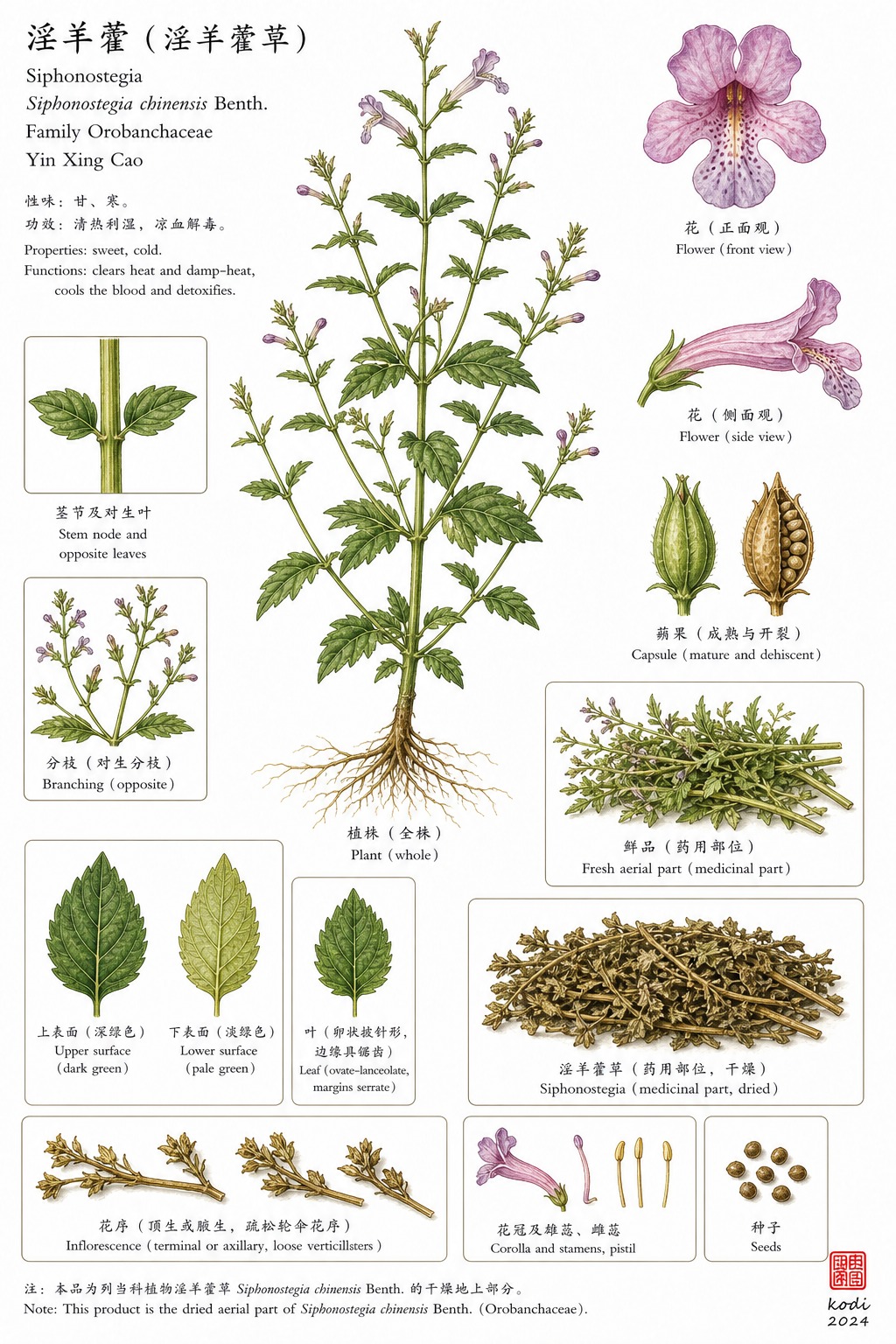
Known in TCM as Yin Xing Cao (阴行草), this bitter, cold herb enters the Spleen, Stomach, Liver, and Gallbladder. Traditionally, it activates Blood and removes stasis in traumatic injury and menstrual obstruction, especially where heat and stasis combine, most often applied for traumatic injury, amenorrhea, and abnormal uterine bleeding. Modern research has identified Phenylpropanoid among its active constituents.
Part used: Whole herb
Also Known As
Latin: Herba Siphonostegiae | Pinyin: Yin Xing Cao | Chinese: 阴行草
TCM Properties
- Taste
- bitter
- Temperature
- cold
- Channels
- Spleen, Stomach, Liver, Gallbladder
Traditional Use
Primary Actions
- Activates Blood and removes stasis in traumatic injury and menstrual obstruction, especially where heat and stasis combine.
- Stimulates menstruation and relieves pain in amenorrhea or dysmenorrhea patterns marked by retained stasis.
- Cools Blood and stops bleeding in selected heat-stasis presentations such as abnormal uterine bleeding or blood-tinged urination.
- Clears heat and promotes urination in damp-heat presentations involving jaundice or urinary irritation.
Secondary Actions
- This is the true `Siphonostegia chinensis` lane, often called `Bei Liu Ji Nu`, and it should not be confused with the unrelated `Artemisia anomala` page above.
- Historical naming overlap explains why northern sources sometimes call Yin Xing Cao `Liu Ji Nu`, but the species and profile are distinct.
Classic Formulas
- Blood-stasis and trauma combinations with Tao Ren or San Qi ... the main practical use pattern for Bei Liu Ji Nu.
- Menstrual-obstruction formulas with Dang Gui and Yi Mu Cao ... a common lower-burner stasis lane.
- Heat-stasis and urinary-damp combinations ... a more specialized use for bleeding and jaundice presentations.
Classical References
- Traditional summaries describe Yin Xing Cao or Bei Liu Ji Nu as bitter and cold, entering the Spleen, Stomach, Liver, and Gallbladder.
- Its core actions are activating Blood, regulating menstruation, cooling Blood to stop bleeding, and clearing damp-heat through urination.
- The long-standing naming collision with Liu Ji Nu is historical, but the medicinal identity here is Siphonostegia chinensis.
Modern Research
Active Compounds
- Phenylpropanoid and caffeoylquinic-acid-related constituents
- Verbascoside and related phenolic compounds
- Whole-herb fractions under early-stage pharmacologic investigation
Studied Effects
- A 1989 historical study traced the medical use and naming of Yinxingcao, documenting that Siphonostegia chinensis is commonly called `Jinzhong Yinchen` in the south and `Liujinu` in the north, which directly clarifies the identity problem in this stub (PMID 2511855).
- A 2026 study identified SARS-CoV-2 Mpro inhibitory constituents from Siphonostegia chinensis, showing that modern phytochemical interest in the true herb is now emerging (PMID 42040628).
- Compared with Liu Ji Nu, direct indexed modern pharmacology on Yin Xing Cao remains relatively sparse, so this page stays conservative and anchored to clear historical identity.
PubMed References
Safety & Interactions
Contraindications
- Pregnancy
- Cold deficiency without blood stasis or damp-heat
- Heavy bleeding from deficiency rather than heat-stasis
Cautions
- Yin Xing Cao is a colder, more blood-moving herb than its naming collision suggests, so species confusion can lead to wrong-pattern use.
- Because traditional indications include menstruation-promotion and bleeding disorders, supervision is important in anyone with active bleeding risk.
Conditions
- Traumatic Injury Traditional ★★★☆☆ JSON
- Amenorrhea Traditional ★★★☆☆ JSON
- Abnormal Uterine Bleeding Traditional ★★☆☆☆ JSON
- Hematuria Traditional ★★☆☆☆ JSON
Frequently Asked Questions
What is Chinese Siphonostegia Herb used for?
Chinese Siphonostegia Herb is traditionally used to Activates Blood and removes stasis in traumatic injury and menstrual obstruction, especially where heat and stasis combine., Stimulates menstruation and relieves pain in amenorrhea or dysmenorrhea patterns marked by retained stasis., Cools Blood and stops bleeding in selected heat-stasis presentations such as abnormal uterine bleeding or blood-tinged urination., Clears heat and promotes urination in damp-heat presentations involving jaundice or urinary irritation.. Research has investigated its effects on: A 1989 historical study traced the medical use and naming of Yinxingcao, documenting that Siphonostegia chinensis is commonly called `Jinzhong Yinchen` in the south and `Liujinu` in the north, which directly clarifies the identity problem in this stub (PMID 2511855).; A 2026 study identified SARS-CoV-2 Mpro inhibitory constituents from Siphonostegia chinensis, showing that modern phytochemical interest in the true herb is now emerging (PMID 42040628)..
What are other names for Chinese Siphonostegia Herb?
Chinese Siphonostegia Herb is also known as Bei Liu Ji Nu, Siphonostegia chinensis Herb. In TCM: 阴行草 (Yin Xing Cao); Herba Siphonostegiae.
Is Chinese Siphonostegia Herb safe during pregnancy?
Chinese Siphonostegia Herb is not recommended during pregnancy.
What are the contraindications for Chinese Siphonostegia Herb?
Chinese Siphonostegia Herb should not be used in: Pregnancy; Cold deficiency without blood stasis or damp-heat; Heavy bleeding from deficiency rather than heat-stasis. Consult a qualified healthcare provider before use.