Xinjiang Fritillary Bulb
- Chinese
- 伊贝母
- Pinyin
- Yi Bei Mu
- Latin
- Bulbus Fritillariae Pallidiflorae
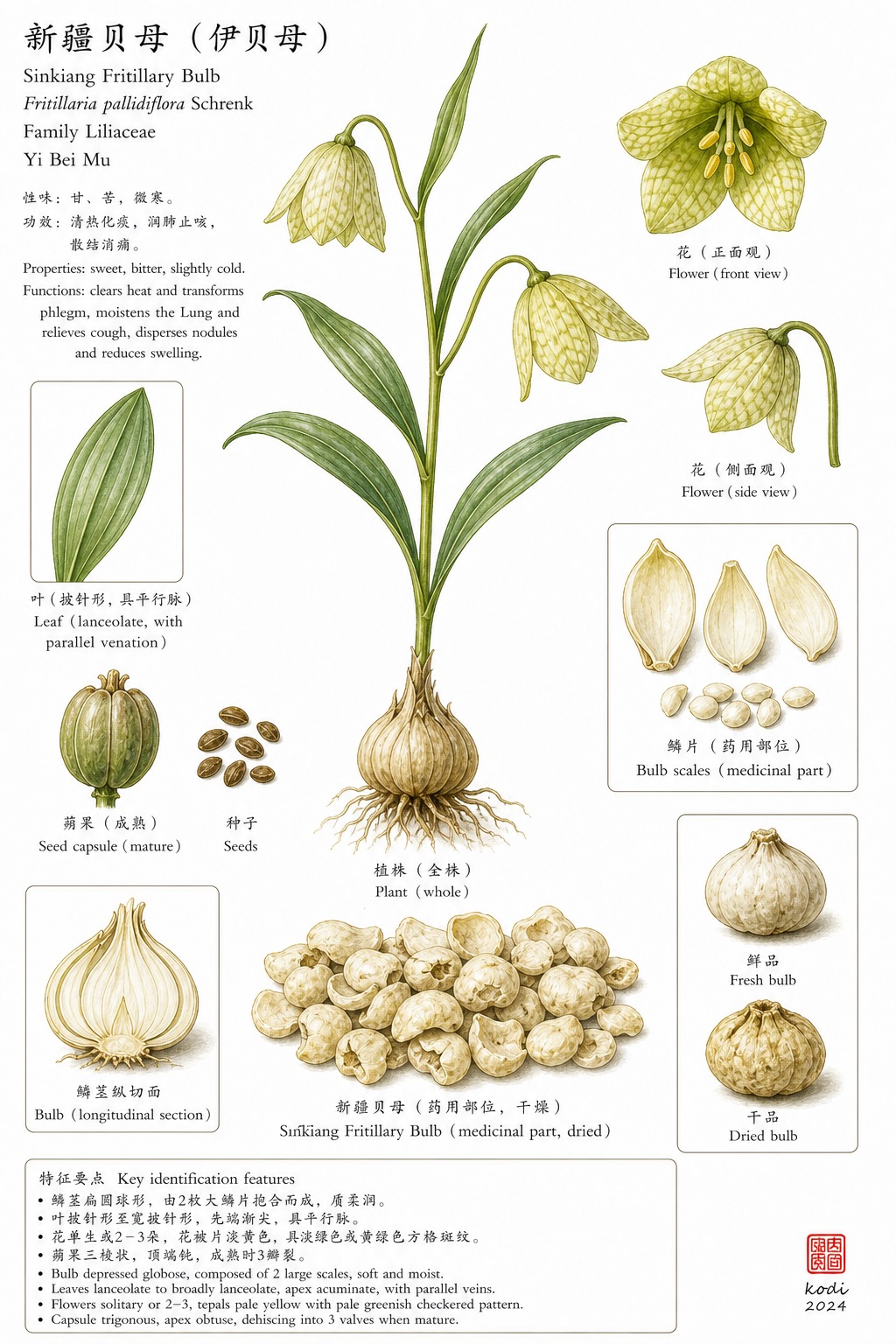
Known in TCM as Yi Bei Mu (伊贝母), this bitter and sweet, slightly cold herb enters the Heart and Lung. Traditionally, it clears heat from the Lung and relieves cough, especially when dryness or lingering heat irritates the chest, most often applied for dry cough, productive cough, and hemoptysis. Modern research has identified Isosteroidal among its active constituents.
Part used: Bulb
Also Known As
Latin: Bulbus Fritillariae Pallidiflorae | Pinyin: Yi Bei Mu | Chinese: 伊贝母
TCM Properties
- Taste
- bitter, sweet
- Temperature
- slightly cold
- Channels
- Heart, Lung
Traditional Use
Primary Actions
- Clears heat from the Lung and relieves cough, especially when dryness or lingering heat irritates the chest.
- Transforms phlegm and moistens the respiratory tract, making it useful for chronic cough with sticky sputum or throat dryness.
- Benefits the Lung in deficiency-tinged heat patterns that include blood-streaked sputum or recurrent irritation.
Secondary Actions
- Yi Bei Mu is a recognized Xinjiang Fritillaria lane and should not be collapsed into generic `Bei Mu` or treated as a simple misspelling of Chuan or Zhe Bei Mu.
- Trade confusion is real because Yi Bei Mu is sometimes mixed with or substituted for other fritillary bulbs, but the species has its own developing modern literature.
Classic Formulas
- Dry-cough and phlegm-heat combinations with Sha Shen, Mai Men Dong, or Pi Pa Ye ... the usual respiratory pattern for Yi Bei Mu.
- Blood-streaked cough support with cooling and moistening herbs ... a gentler fritillary use context.
- Regional fritillary substitutions in cough formulas ... a practical reality in trade and prescribing.
Classical References
- Traditional summaries describe Yi Bei Mu as bitter, sweet, and slightly cold, entering the Heart and Lung to clear heat, transform phlegm, and stop cough.
- Its profile sits within the wider Fritillaria cough-relieving tradition but retains a distinct source identity in Xinjiang materia medica.
- Classical incompatibility teaching groups Yi Bei Mu with other fritillary species that should not be combined with the aconite family.
Modern Research
Active Compounds
- Isosteroidal alkaloids characteristic of Fritillaria species
- Total alkaloid fractions studied for anti-inflammatory and pulmonary effects
- Tracheal-relaxant alkaloid constituents
Studied Effects
- A 2025 review focused specifically on Fritillaria pallidiflora, summarizing ethnopharmacology, phytochemistry, pharmacology, and future directions for Yi Bei Mu (PMID 41470653).
- A 2025 study reported that total alkaloids of Bulbus Fritillariae Pallidiflorae alleviated silica-induced pulmonary inflammation and fibrosis through EMT and TGF-beta1/Smad pathway regulation in preclinical research (PMID 41197275).
- Earlier phytochemical work isolated new isosteroidal alkaloids with tracheal-relaxant activity from Fritillaria pallidiflora bulbs, which is highly relevant to the herb's cough and wheeze tradition (PMID 26965859).
PubMed References
- Fritillaria pallidiflora Schrenk ex Fisch. & C.A.Mey. (Yi Beimu): Ethnopharmacology, Phytochemistry, Pharmacological Insights, and Future Prospects. (2025)
- Total alkaloids of Bulbus Fritillariae Pallidiflorae alleviated silica induced pulmonary inflammation and fibrosis via regulating EMT and TGF-beta1/Smad signaling pathway. (2025)
- New isosteroidal alkaloids with tracheal relaxant effect from the bulbs of Fritillaria pallidiflora Schrenk. (2016)
Safety & Interactions
Contraindications
- Cold-phlegm cough without heat or dryness
- Use of adulterated fritillary material
Cautions
- Correct species identification matters because fritillary bulbs are frequently mixed in trade.
- Most modern data is preclinical and should not be overstated into direct clinical efficacy.
Drug Interactions
- Aconite-family medicinals such as Chuan Wu, Cao Wu, and Fu Zi ... classical incompatibility teaching advises against combining fritillary bulbs with aconites
Conditions
- Dry Cough Traditional ★★★★☆ JSON
- Productive Cough Traditional ★★★☆☆ JSON
- Hemoptysis Traditional ★★☆☆☆ JSON
- Phlegm Accumulation Traditional ★★★☆☆ JSON
Frequently Asked Questions
What is Xinjiang Fritillary Bulb used for?
Xinjiang Fritillary Bulb is traditionally used to Clears heat from the Lung and relieves cough, especially when dryness or lingering heat irritates the chest., Transforms phlegm and moistens the respiratory tract, making it useful for chronic cough with sticky sputum or throat dryness., Benefits the Lung in deficiency-tinged heat patterns that include blood-streaked sputum or recurrent irritation.. Research has investigated its effects on: A 2025 review focused specifically on Fritillaria pallidiflora, summarizing ethnopharmacology, phytochemistry, pharmacology, and future directions for Yi Bei Mu (PMID 41470653).; A 2025 study reported that total alkaloids of Bulbus Fritillariae Pallidiflorae alleviated silica-induced pulmonary inflammation and fibrosis through EMT and TGF-beta1/Smad pathway regulation in preclinical research (PMID 41197275)..
What are other names for Xinjiang Fritillary Bulb?
Xinjiang Fritillary Bulb is also known as Sinkiang Fritillary Bulb, Fritillaria pallidiflora, Yi Beimu. In TCM: 伊贝母 (Yi Bei Mu); Bulbus Fritillariae Pallidiflorae.
Is Xinjiang Fritillary Bulb safe during pregnancy?
The safety of Xinjiang Fritillary Bulb during pregnancy has not been established. Consult a qualified healthcare provider before use.
What are the contraindications for Xinjiang Fritillary Bulb?
Xinjiang Fritillary Bulb should not be used in: Cold-phlegm cough without heat or dryness; Use of adulterated fritillary material. Consult a qualified healthcare provider before use.
Does Xinjiang Fritillary Bulb interact with any medications?
Xinjiang Fritillary Bulb may interact with: Aconite-family medicinals such as Chuan Wu, Cao Wu, and Fu Zi ... classical incompatibility teaching advises against combining fritillary bulbs with aconites. Always inform your healthcare provider of any herbal supplements you are taking.