Late-Harvest Silkworm Droppings
- Chinese
- 晚蚕沙
- Pinyin
- Wan Can Sha
- Latin
- Excrementum Bombycis Mori
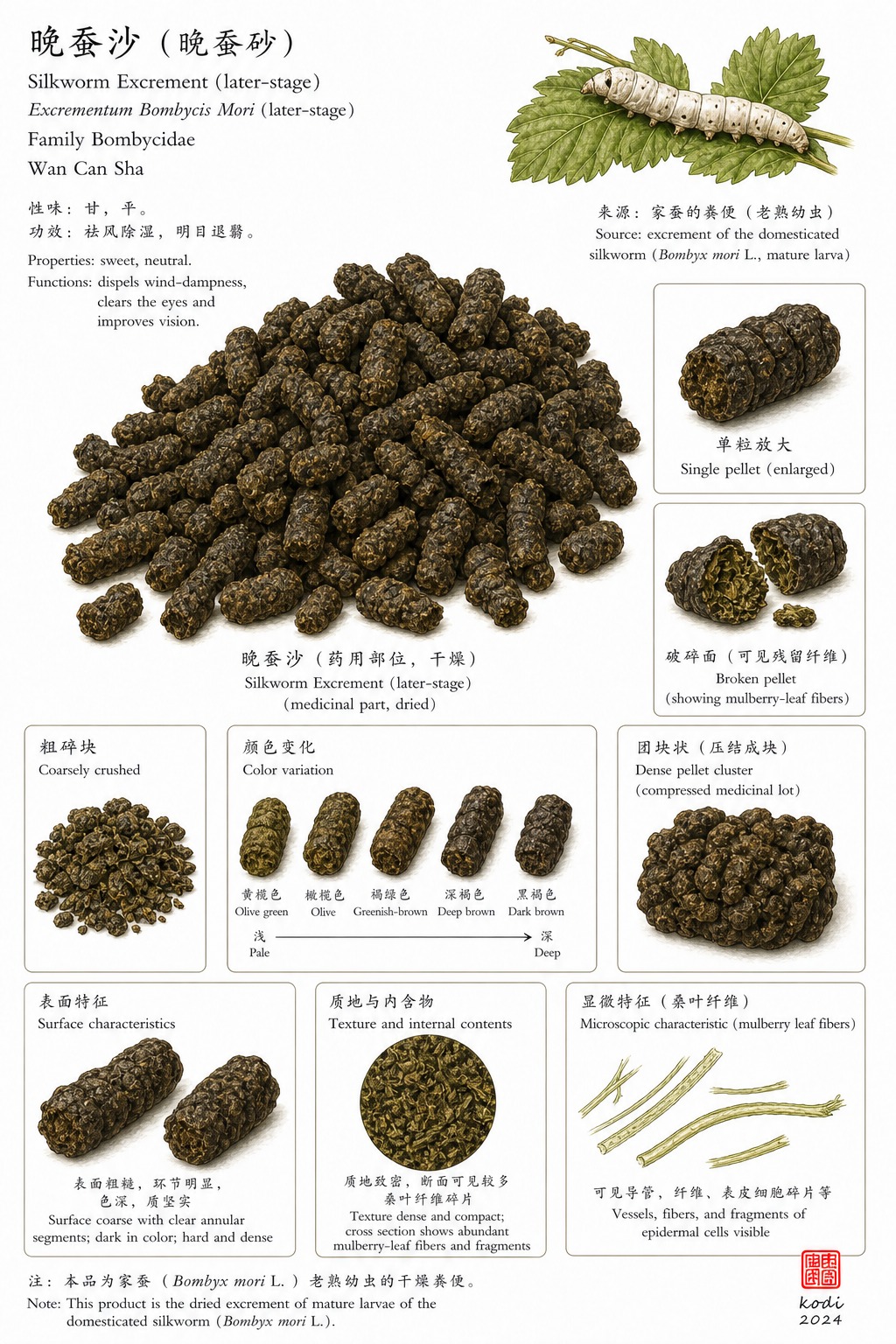
Known in TCM as Wan Can Sha (晚蚕沙), this pungent and sweet, warm herb enters the Liver, Spleen, and Stomach. Traditionally, it dispels wind-dampness and frees the collaterals in the same general herb family as Can Sha, especially for chronic joint pain, stiffness, and rheumatic discomfort, most often applied for joint pain, rheumatism, and diarrhea. Modern research has identified Chlorophyll-derivative among its active constituents.
Part used: Faeces
Also Known As
Latin: Excrementum Bombycis Mori | Pinyin: Wan Can Sha | Chinese: 晚蚕沙
TCM Properties
- Taste
- pungent, sweet
- Temperature
- warm
- Channels
- Liver, Spleen, Stomach
Traditional Use
Primary Actions
- Dispels wind-dampness and frees the collaterals in the same general herb family as Can Sha, especially for chronic joint pain, stiffness, and rheumatic discomfort.
- Harmonizes the middle and transforms turbid dampness for diarrhea, abdominal discomfort, and cramping when digestion is burdened by damp obstruction.
- Supports external-use traditions for itching, damp skin irritation, or warm compresses over painful areas.
Secondary Actions
- Wan Can Sha is best understood as an alternate or later-harvest naming lane within the Can Sha tradition, not as a different source species.
- Classical quality notes often regard later-instar droppings as less prized than earlier collection lots, which is useful sourcing context but does not create a separate pharmacologic identity.
Classic Formulas
- Can Shi Tang-style digestive formulas ... the same core family context shared with Can Sha.
- Warm bag, wash, or external applications ... especially when local dampness, itching, or aching dominates.
- Wind-damp combinations for chronic obstruction ... the practical lane for long-standing joint complaints.
Classical References
- Traditional sources treat Wan Can Sha as a recognized name within the Can Sha lineage rather than as a wholly distinct medicinal.
- Its actions remain the familiar Can Sha pattern ... dispelling wind-dampness and harmonizing the Stomach.
- Quality discussion centers more on harvest stage and processing than on any fundamentally different TCM nature.
Modern Research
Active Compounds
- Chlorophyll-derivative metabolites
- Flavonoids and sesquiterpene fractions
- Storage-sensitive plant-derived compounds transformed by silkworm digestion
Studied Effects
- Modern indexed research focuses on Can Sha as the broader silkworm-droppings medicinal rather than cleanly separating Wan Can Sha, so the chemistry and activity evidence is shared across the same underlying drug family.
- Phytochemical work isolated megastigmane sesquiterpenes and reported HO-1 and SIRT1-related activity from silkworm droppings extracts (PMID 21544718).
- Related flavonoid-isolation work also found HO-1-promoting activity, while newer analytical work shows that composition changes with storage and processing, which is especially relevant to later-harvest naming lanes such as Wan Can Sha (PMIDs 21462044, 32495562).
PubMed References
- Isolation of megastigmane sesquiterpenes from the silkworm (Bombyx mori L.) droppings and their promotion activity on HO-1 and SIRT1. (2011)
- Flavonoids from silkworm droppings and their promotional activities on heme oxygenase-1. (2011)
- [Study on degradation of silkworm excrement chemical components in vitro]. (2020)
Safety & Interactions
Contraindications
- Dry, heat-damaged, or fluid-depleted patterns without dampness
- Use of poorly stored or contaminated material
Cautions
- Later-harvest naming does not guarantee quality, so sourcing and cleanliness remain more important than the alias itself.
- As with other animal byproduct medicinals, poorly processed material should not be used internally.
Conditions
- Joint Pain Traditional ★★★☆☆ JSON
- Rheumatism Traditional ★★★☆☆ JSON
- Diarrhea Traditional ★★☆☆☆ JSON
- Eczema Traditional ★★☆☆☆ JSON
Frequently Asked Questions
What is Late-Harvest Silkworm Droppings used for?
Late-Harvest Silkworm Droppings is traditionally used to Dispels wind-dampness and frees the collaterals in the same general herb family as Can Sha, especially for chronic joint pain, stiffness, and rheumatic discomfort., Harmonizes the middle and transforms turbid dampness for diarrhea, abdominal discomfort, and cramping when digestion is burdened by damp obstruction., Supports external-use traditions for itching, damp skin irritation, or warm compresses over painful areas.. Research has investigated its effects on: Modern indexed research focuses on Can Sha as the broader silkworm-droppings medicinal rather than cleanly separating Wan Can Sha, so the chemistry and activity evidence is shared across the same underlying drug family.; Phytochemical work isolated megastigmane sesquiterpenes and reported HO-1 and SIRT1-related activity from silkworm droppings extracts (PMID 21544718)..
What are other names for Late-Harvest Silkworm Droppings?
Late-Harvest Silkworm Droppings is also known as Wan Can Sha, Silkworm excrement, Late silkworm droppings. In TCM: 晚蚕沙 (Wan Can Sha); Excrementum Bombycis Mori.
Is Late-Harvest Silkworm Droppings safe during pregnancy?
The safety of Late-Harvest Silkworm Droppings during pregnancy has not been established. Consult a qualified healthcare provider before use.
What are the contraindications for Late-Harvest Silkworm Droppings?
Late-Harvest Silkworm Droppings should not be used in: Dry, heat-damaged, or fluid-depleted patterns without dampness; Use of poorly stored or contaminated material. Consult a qualified healthcare provider before use.