Sheep Penis
- Chinese
- 羊鞭
- Pinyin
- Yang Bian
- Latin
- Penis Caprae Seu Ovis
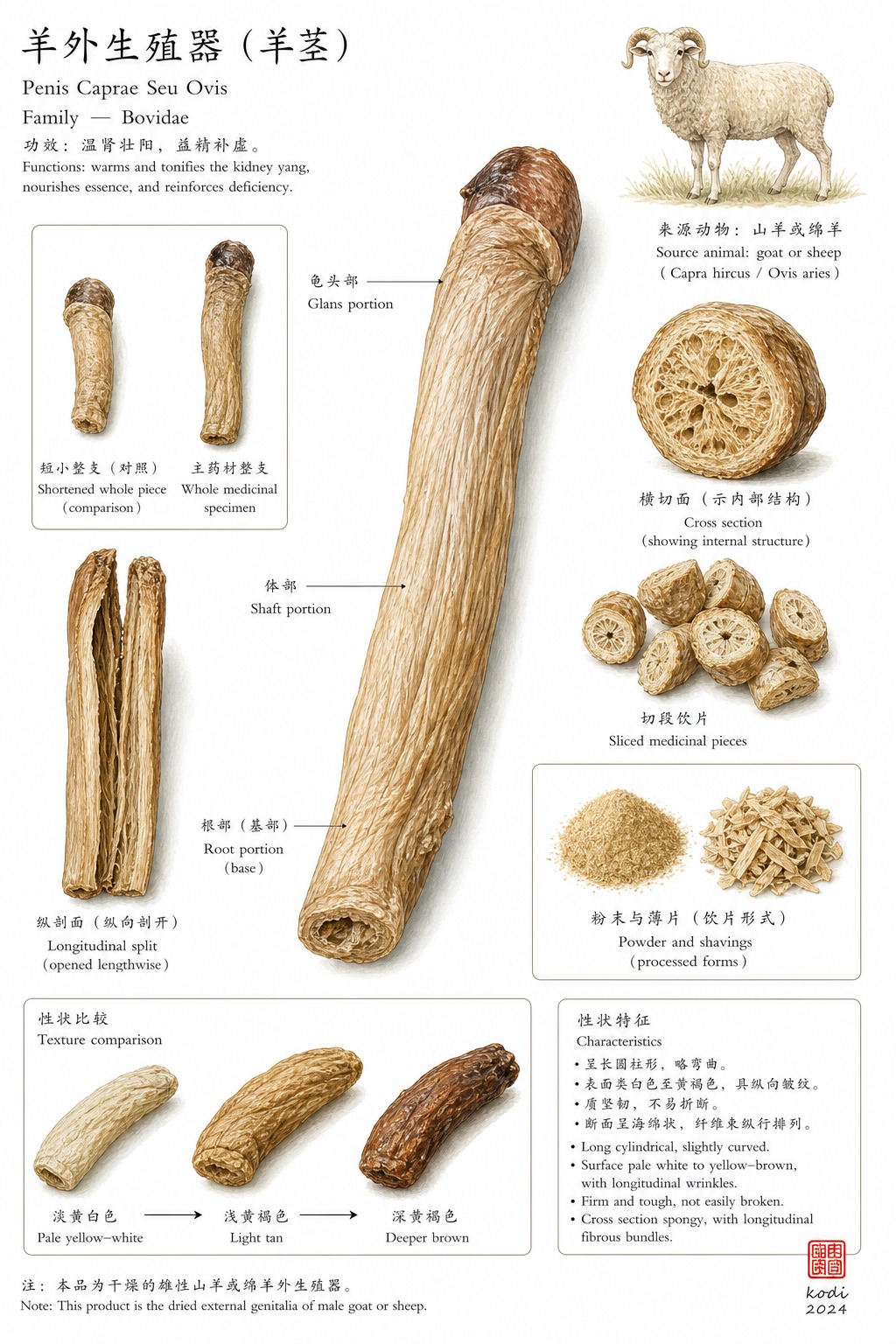
Known in TCM as Yang Bian (羊鞭), this sweet and salty, warm herb enters the Kidney. Traditionally, it warms the Kidneys and supports Yang in the historical animal-tonic tradition, especially for impotence, infertility, cold lower-back weakness, and reduced sexual vitality tied to Kidney-Yang deficiency, most often applied for impotence, infertility, and kidney yang deficiency. Modern research has identified Protein, among its active constituents.
Part used: Penis
Also Known As
Latin: Penis Caprae Seu Ovis | Pinyin: Yang Bian | Chinese: 羊鞭
TCM Properties
- Taste
- sweet, salty
- Temperature
- warm
- Channels
- Kidney
Traditional Use
Primary Actions
- Warms the Kidneys and supports Yang in the historical animal-tonic tradition, especially for impotence, infertility, cold lower-back weakness, and reduced sexual vitality tied to Kidney-Yang deficiency.
- Supplements essence and reproductive strength in older organotherapy logic, where a warming genital tissue is chosen to reinforce constitutional depletion rather than to treat ordinary fatigue alone.
- Supports the lower burner in chronic cold-deficiency patterns that combine reproductive weakness, soreness, lassitude, and diminished drive.
Secondary Actions
- Yang Bian belongs to a narrow historical organotherapy lane and should be read as a documentary materia medica item, not as a modern evidence-based aphrodisiac claim.
- Classical and trade sources sometimes group sheep and goat material together under closely related names, which helps explain the inherited Latin wording.
Classic Formulas
- Kidney-Yang tonic pairings with Lu Rong, Yin Yang Huo, or Rou Cong Rong ... the usual classical-style context when impotence and cold weakness are the core pattern.
- Animal-tonic wine or broth preparations ... older practical use aimed at severe constitutional depletion rather than mild everyday complaints.
- Reproductive-support combinations with Gou Qi Zi and Tu Si Zi ... traditional logic for infertility or low vitality associated with Kidney deficiency.
Classical References
- Traditional listings describe Yang Bian as sweet, salty, and warm, entering the Kidney to reinforce Yang and reproductive function.
- Its use reflects the older principle of treating deep constitutional weakness with organ analogues rather than the broader plant-tonic strategy used today.
- Modern references repeat the Kidney-Yang and male-infertility indications, but high-quality clinical evidence remains sparse.
Modern Research
Active Compounds
- Protein, lipid, and mineral-rich animal tissue fractions
- Sterol and hormone-like biochemical constituents discussed in broader animal-tonic literature
- Authentication markers relevant to animal-derived medicinal trade
Studied Effects
- A 2023 ethnobiological assessment of animal- and mineral-based medicines documented Yang Bian as a recognized traditional medicinal item in northwestern Chinese practice, supporting its historical rather than modern mainstream status (PMID 38089056).
- A 2023 review on medical animals summarized the renewed research interest in animal-derived traditional medicines, but it also underscored that evidence quality varies widely across materials such as Yang tonics (PMID 37593512).
- A 2003 review on animal products in traditional Chinese medicine remains important context because it highlights the sourcing, contamination, and health-hazard issues that now surround many historical animal medicinals (PMID 12801499).
PubMed References
- Animal-and mineral-based medicines in Gansu-Ningxia-inner Mongolia region, P.R. China: a cross-cultural ethnobiological assessment. (2023)
- The Development Trend of Medical Animals in the Last Ten Years: A Review. (2023)
- Use of animal products in traditional Chinese medicine: environmental impact and health hazards. (2003)
Safety & Interactions
Contraindications
- Pregnancy
- Damp-heat or excess-heat patterns without Kidney-Yang deficiency
- Use of unverified or poorly sourced animal material
Cautions
- This is a specialized historical animal tonic and should not be treated as a routine supplement for low energy or sexual-performance marketing.
- Modern concerns center on sourcing, sanitation, and product authenticity more than on any well-standardized therapeutic profile.
- People with endocrine-sensitive conditions or significant cardiometabolic disease should avoid self-prescribing concentrated animal-tonic products.
Conditions
- Impotence Traditional ★★★★☆ JSON
- Infertility Traditional ★★★☆☆ JSON
- Kidney Yang Deficiency Traditional ★★★★☆ JSON
- Fatigue Traditional ★★☆☆☆ JSON
Frequently Asked Questions
What is Sheep Penis used for?
Sheep Penis is traditionally used to Warms the Kidneys and supports Yang in the historical animal-tonic tradition, especially for impotence, infertility, cold lower-back weakness, and reduced sexual vitality tied to Kidney-Yang deficiency., Supplements essence and reproductive strength in older organotherapy logic, where a warming genital tissue is chosen to reinforce constitutional depletion rather than to treat ordinary fatigue alone., Supports the lower burner in chronic cold-deficiency patterns that combine reproductive weakness, soreness, lassitude, and diminished drive.. Research has investigated its effects on: A 2023 ethnobiological assessment of animal- and mineral-based medicines documented Yang Bian as a recognized traditional medicinal item in northwestern Chinese practice, supporting its historical rather than modern mainstream status (PMID 38089056).; A 2023 review on medical animals summarized the renewed research interest in animal-derived traditional medicines, but it also underscored that evidence quality varies widely across materials such as Yang tonics (PMID 37593512)..
What are other names for Sheep Penis?
Sheep Penis is also known as Yang Bian, Sheep whip, Goat or sheep penis. In TCM: 羊鞭 (Yang Bian); Penis Caprae Seu Ovis.
Is Sheep Penis safe during pregnancy?
Sheep Penis is not recommended during pregnancy.
What are the contraindications for Sheep Penis?
Sheep Penis should not be used in: Pregnancy; Damp-heat or excess-heat patterns without Kidney-Yang deficiency; Use of unverified or poorly sourced animal material. Consult a qualified healthcare provider before use.