Senna Leaf
- Chinese
- 番泻叶
- Pinyin
- Fan Xie Ye
- Latin
- Folium Sennae
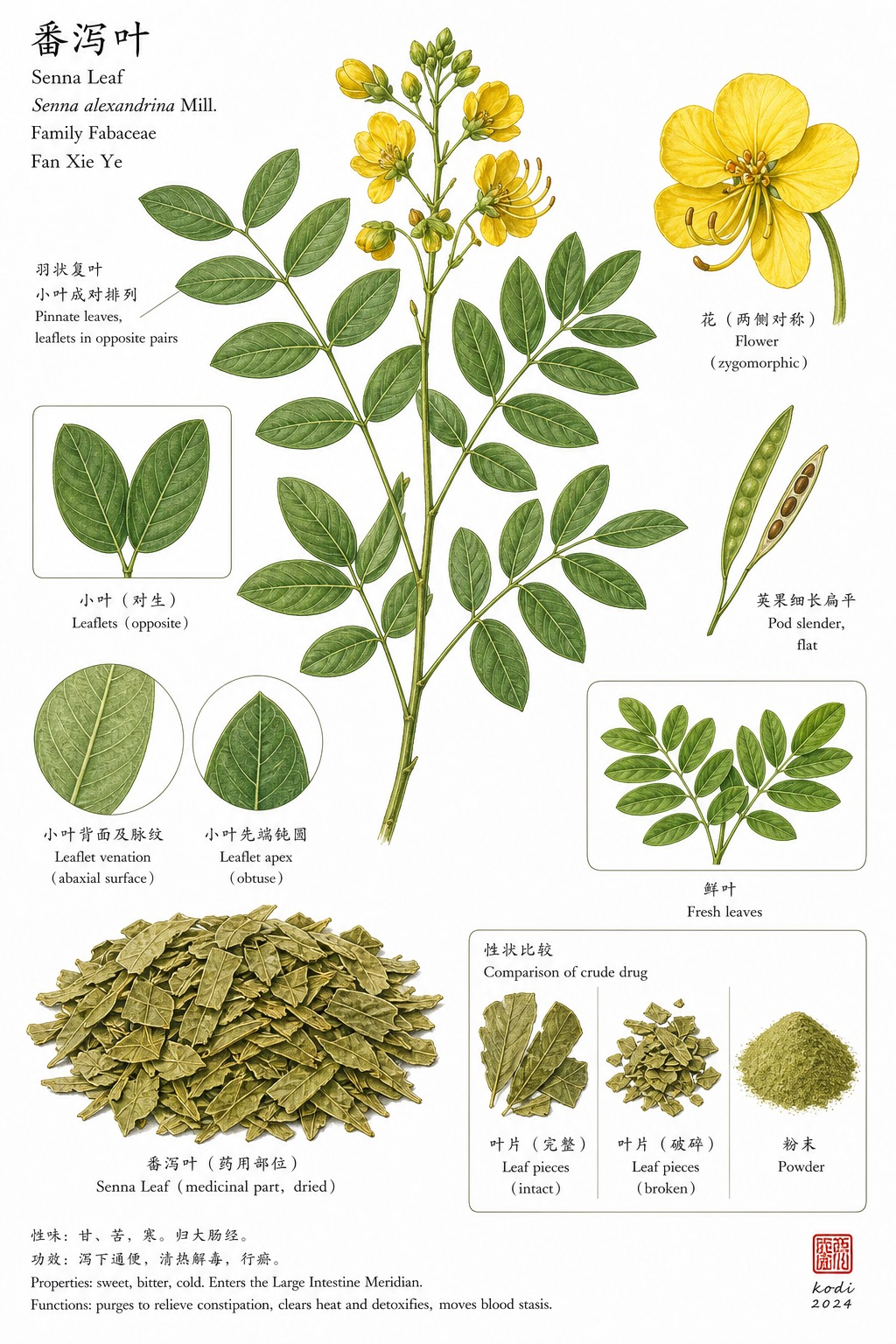
Known in TCM as Fan Xie Ye (番泻叶), this bitter, cold herb enters the Large Intestine. Traditionally, it purges accumulation and relieves constipation quickly ... Fan Xie Ye is a short-course stimulant laxative herb used when stool is dry, obstructed, and difficult to pass, most often applied for constipation and abdominal distension. Modern research has identified Sennosides among its active constituents.
Part used: Leaf
Also Known As
Latin: Folium Sennae | Pinyin: Fan Xie Ye | Chinese: 番泻叶
TCM Properties
- Taste
- bitter
- Temperature
- cold
- Channels
- Large Intestine
Traditional Use
Primary Actions
- Purges accumulation and relieves constipation quickly ... Fan Xie Ye is a short-course stimulant laxative herb used when stool is dry, obstructed, and difficult to pass.
- Drains downward rather than tonifying upward ... its logic is to move stagnation out through the bowels, not to rebuild digestion or moisten deeply over time.
- Can reduce fullness from intestinal accumulation ... when distension and pressure come from retained stool, the leaf's purgative action may secondarily ease the bloated feeling.
Secondary Actions
- Fan Xie Ye is one of the more obviously pharmacologic herbs in the materia medica ... consumers often underestimate it because it appears in teas and over-the-counter cleansing products.
- The classical role is short and specific, not long-term constitutional bowel support.
Classic Formulas
- Single-herb steeping or brief decoction ... the traditional simplest use for acute constipation.
- Fan Xie Ye with Zhi Shi or Hou Po ... used when stool retention and abdominal fullness occur together.
- Pairings with Ma Zi Ren or honey ... sometimes used to temper harshness while still encouraging passage.
Classical References
- Traditional herb references describe Fan Xie Ye as bitter and cold, entering the Large Intestine to purge accumulation and relieve constipation.
- The herb is classically used as a short-course downward-draining medicinal rather than as a tonic bowel regulator.
Modern Research
Active Compounds
- Sennosides ... the best-known anthraquinone glycosides responsible for stimulant laxative activity
- Anthraquinone derivatives and related phenolics ... important to both effect and safety discussions
- Minor flavonoid and metabolite fractions ... supportive but not primary constituents
Studied Effects
- A 2022 review compared herbal medicines for constipation and their active phytochemicals, placing senna among the best-recognized stimulant-laxative herbs in modern use (PMID 35331086).
- A 2023 metabolite-profiling study compared Senna italica with Senna alexandrina and also evaluated hepatotoxicity, which is relevant to quality control and safety framing (PMID 37110216).
- A 2014 paper on laxative activities of Cassia sieberiana and Senna obtusifolia illustrates the broader pharmacologic consistency of the senna-type anthraquinone family even when not all studies use the exact pharmacopoeial leaf source (PMID 25392579).
PubMed References
Safety & Interactions
Contraindications
- Pregnancy
- Chronic diarrhea or loose stools
- Intestinal obstruction or acute inflammatory bowel pain without evaluation
Cautions
- Fan Xie Ye is best kept to short-course use because overuse can cause cramping, diarrhea, and fluid or electrolyte depletion.
- Tea, capsule, and crude-leaf use are not equivalent in strength.
- Because this herb works by purging, it is a poor fit for chronic constipation caused mainly by severe blood or Yin deficiency without careful adjustment.
Drug Interactions
- Diuretics, stimulant laxatives, or other therapies affected by electrolyte depletion ... additive fluid and potassium loss is plausible
Conditions
- Constipation Traditional ★★★★☆ JSON
- Abdominal Distension Traditional ★★☆☆☆ JSON
Frequently Asked Questions
What is Senna Leaf used for?
Senna Leaf is traditionally used to Purges accumulation and relieves constipation quickly ... Fan Xie Ye is a short-course stimulant laxative herb used when stool is dry, obstructed, and difficult to pass., Drains downward rather than tonifying upward ... its logic is to move stagnation out through the bowels, not to rebuild digestion or moisten deeply over time., Can reduce fullness from intestinal accumulation ... when distension and pressure come from retained stool, the leaf's purgative action may secondarily ease the bloated feeling.. Research has investigated its effects on: A 2022 review compared herbal medicines for constipation and their active phytochemicals, placing senna among the best-recognized stimulant-laxative herbs in modern use (PMID 35331086).; A 2023 metabolite-profiling study compared Senna italica with Senna alexandrina and also evaluated hepatotoxicity, which is relevant to quality control and safety framing (PMID 37110216)..
What are other names for Senna Leaf?
Senna Leaf is also known as Alexandrian senna leaf, Cassia angustifolia leaf, Fan Xie Ye. In TCM: 番泻叶 (Fan Xie Ye); Folium Sennae.
Is Senna Leaf safe during pregnancy?
Senna Leaf is not recommended during pregnancy.
What are the contraindications for Senna Leaf?
Senna Leaf should not be used in: Pregnancy; Chronic diarrhea or loose stools; Intestinal obstruction or acute inflammatory bowel pain without evaluation. Consult a qualified healthcare provider before use.
Does Senna Leaf interact with any medications?
Senna Leaf may interact with: Diuretics, stimulant laxatives, or other therapies affected by electrolyte depletion ... additive fluid and potassium loss is plausible. Always inform your healthcare provider of any herbal supplements you are taking.