Peanut Coat
- Chinese
- 花生衣
- Pinyin
- Hua Sheng Yi
- Latin
- Testa Arachidis Hypogaeae
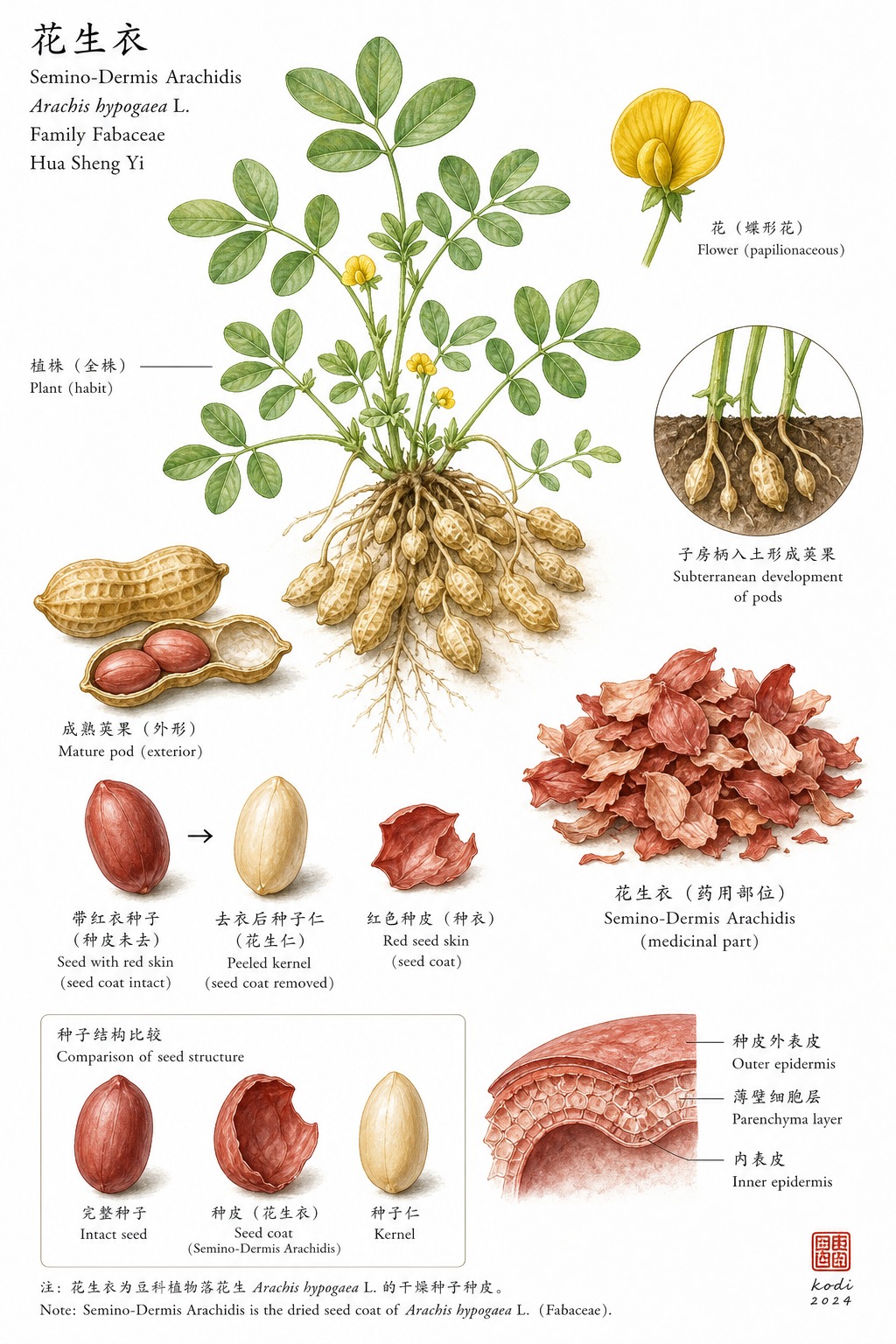
Known in TCM as Hua Sheng Yi (花生衣), this sweet and astringent, neutral herb enters the Spleen and Lung. Traditionally, it stops bleeding with relatively gentle astringency ... Hua Sheng Yi is used for hemoptysis, epistaxis, blood in the urine, and uterine bleeding when the pattern does not require harsh cooling or drastic movement, most often applied for hemoptysis, abnormal uterine bleeding, and hematuria. Modern research has identified Peanut-skin among its active constituents.
Part used: Seed coat
Also Known As
Latin: Testa Arachidis Hypogaeae | Pinyin: Hua Sheng Yi | Chinese: 花生衣
TCM Properties
- Taste
- sweet, astringent
- Temperature
- neutral
- Channels
- Spleen, Lung
Traditional Use
Primary Actions
- Stops bleeding with relatively gentle astringency ... Hua Sheng Yi is used for hemoptysis, epistaxis, blood in the urine, and uterine bleeding when the pattern does not require harsh cooling or drastic movement.
- Dispels stasis and resolves swelling ... traditional use also extends to traumatic bleeding and bruising where bleeding and stasis coexist.
- Uses the red seed coat rather than the nutritive peanut kernel ... the medicinal lane depends on the skin's hemostatic and polyphenol-rich identity, not on the food value of the nut itself.
Secondary Actions
- This is a food-adjacent adjunct herb rather than a heavy classical formula centerpiece, which is why it often appears in simple hemostatic combinations.
- Modern research on peanut skin focuses mostly on polyphenols and metabolic effects, so the traditional hemostatic indication still carries the main interpretive weight.
Classic Formulas
- Hua Sheng Yi with Bai Ji or Ce Bai Ye ... traditional Lung-bleeding logic for cough with blood or blood-streaked sputum.
- Uterine-bleeding combinations with Ai Ye and Pao Jiang ... used when bleeding needs gentle restraint without abandoning warming support.
- Traumatic-bleeding pairings with San Qi or Ru Xiang and Mo Yao ... used when swelling, bruising, and bleeding occur together.
Classical References
- TCM Wiki describes Hua Sheng Yi as sweet, astringent, and neutral, entering the Spleen and Lung to stop bleeding, dissipate stasis, and reduce swelling.
- The medicinal emphasis is on the seed coat, so removing the skin from the peanut changes the herb identity substantially.
Modern Research
Active Compounds
- Peanut-skin polyphenols ... the best-known modern actives in this medicinal lane
- Procyanidins and related phenolic antioxidants ... key contributors to experimental anti-inflammatory and metabolic effects
- Pigmented seed-coat flavonoids ... part of the reason the coat is pharmacologically distinct from the peanut kernel
Studied Effects
- A 2019 study found peanut skin phenolic extract attenuated hyperglycemic responses in vivo and in vitro, underscoring the modern functional-food interest in the medicinal coat (PMID 30917157).
- A 2015 paper reported bioavailability and hypolipidemic effects of peanut skin polyphenols, which helps explain why the coat is studied separately from ordinary peanut nutrition (PMID 25184693).
- A 2020 macrophage study found peanut skin polyphenols reduced toxicity induced by advanced glycation end-products, again reinforcing a polyphenol-centered modern research profile rather than a direct clinical hemostatic one (PMID 32791243).
PubMed References
Safety & Interactions
Contraindications
- Known peanut allergy
- Bleeding patterns that require emergency care rather than self-treatment
Cautions
- The peanut coat is not interchangeable with eating peanuts, especially for people with allergy risk.
- Modern literature is richer on polyphenol chemistry than on clinical hemostatic trials, so traditional use still does most of the interpretive work here.
Conditions
- Hemoptysis Traditional ★★★☆☆ JSON
- Abnormal Uterine Bleeding Traditional ★★★☆☆ JSON
- Hematuria Traditional ★★☆☆☆ JSON
- Traumatic Injury Traditional ★★☆☆☆ JSON
Frequently Asked Questions
What is Peanut Coat used for?
Peanut Coat is traditionally used to Stops bleeding with relatively gentle astringency ... Hua Sheng Yi is used for hemoptysis, epistaxis, blood in the urine, and uterine bleeding when the pattern does not require harsh cooling or drastic movement., Dispels stasis and resolves swelling ... traditional use also extends to traumatic bleeding and bruising where bleeding and stasis coexist., Uses the red seed coat rather than the nutritive peanut kernel ... the medicinal lane depends on the skin's hemostatic and polyphenol-rich identity, not on the food value of the nut itself.. Research has investigated its effects on: A 2019 study found peanut skin phenolic extract attenuated hyperglycemic responses in vivo and in vitro, underscoring the modern functional-food interest in the medicinal coat (PMID 30917157).; A 2015 paper reported bioavailability and hypolipidemic effects of peanut skin polyphenols, which helps explain why the coat is studied separately from ordinary peanut nutrition (PMID 25184693)..
What are other names for Peanut Coat?
Peanut Coat is also known as Peanut skin, Semino-Dermis Arachidis, Peanut seed coat. In TCM: 花生衣 (Hua Sheng Yi); Testa Arachidis Hypogaeae.
Is Peanut Coat safe during pregnancy?
The safety of Peanut Coat during pregnancy has not been established. Consult a qualified healthcare provider before use.
What are the contraindications for Peanut Coat?
Peanut Coat should not be used in: Known peanut allergy; Bleeding patterns that require emergency care rather than self-treatment. Consult a qualified healthcare provider before use.