Lacquer Tree Seed
- Chinese
- 漆子
- Pinyin
- Qi Zi
- Latin
- Semen Toxicodendri Vernicifluae
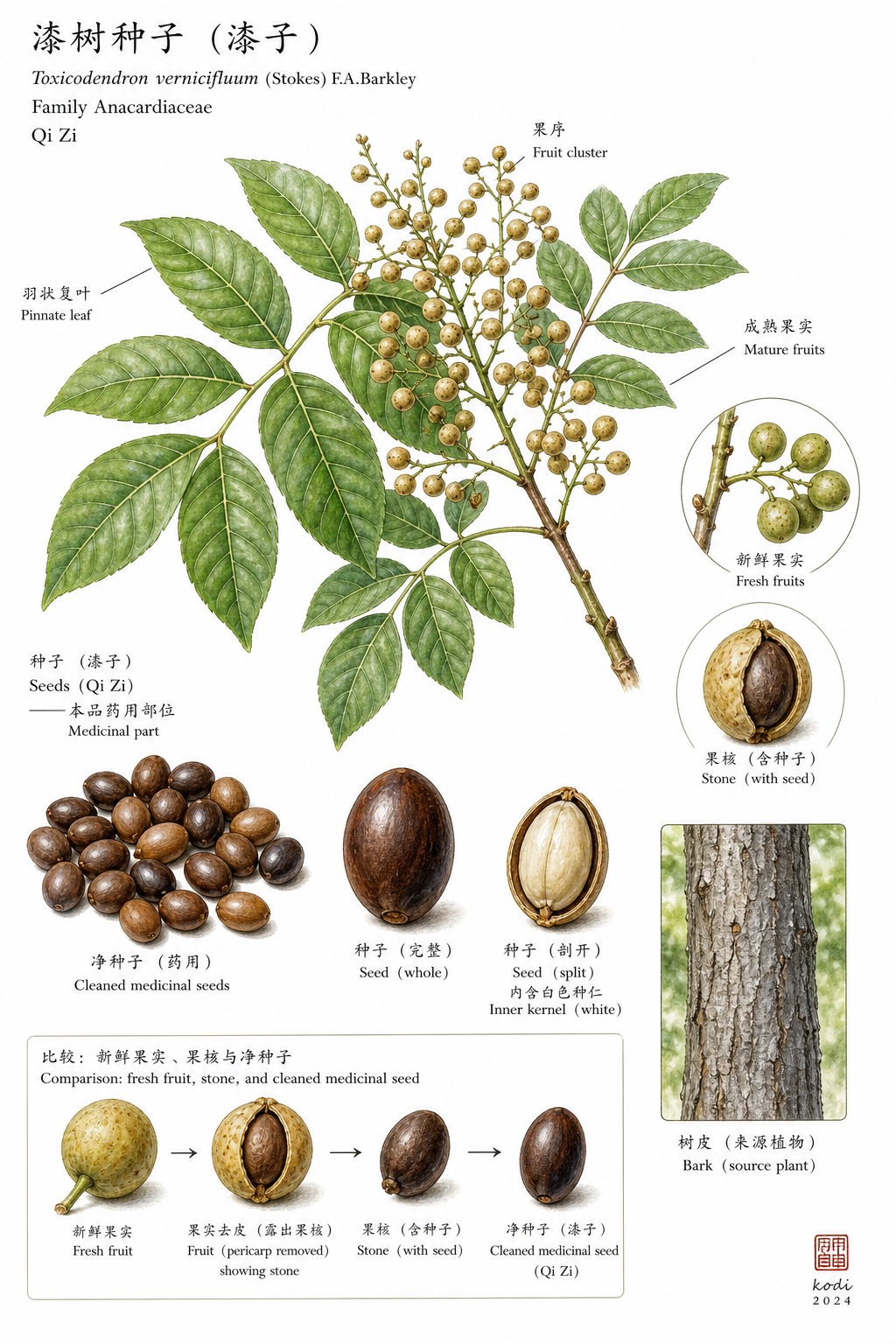
Known in TCM as Qi Zi (漆子), this pungent, warm herb enters the Liver and Spleen. Traditionally, it activates blood and stops bleeding when bleeding is mixed with stasis ... Qi Zi is a niche historical material used for blood in the stool, blood in the urine, and uterine bleeding with obstructive features, most often applied for abnormal uterine bleeding, hematuria, and abdominal pain. Modern research has identified Seed among its active constituents.
Part used: Seed
Also Known As
Latin: Semen Toxicodendri Vernicifluae | Pinyin: Qi Zi | Chinese: 漆子
TCM Properties
- Taste
- pungent
- Temperature
- warm
- Channels
- Liver, Spleen
Traditional Use
Primary Actions
- Activates blood and stops bleeding when bleeding is mixed with stasis ... Qi Zi is a niche historical material used for blood in the stool, blood in the urine, and uterine bleeding with obstructive features.
- Warms the channels and stops pain ... older sources extend its use to cold-stasis abdominal pain and amenorrhea with congealed obstruction.
- Belongs to a conservative documentary lane, not a casual tonic or household remedy ... the lacquer-tree identity carries real toxicologic and allergy implications.
Secondary Actions
- This seed record should stay clearly distinct from the already-live `dried-lacquer` / Gan Qi page ... same plant family, but the historical medicinal part and safety emphasis are not identical.
- Most modern literature now focuses on lacquer seed oil and food-safety assessment rather than on direct validation of older crude-drug indications.
Classic Formulas
- Qi Zi with Pu Huang or San Qi ... traditional logic for bleeding patterns complicated by blood stasis rather than by pure deficiency.
- Qi Zi with Yan Hu Suo or Dang Gui ... historical pairing style for cold-stasis abdominal pain and obstructed menstruation.
- Warm-channel combinations with Ai Ye or Xiao Hui Xiang ... used when pain and bleeding reflect cold with congealed blood.
Classical References
- Chinese-language materia medica references describe Qi Zi as pungent, warm, and toxic, entering the Liver and Spleen to activate blood, stop bleeding, warm the channels, and relieve pain.
- Classical caution notes warn against casual use when there is no stasis to resolve.
Modern Research
Active Compounds
- Seed oils rich in fatty acids ... the most prominent focus of current lacquer-seed research
- Minor phenolic and lipidomic constituents ... increasingly profiled in food and metabolomics studies
- Plant-family allergen context tied to urushiol-bearing lacquer relatives ... important for safety framing even when refined oil is studied
Studied Effects
- A 2023 rat safety assessment found lacquer-seed oil tolerated in acute and subchronic testing, which is relevant to modern food-use discussion but should not be mistaken for direct proof of the historical crude medicinal seed indication (PMID 36336220).
- A 2022 comparative lipidomic and metabolomic study examined lacquer oil from Toxicodendron vernicifluum in a traditional postpartum-use context, highlighting anti-inflammatory and mood-related research interest around the seed-oil lane (PMID 35770099).
- Modern evidence around Qi Zi is still indirect and preparation-dependent, so historical use should be presented conservatively.
PubMed References
- Safety assessment of oil extracted from lacquer (Toxicodendron vernicifluum (Stokes) F.A. Barkley) seed: acute and subchronic toxicity studies in rats. (2023)
- Comparative Lipidomic and Metabolomic Analyses Reveal the Mystery of Lacquer Oil from Toxicodendron vernicifluum for the Treatment of "Yuezi" Disease in Nujiang, China: From Anti-Inflammation and Anti-Postpartum Depression Perspective. (2022)
Safety & Interactions
Contraindications
- Pregnancy
- Known poison ivy, poison oak, or lacquer hypersensitivity
- Bleeding without blood stasis
- Any unsupervised use
Cautions
- Qi Zi is a historical specialty material with real toxicity and allergy concerns, not a routine self-care herb.
- Research on refined lacquer seed oil does not make crude or loosely identified lacquer-tree products automatically safe.
- This record is primarily documentary and should be read with the same caution applied to other Toxicodendron-derived medicinals.
Conditions
- Abnormal Uterine Bleeding Traditional ★★☆☆☆ JSON
- Hematuria Traditional ★★☆☆☆ JSON
- Abdominal Pain Traditional ★★☆☆☆ JSON
- Amenorrhea Traditional ★★☆☆☆ JSON
Frequently Asked Questions
What is Lacquer Tree Seed used for?
Lacquer Tree Seed is traditionally used to Activates blood and stops bleeding when bleeding is mixed with stasis ... Qi Zi is a niche historical material used for blood in the stool, blood in the urine, and uterine bleeding with obstructive features., Warms the channels and stops pain ... older sources extend its use to cold-stasis abdominal pain and amenorrhea with congealed obstruction., Belongs to a conservative documentary lane, not a casual tonic or household remedy ... the lacquer-tree identity carries real toxicologic and allergy implications.. Research has investigated its effects on: A 2023 rat safety assessment found lacquer-seed oil tolerated in acute and subchronic testing, which is relevant to modern food-use discussion but should not be mistaken for direct proof of the historical crude medicinal seed indication (PMID 36336220).; A 2022 comparative lipidomic and metabolomic study examined lacquer oil from Toxicodendron vernicifluum in a traditional postpartum-use context, highlighting anti-inflammatory and mood-related research interest around the seed-oil lane (PMID 35770099)..
What are other names for Lacquer Tree Seed?
Lacquer Tree Seed is also known as Seed of True Lacquertree, Toxicodendron vernicifluum seed, Qi Zi. In TCM: 漆子 (Qi Zi); Semen Toxicodendri Vernicifluae.
Is Lacquer Tree Seed safe during pregnancy?
Lacquer Tree Seed is not recommended during pregnancy.
What are the contraindications for Lacquer Tree Seed?
Lacquer Tree Seed should not be used in: Pregnancy; Known poison ivy, poison oak, or lacquer hypersensitivity; Bleeding without blood stasis; Any unsupervised use. Consult a qualified healthcare provider before use.