Katsumada Galangal Kernel
- Chinese
- 草蔻仁
- Pinyin
- Cao Kou Ren
- Latin
- Semen Alpiniae Katsumadai
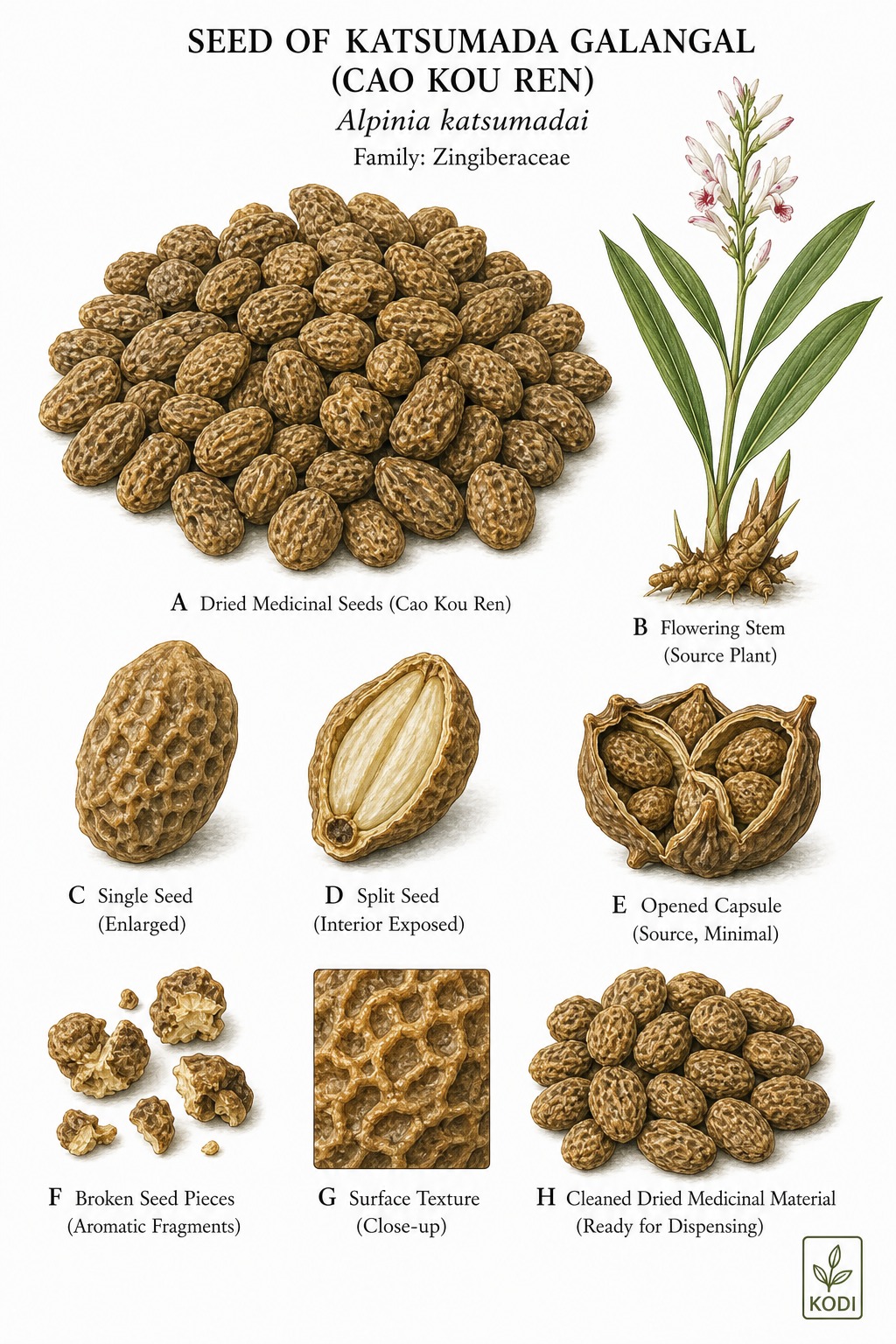
Known in TCM as Cao Kou Ren (草蔻仁), this pungent, warm herb enters the Spleen and Stomach. Traditionally, it moves dampness and stagnant Qi in the middle burner ... Cao Kou Ren is used when appetite is poor, the abdomen feels distended, and damp obstruction makes digestion feel slow and turbid, most often applied for nausea, abdominal distension, and poor appetite. Modern research has identified Volatile among its active constituents.
Part used: Seed
Also Known As
Latin: Semen Alpiniae Katsumadai | Pinyin: Cao Kou Ren | Chinese: 草蔻仁
TCM Properties
- Taste
- pungent
- Temperature
- warm
- Channels
- Spleen, Stomach
Traditional Use
Primary Actions
- Moves dampness and stagnant Qi in the middle burner ... Cao Kou Ren is used when appetite is poor, the abdomen feels distended, and damp obstruction makes digestion feel slow and turbid.
- Warms the Stomach and stops nausea or vomiting ... the kernel lane emphasizes the aromatic inner seed used to redirect rebellious middle-burner Qi downward.
- Supports cold-damp digestive recovery without being a heavy tonic ... it is aromatic, moving, and warming rather than supplementing.
Secondary Actions
- This page should not be treated as a separate species from `seed-of-katsumada-galangal` ... Cao Kou Ren is the inner-seed or dispensing-name lane within the same Semen Alpiniae Katsumadai family.
- Traditional naming overlaps with Cao Dou Kou and Cao Kou, so the main editorial task here is disambiguation, not invention of a new herb identity.
Classic Formulas
- Kernel-focused aromatic digestive combinations with Hou Po, Chen Pi, or Sha Ren ... used when dampness blocks the middle and nausea rises upward.
- Cold-damp middle-burner pairings with Gan Jiang or Ban Xia ... traditional strategy for vomiting, heaviness, and poor transformation.
- Powder and pill contexts with Mu Xiang or Bai Zhu ... used when an aromatic inner-seed lot is preferred over a broader whole-fruit description.
Classical References
- Chinese herb references and trade dictionaries treat Cao Kou Ren as an overlapping name within the same Katsumada galangal seed tradition as Cao Dou Kou.
- The kernel naming reinforces the dispensing form but does not create a separate botanical medicinal.
Modern Research
Active Compounds
- Volatile aromatic oils ... the constituents most likely to shift when only the inner seed lot is emphasized
- Flavonoid and phenolic constituents ... part of the broader Alpinia katsumadai chemistry profile
- Seed lipids and pungent fragrance compounds ... relevant to both culinary and medicinal handling
Studied Effects
- A 2026 review summarized the chemistry and health-related research on Alpinia katsumadai seed, which remains the best broad modern overview for both Cao Dou Kou and Cao Kou Ren naming lanes (PMID 41696736).
- A 2026 comparative review examined Semen Alpiniae Katsumadai alongside related aromatic digestive medicinals, helping place this kernel name inside its proper larger herb family (PMID 41176135).
- Direct modern studies rarely separate Cao Kou Ren from Cao Dou Kou, which supports keeping the pages distinct editorially but connected pharmacologically.
PubMed References
- Alpinia katsumadai seed from a condiment to ethnomedicine to nutraceutical, a comprehensive review of its chemistry and health benefits. (2026)
- Fructus Amomi Rotundus, Fructus Galangae, Semen Alpiniae Katsumadai and Semen Myristicae comparison of traditional medicinal uses, phytoconstituents, bioactivities. (2026)
Safety & Interactions
Contraindications
- Yin deficiency or dryness-heat without cold-damp or stagnant middle-burner Qi
- Vomiting driven by pure excess Heat rather than by cold-damp or aromatic obstruction
Cautions
- As with other aromatic digestive seeds, prolonged simmering weakens the volatile fraction that gives Cao Kou Ren much of its traditional effect.
- Because naming overlaps are real, authenticated sourcing matters more than the English gloss alone.
Conditions
- Nausea Traditional ★★★★☆ JSON
- Abdominal Distension Traditional ★★★★☆ JSON
- Poor Appetite Traditional ★★★☆☆ JSON
- Diarrhea Traditional ★★★☆☆ JSON
Frequently Asked Questions
What is Katsumada Galangal Kernel used for?
Katsumada Galangal Kernel is traditionally used to Moves dampness and stagnant Qi in the middle burner ... Cao Kou Ren is used when appetite is poor, the abdomen feels distended, and damp obstruction makes digestion feel slow and turbid., Warms the Stomach and stops nausea or vomiting ... the kernel lane emphasizes the aromatic inner seed used to redirect rebellious middle-burner Qi downward., Supports cold-damp digestive recovery without being a heavy tonic ... it is aromatic, moving, and warming rather than supplementing.. Research has investigated its effects on: A 2026 review summarized the chemistry and health-related research on Alpinia katsumadai seed, which remains the best broad modern overview for both Cao Dou Kou and Cao Kou Ren naming lanes (PMID 41696736).; A 2026 comparative review examined Semen Alpiniae Katsumadai alongside related aromatic digestive medicinals, helping place this kernel name inside its proper larger herb family (PMID 41176135)..
What are other names for Katsumada Galangal Kernel?
Katsumada Galangal Kernel is also known as Cao Dou Kou, Dehusked Katsumada galangal seed, Alpinia katsumadai kernel. In TCM: 草蔻仁 (Cao Kou Ren); Semen Alpiniae Katsumadai.
Is Katsumada Galangal Kernel safe during pregnancy?
The safety of Katsumada Galangal Kernel during pregnancy has not been established. Consult a qualified healthcare provider before use.
What are the contraindications for Katsumada Galangal Kernel?
Katsumada Galangal Kernel should not be used in: Yin deficiency or dryness-heat without cold-damp or stagnant middle-burner Qi; Vomiting driven by pure excess Heat rather than by cold-damp or aromatic obstruction. Consult a qualified healthcare provider before use.