Job's Tears Seed
- Chinese
- 薏苡仁
- Pinyin
- Yi Yi Ren
- Latin
- Semen Coicis
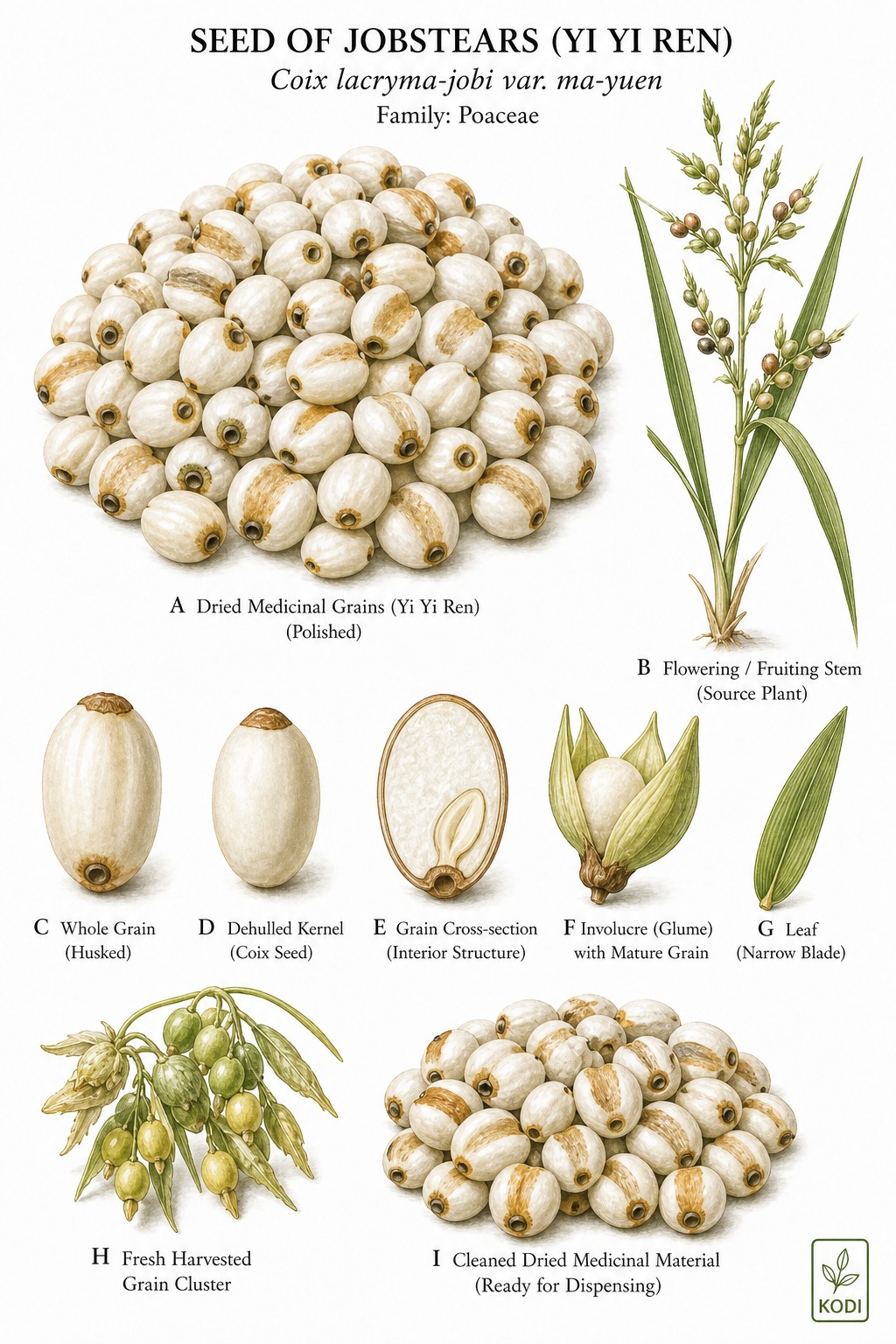
Known in TCM as Yi Yi Ren (薏苡仁), this sweet and bland, slightly cold herb enters the Spleen, Stomach, and Lung. Traditionally, it induces urination and drains dampness ... Yi Yi Ren is used for edema, heaviness, and damp obstruction where fluid metabolism is sluggish, most often applied for edema, diarrhea, and joint pain. Modern research has identified Polysaccharides among its active constituents.
Part used: Seed
Also Known As
Latin: Semen Coicis | Pinyin: Yi Yi Ren | Chinese: 薏苡仁
TCM Properties
- Taste
- sweet, bland
- Temperature
- slightly cold
- Channels
- Spleen, Stomach, Lung
Traditional Use
Primary Actions
- Induces urination and drains dampness ... Yi Yi Ren is used for edema, heaviness, and damp obstruction where fluid metabolism is sluggish.
- Strengthens the Spleen and stops diarrhea ... it is especially useful when loose stool, fatigue, and poor transformation accompany damp accumulation.
- Relieves damp painful obstruction and clears heat to drain pus ... traditional teaching extends to swollen painful joints as well as intestinal or Lung abscess patterns.
Secondary Actions
- Yi Yi Ren is both a medicinal and a grain, which is why it appears so often in congee, soups, and longer-course dietary support.
- Its damp-draining action is gentler than harsher diuretics, making it useful when constitution and digestion need support at the same time.
Classic Formulas
- Shen Ling Bai Zhu San ... a classic Spleen-strengthening formula in which Yi Yi Ren helps address dampness and chronic loose stool.
- Yi Yi Fu Zi Bai Jiang San ... traditional formula context for intestinal abscess and deep-seated damp-heat toxicity.
- San Ren Tang and related damp-warmth pairings ... Yi Yi Ren helps move dampness without over-drying the patient.
Classical References
- Traditional references describe Yi Yi Ren as sweet, bland, and slightly cold, entering the Spleen, Stomach, and Lung to drain dampness while supporting the middle.
- Its dual use for edema and diarrhea reflects a core TCM principle ... when the Spleen transforms better, both water retention and loose stool can improve.
- The pus-draining indication is classical and should not be reduced to a simple wellness-grain narrative.
Modern Research
Active Compounds
- Polysaccharides ... widely studied for anti-inflammatory and immunomodulatory effects
- Coixenolide and related lipid fractions ... classic markers in modern Coix literature
- Phenolic compounds, proteins, and starch fractions ... part of the broader food-medicine profile
Studied Effects
- A 2026 review summarized the nutritional composition, functional properties, and food applications of adlay, reinforcing Yi Yi Ren's strong food-medicine identity in modern literature (PMID 41392849).
- A 2024 review covered Coix seed as both a food and medicinal resource, tying together its phytochemistry with broad pharmacologic interest (PMID 37858750).
- A 2024 study isolated anti-inflammatory and analgesic polysaccharides from Coix seed, offering a modern mechanistic bridge to its classical use in damp painful obstruction and inflammatory patterns (PMID 36584288).
PubMed References
- The Nutritional Composition, Functional Properties, and Food Application of Adlay (Coix lacryma-Jobi L.): A Comprehensive Review. (2026)
- Research on Coix seed as a food and medicinal resource, it's chemical components and their pharmacological activities: A review. (2024)
- Isolation and identification of anti-inflammatory and analgesic polysaccharides from Coix seed (Coix lacryma-jobi L.var. Ma-yuen (Roman.) Stapf). (2024)
Safety & Interactions
Contraindications
- Marked fluid depletion or severe constipation from dryness without dampness
- Deficiency-cold with no damp accumulation
Cautions
- Food-grade familiarity can make Yi Yi Ren seem universally appropriate, but the medicinal pattern still matters.
- Large doses aimed at draining dampness may be too cooling or drying for patients who are already depleted.
Conditions
Frequently Asked Questions
What is Job's Tears Seed used for?
Job's Tears Seed is traditionally used to Induces urination and drains dampness ... Yi Yi Ren is used for edema, heaviness, and damp obstruction where fluid metabolism is sluggish., Strengthens the Spleen and stops diarrhea ... it is especially useful when loose stool, fatigue, and poor transformation accompany damp accumulation., Relieves damp painful obstruction and clears heat to drain pus ... traditional teaching extends to swollen painful joints as well as intestinal or Lung abscess patterns.. Research has investigated its effects on: A 2026 review summarized the nutritional composition, functional properties, and food applications of adlay, reinforcing Yi Yi Ren's strong food-medicine identity in modern literature (PMID 41392849).; A 2024 review covered Coix seed as both a food and medicinal resource, tying together its phytochemistry with broad pharmacologic interest (PMID 37858750)..
What are other names for Job's Tears Seed?
Job's Tears Seed is also known as Coix seed, Adlay seed, Seed of Jobstears. In TCM: 薏苡仁 (Yi Yi Ren); Semen Coicis.
Is Job's Tears Seed safe during pregnancy?
The safety of Job's Tears Seed during pregnancy has not been established. Consult a qualified healthcare provider before use.
What are the contraindications for Job's Tears Seed?
Job's Tears Seed should not be used in: Marked fluid depletion or severe constipation from dryness without dampness; Deficiency-cold with no damp accumulation. Consult a qualified healthcare provider before use.