Euryale Seed
- Chinese
- 芡实
- Pinyin
- Qian Shi
- Latin
- Semen Euryales
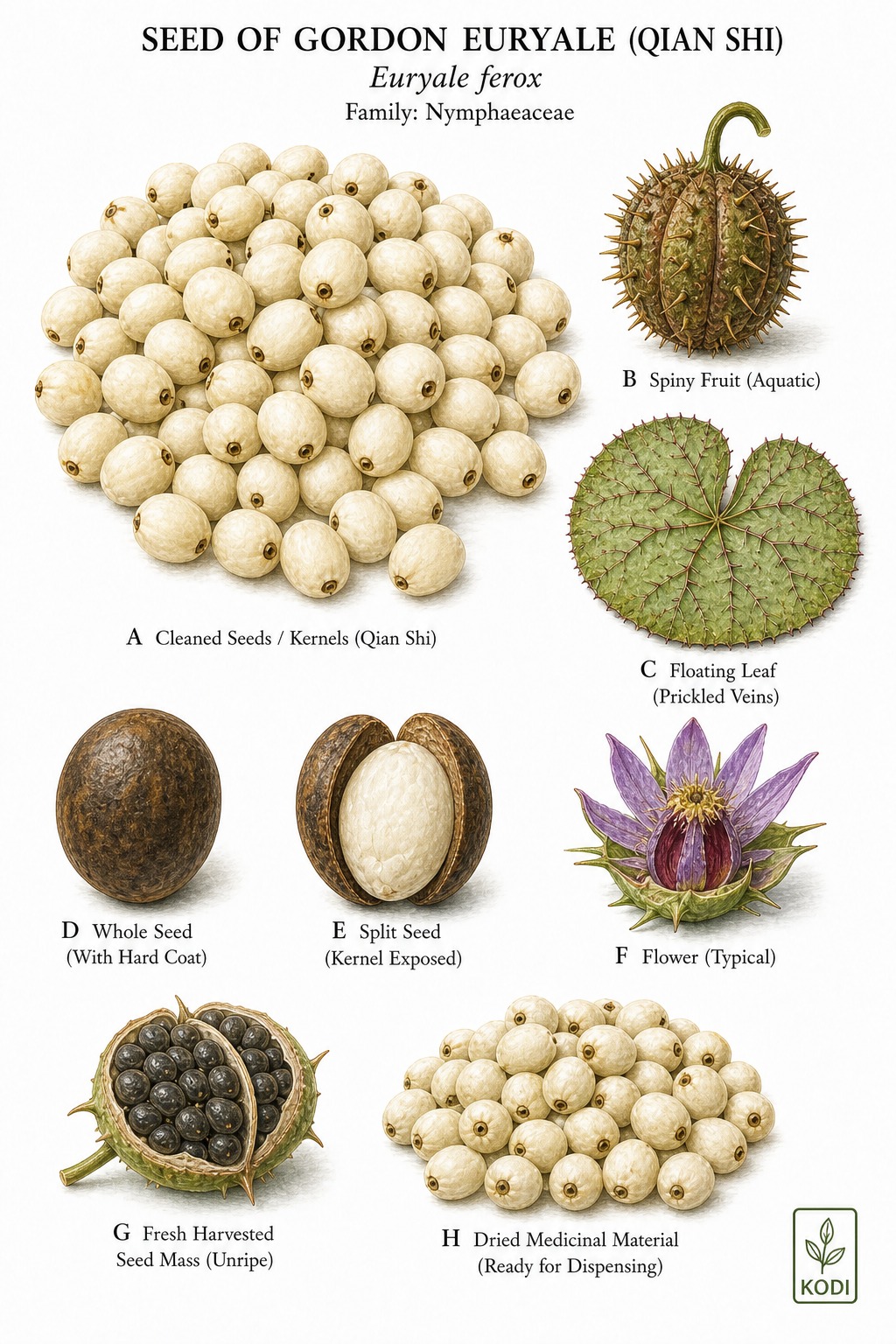
Known in TCM as Qian Shi (芡实), this sweet and astringent, neutral herb enters the Kidney and Spleen. Traditionally, it tonifies the Spleen and stops diarrhea ... Qian Shi is used when loose stool, poor appetite, and chronic digestive weakness reflect deficiency rather than acute infection, most often applied for diarrhea, digestive weakness, and frequent urination. Modern research has identified Polysaccharides among its active constituents.
Part used: Seed
Also Known As
Latin: Semen Euryales | Pinyin: Qian Shi | Chinese: 芡实
TCM Properties
- Taste
- sweet, astringent
- Temperature
- neutral
- Channels
- Kidney, Spleen
Traditional Use
Primary Actions
- Tonifies the Spleen and stops diarrhea ... Qian Shi is used when loose stool, poor appetite, and chronic digestive weakness reflect deficiency rather than acute infection.
- Tonifies the Kidneys and secures essence ... traditional use includes spermatorrhea, frequent urination, and lower-burner weakness with leakage.
- Dries dampness and stops leukorrhea ... it belongs to the group of astringent tonics that both supplement and stabilize rather than merely binding.
Secondary Actions
- Qian Shi is one of the clearest food-medicine bridge seeds in Chinese practice ... bland, starchy, and suitable for longer constitutional support.
- Unlike harsher astringents, it is classically valued because it secures while still supporting digestion and deficient constitutional reserve.
Classic Formulas
- Jin Suo Gu Jing Wan style pairings with Lian Zi and Sha Yuan Zi ... essence-securing logic for chronic lower-burner leakage.
- Yi Huang Tang ... a classic leukorrhea formula in which Qian Shi helps dry dampness while supporting the Spleen.
- Deficiency-diarrhea combinations with Shan Yao and Bai Zhu ... traditional approach when weak transformation leads to chronic loose stool.
Classical References
- Traditional references describe Qian Shi as sweet, astringent, and neutral, entering the Kidney and Spleen to tonify, secure, and check chronic leakage.
- Its combination of tonifying and binding action is why it appears in both reproductive-tonic and diarrhea-stabilizing formulas.
- The herb is most appropriate for deficiency with leakage, not for active damp-heat excess.
Modern Research
Active Compounds
- Polysaccharides and starch fractions ... major contributors to food-medicine interest
- Flavonoids and phenolic compounds ... antioxidant-linked constituents in current review literature
- Seed oils and protein fractions ... part of the nutritional and functional profile of Euryale seed
Studied Effects
- A 2023 review summarized the ethnopharmacology, phytochemistry, and pharmacology of Euryale ferox, reinforcing how strongly the modern literature frames Qian Shi as both a medicinal and food resource (PMID 37298878).
- A 2022 review highlighted Euryale ferox as a nutritional and pharmaceutical superfood, which fits well with its long-standing role as a gentle constitutional seed rather than a harsh corrective drug (PMID 36183158).
- A 2019 mouse study reported hepatoprotective effects from seed-coat extract in a high-fat-diet model, offering a modern metabolic angle that is interesting but still separate from the classical leakage-focused indications (PMID 31092797).
PubMed References
- The Ethnopharmacological, Phytochemical, and Pharmacological Review of Euryale ferox Salisb.: A Chinese Medicine Food Homology. (2023)
- Euryale ferox, a prominent superfood: Nutritional, pharmaceutical, and its economical importance. (2022)
- Hepatoprotective Effect of Seed Coat ofEuryale ferox Extract in Non-alcoholic Fatty Liver Disease Induced by High-fat Diet in Mice by Increasing IRs-1 and Inhibiting CYP2E1. (2019)
Safety & Interactions
Contraindications
- Early-stage excess disorders where retention should not be secured
- Constipation from marked dryness without underlying deficiency
Cautions
- Because Qian Shi is astringent, it is a poor fit when damp-heat, food stagnation, or acute infection still needs to be vented.
- Food use and medicinal use overlap, but concentrated powder or pill use should still follow the pattern being treated.
Conditions
- Diarrhea Traditional ★★★★☆ JSON
- Digestive Weakness Traditional ★★★☆☆ JSON
- Frequent Urination Traditional ★★★☆☆ JSON
- Leukorrhea Traditional ★★★☆☆ JSON
Frequently Asked Questions
What is Euryale Seed used for?
Euryale Seed is traditionally used to Tonifies the Spleen and stops diarrhea ... Qian Shi is used when loose stool, poor appetite, and chronic digestive weakness reflect deficiency rather than acute infection., Tonifies the Kidneys and secures essence ... traditional use includes spermatorrhea, frequent urination, and lower-burner weakness with leakage., Dries dampness and stops leukorrhea ... it belongs to the group of astringent tonics that both supplement and stabilize rather than merely binding.. Research has investigated its effects on: A 2023 review summarized the ethnopharmacology, phytochemistry, and pharmacology of Euryale ferox, reinforcing how strongly the modern literature frames Qian Shi as both a medicinal and food resource (PMID 37298878).; A 2022 review highlighted Euryale ferox as a nutritional and pharmaceutical superfood, which fits well with its long-standing role as a gentle constitutional seed rather than a harsh corrective drug (PMID 36183158)..
What are other names for Euryale Seed?
Euryale Seed is also known as Fox nut, Gorgon seed, Seed of Gordon Euryale. In TCM: 芡实 (Qian Shi); Semen Euryales.
Is Euryale Seed safe during pregnancy?
The safety of Euryale Seed during pregnancy has not been established. Consult a qualified healthcare provider before use.
What are the contraindications for Euryale Seed?
Euryale Seed should not be used in: Early-stage excess disorders where retention should not be secured; Constipation from marked dryness without underlying deficiency. Consult a qualified healthcare provider before use.