Garden Balsam Seed
- Chinese
- 急性子
- Pinyin
- Ji Xing Zi
- Latin
- Semen Impatientis
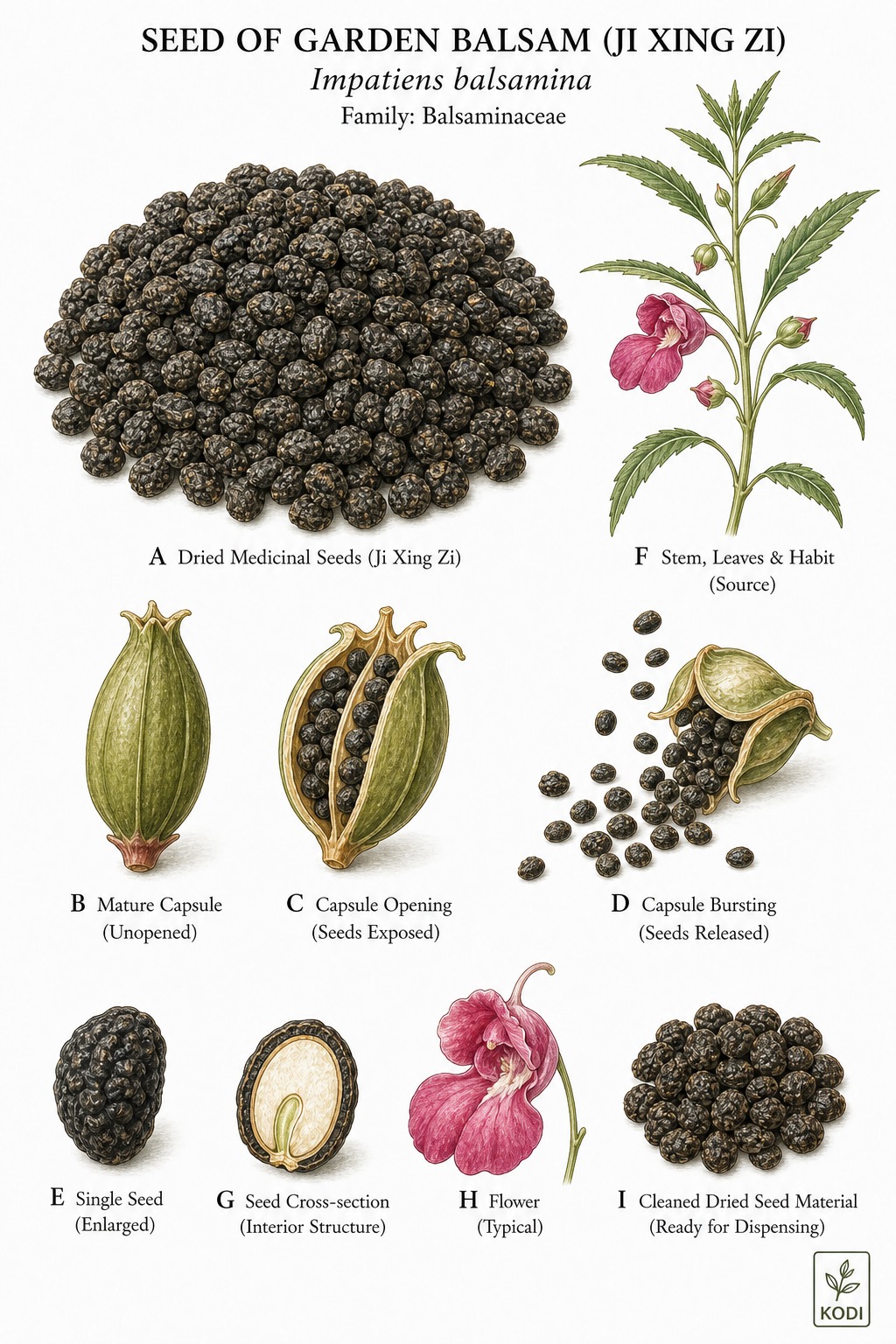
Known in TCM as Ji Xing Zi (急性子), this pungent and bitter, warm herb enters the Liver, Lung, and Kidney. Traditionally, it breaks blood and softens hardness ... Ji Xing Zi is used for amenorrhea, fixed abdominal masses, and stasis-type pain where obstruction needs to be dispersed rather than merely soothed, most often applied for amenorrhea, abdominal pain, and scrofula. Modern research has identified Baccharane among its active constituents.
Part used: Seed
Also Known As
Latin: Semen Impatientis | Pinyin: Ji Xing Zi | Chinese: 急性子
TCM Properties
- Taste
- pungent, bitter
- Temperature
- warm
- Channels
- Liver, Lung, Kidney
Traditional Use
Primary Actions
- Breaks blood and softens hardness ... Ji Xing Zi is used for amenorrhea, fixed abdominal masses, and stasis-type pain where obstruction needs to be dispersed rather than merely soothed.
- Dissipates stasis and resolves swelling ... traditional use extends to hard nodules, scrofula, and toxic external swellings, often with topical application.
- Acts as a forceful specialty seed rather than a gentle garden remedy ... despite the ornamental source plant, the medicinal seed is regarded as warm, blood-moving, and slightly toxic.
Secondary Actions
- This seed page should stay distinct from other Impatiens-derived medicinals such as Feng Xian Hua or regional Tou Gu Cao lineages ... same plant family, different therapeutic lanes.
- The imported English stub was literal, but the real medicinal identity here is Ji Xing Zi, the seed of Impatiens balsamina.
Classic Formulas
- Ji Xing Zi with San Leng and E Zhu ... traditional mass-dispersing logic for blood stasis with hard abdominal accumulation.
- Topical Ji Xing Zi powder with vinegar or oil ... a classic external approach for hard nodules, scrofula, and swollen painful lesions.
- Amenorrhea-oriented combinations with Tao Ren and Hong Hua ... used when menstrual obstruction reflects blood stasis rather than deficiency alone.
Classical References
- TCM Wiki describes Ji Xing Zi as pungent, bitter, warm, and slightly toxic, entering the Liver, Lung, and Kidney to break blood, soften hardness, dissipate stasis, and resolve swelling.
- Traditional directions commonly keep internal dosage modest and allow stronger external use for hard swellings and nodules.
- Because the herb breaks blood and moves downward, classical use is intentionally more guarded than for ordinary food-medicine seeds.
Modern Research
Active Compounds
- Baccharane glycosides ... early-characterized seed constituents from Impatiens balsamina
- Triacylglycerols and fatty acids ... major seed-oil components used in modern compositional work
- Phenolic and antioxidant constituents ... part of the broader experimental interest in seed and callus extracts
Studied Effects
- A 2026 experimental study reported antioxidant activity and lipid-accumulation inhibitory effects from seed and callus extracts of Impatiens balsamina, showing continuing metabolic and functional-food interest in the plant family (PMID 42280753).
- A 2022 compositional study characterized triacylglycerol and fatty-acid patterns in Impatiens seed oils, helping clarify the chemical basis of the seed material itself rather than only the flowers or whole plant (PMID 37538780).
- A 1994 phytochemical paper identified baccharane glycosides from the seeds of Impatiens balsamina, which remains part of the foundational seed-specific chemistry literature (PMID 7765763).
PubMed References
- Antioxidant Activities and Lipid Accumulation-Inhibitory Effects of Seed and Callus Extracts of Impatiens balsamina L. (2026)
- Determination of triacylglycerol and fatty acid compositions of Impatiens seed oils using reverse phase high performance liquid chromatography. (2022)
- Baccharane glycosides from seeds of Impatiens balsamina. (1994)
Safety & Interactions
Contraindications
- Pregnancy
- Heavy bleeding without blood stasis
- Marked deficiency without fixed accumulation or swelling
Cautions
- Ji Xing Zi is stronger and more specialist than the decorative source plant suggests, and internal dosing should stay conservative.
- Traditional use includes external application for nodules and swellings, but that does not make casual self-treatment appropriate for unexplained masses.
- Modern research is still mostly chemical or preclinical and does not replace classical caution around toxicity and blood-moving intensity.
Drug Interactions
- Anticoagulant or antiplatelet medications ... additive effects are theoretically possible because the herb is classically used to break stasis and move blood
Conditions
- Amenorrhea Traditional ★★★☆☆ JSON
- Abdominal Pain Traditional ★★☆☆☆ JSON
- Scrofula Traditional ★★☆☆☆ JSON
- Thyroid Nodule Traditional ★★☆☆☆ JSON
Frequently Asked Questions
What is Garden Balsam Seed used for?
Garden Balsam Seed is traditionally used to Breaks blood and softens hardness ... Ji Xing Zi is used for amenorrhea, fixed abdominal masses, and stasis-type pain where obstruction needs to be dispersed rather than merely soothed., Dissipates stasis and resolves swelling ... traditional use extends to hard nodules, scrofula, and toxic external swellings, often with topical application., Acts as a forceful specialty seed rather than a gentle garden remedy ... despite the ornamental source plant, the medicinal seed is regarded as warm, blood-moving, and slightly toxic.. Research has investigated its effects on: A 2026 experimental study reported antioxidant activity and lipid-accumulation inhibitory effects from seed and callus extracts of Impatiens balsamina, showing continuing metabolic and functional-food interest in the plant family (PMID 42280753).; A 2022 compositional study characterized triacylglycerol and fatty-acid patterns in Impatiens seed oils, helping clarify the chemical basis of the seed material itself rather than only the flowers or whole plant (PMID 37538780)..
What are other names for Garden Balsam Seed?
Garden Balsam Seed is also known as Seed of Garden Balsam, Impatiens balsamina seed, Touch-me-not seed. In TCM: 急性子 (Ji Xing Zi); Semen Impatientis.
Is Garden Balsam Seed safe during pregnancy?
Garden Balsam Seed is not recommended during pregnancy.
What are the contraindications for Garden Balsam Seed?
Garden Balsam Seed should not be used in: Pregnancy; Heavy bleeding without blood stasis; Marked deficiency without fixed accumulation or swelling. Consult a qualified healthcare provider before use.
Does Garden Balsam Seed interact with any medications?
Garden Balsam Seed may interact with: Anticoagulant or antiplatelet medications ... additive effects are theoretically possible because the herb is classically used to break stasis and move blood. Always inform your healthcare provider of any herbal supplements you are taking.