Cochinchina Momordica Seed
- Chinese
- 木鳖子
- Pinyin
- Mu Bie Zi
- Latin
- Semen Momordicae
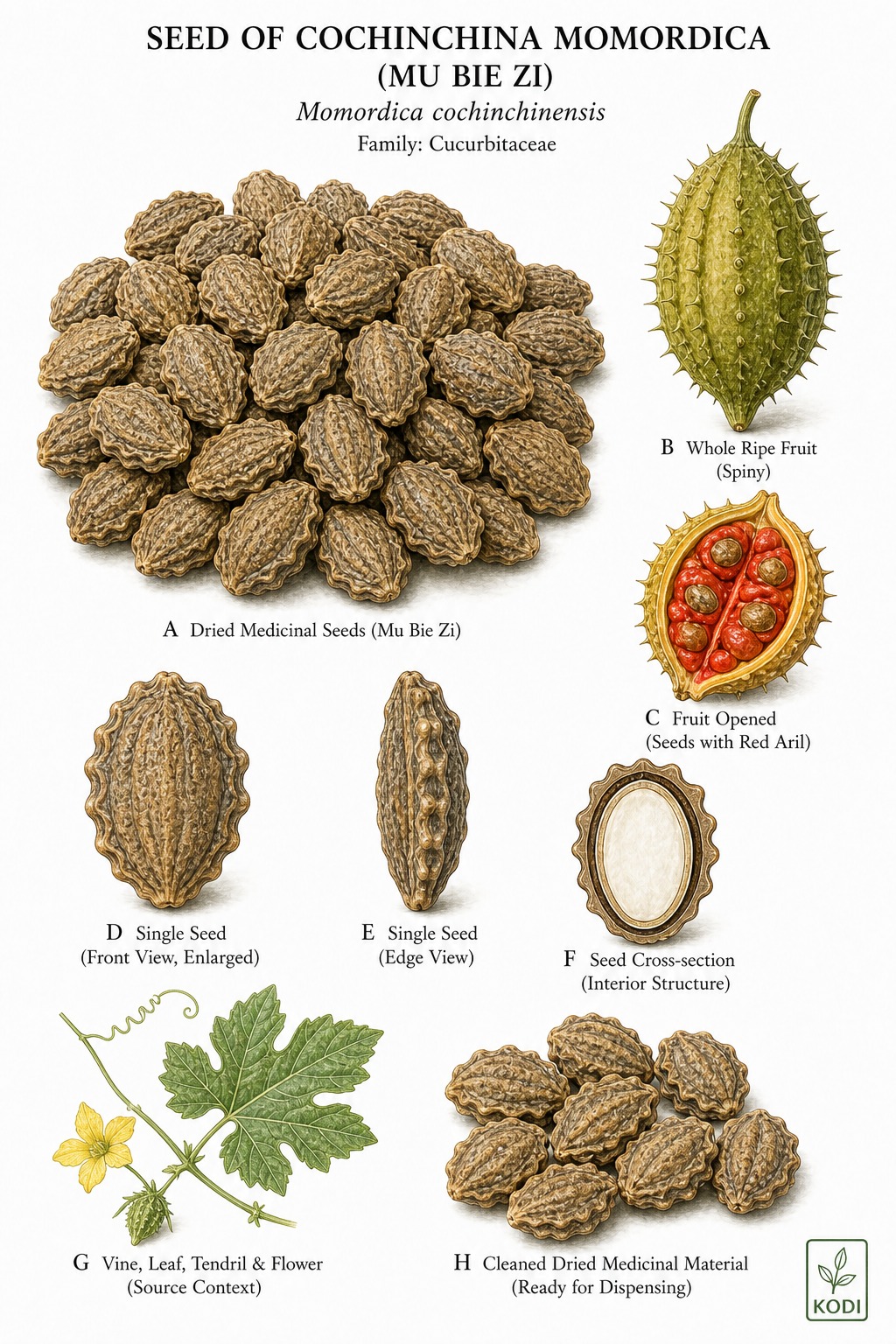
Known in TCM as Mu Bie Zi (木鳖子), this bitter and slightly sweet, warm herb enters the Liver, Spleen, and Kidney. Traditionally, it resolves swelling and expels toxin ... Mu Bie Zi is used for sores, carbuncles, hard swelling, and inflammatory lesions that have become firm or nodular, most often applied for scrofula, abscess, and hemorrhoids. Modern research has identified Triterpenoid among its active constituents.
Part used: Seed
Also Known As
Latin: Semen Momordicae | Pinyin: Mu Bie Zi | Chinese: 木鳖子
TCM Properties
- Taste
- bitter, slightly sweet
- Temperature
- warm
- Channels
- Liver, Spleen, Kidney
Traditional Use
Primary Actions
- Resolves swelling and expels toxin ... Mu Bie Zi is used for sores, carbuncles, hard swelling, and inflammatory lesions that have become firm or nodular.
- Dissipates nodules and softens hardness ... traditional use extends to scrofula, breast lumps, and other knotty accumulations.
- Opens the collaterals and relieves painful obstruction ... some records also use it for stubborn joint or tendon pain when swelling and blockage are part of the picture.
Secondary Actions
- Mu Bie Zi is primarily a specialty external-use or carefully supervised internal-use medicinal, not a casual food seed.
- Its warmth and toxicity distinguish it from cooler edible cucurbit seeds, even though the source plant belongs to the same broad family.
Classic Formulas
- Xiao Jin Dan ... classic nodule and hard-swelling formula in which Mu Bie Zi helps break up phlegm-stasis masses.
- Bai Jie Zi San ... traditional painful-obstruction pairing logic for swelling, numbness, and phlegm-damp accumulation in the channels.
- External powder or paste traditions ... used for scrofula, breast swelling, or toxic sores under specialist guidance.
Classical References
- TCM Wiki describes Mu Bie Zi as bitter, slightly sweet, warm, and toxic, entering the Liver, Spleen, and Kidney to resolve swelling, expel toxin, and dissipate nodulation.
- Traditional commentary treats it as a forceful specialty herb for hard swelling rather than as a general anti-inflammatory kitchen remedy.
Modern Research
Active Compounds
- Triterpenoid saponins and cucurbitane-related constituents ... major modern candidates behind anti-inflammatory and cytotoxic interest
- Protein and peptide fractions ... part of the broader bioactive seed profile discussed in pharmacology reviews
- Fatty oils and sterol-related constituents ... supportive components in seed chemistry work
Studied Effects
- A 2019 review summarized the phytochemistry, pharmacological activities, toxicity, and clinical application literature of Momordica cochinchinensis, providing the best broad modern overview for Mu Bie Zi (PMID 30931848).
- A 2019 study isolated cytotoxic and anti-inflammatory constituents from Momordica cochinchinensis seeds, supporting the traditional swelling-and-toxin framework with direct seed-based pharmacology (PMID 31629869).
- A 2023 study found Momordica cochinchinensis seed extracts induced apoptosis and necrosis in melanoma cells, continuing the modern anticancer interest around this seed lane (PMID 36678596).
PubMed References
- Phytochemistry, Pharmacological Activities, Toxicity and Clinical Application of Momordica cochinchinensis. (2019)
- Cytotoxic and anti-inflammatory constituents from Momordica cochinchinensis seeds. (2019)
- Momordica cochinchinensis (Gac) Seed Extracts Induce Apoptosis and Necrosis in Melanoma Cells. (2023)
Safety & Interactions
Contraindications
- Pregnancy
- Unsupervised internal use
- Marked Yin deficiency with Heat
Cautions
- Mu Bie Zi is toxic and should not be treated as a casual anticancer or anti-swelling supplement.
- Traditional external-use and specialist-supervised internal-use contexts are not interchangeable with concentrated modern extracts.
- Persistent breast masses, scrofula, or hemorrhoidal bleeding need proper diagnosis rather than self-treatment.
Conditions
- Scrofula Traditional ★★★☆☆ JSON
- Abscess Traditional ★★★☆☆ JSON
- Hemorrhoids Traditional ★★☆☆☆ JSON
- Joint Pain Traditional ★★☆☆☆ JSON
Frequently Asked Questions
What is Cochinchina Momordica Seed used for?
Cochinchina Momordica Seed is traditionally used to Resolves swelling and expels toxin ... Mu Bie Zi is used for sores, carbuncles, hard swelling, and inflammatory lesions that have become firm or nodular., Dissipates nodules and softens hardness ... traditional use extends to scrofula, breast lumps, and other knotty accumulations., Opens the collaterals and relieves painful obstruction ... some records also use it for stubborn joint or tendon pain when swelling and blockage are part of the picture.. Research has investigated its effects on: A 2019 review summarized the phytochemistry, pharmacological activities, toxicity, and clinical application literature of Momordica cochinchinensis, providing the best broad modern overview for Mu Bie Zi (PMID 30931848).; A 2019 study isolated cytotoxic and anti-inflammatory constituents from Momordica cochinchinensis seeds, supporting the traditional swelling-and-toxin framework with direct seed-based pharmacology (PMID 31629869)..
What are other names for Cochinchina Momordica Seed?
Cochinchina Momordica Seed is also known as Gac Seed, Momordica cochinchinensis seed. In TCM: 木鳖子 (Mu Bie Zi); Semen Momordicae.
Is Cochinchina Momordica Seed safe during pregnancy?
Cochinchina Momordica Seed is not recommended during pregnancy.
What are the contraindications for Cochinchina Momordica Seed?
Cochinchina Momordica Seed should not be used in: Pregnancy; Unsupervised internal use; Marked Yin deficiency with Heat. Consult a qualified healthcare provider before use.