Cluster Mallow Seed
- Chinese
- 冬葵子
- Pinyin
- Dong Kui Zi
- Latin
- Fructus Malvae
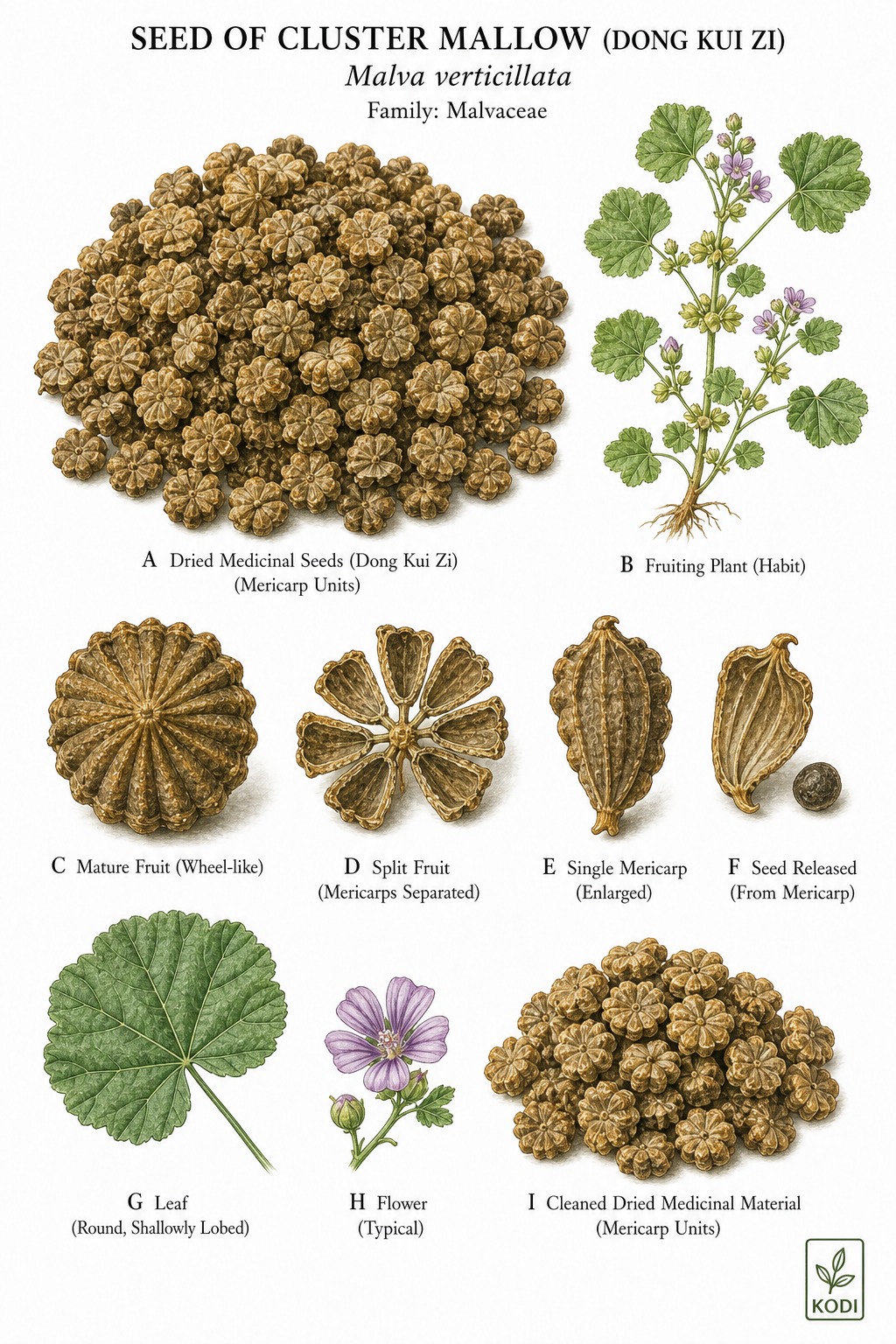
Known in TCM as Dong Kui Zi (冬葵子), this sweet, cold herb enters the Bladder, Large Intestine, and Small Intestine. Traditionally, it promotes urination and relieves strangury ... Dong Kui Zi is used for dribbling, painful urination, dark scanty urine, and damp-Heat obstructing the lower burner, most often applied for urinary tract infection, edema, and constipation. Modern research has identified Mucilage-rich among its active constituents.
Part used: Fruit
Also Known As
Latin: Fructus Malvae | Pinyin: Dong Kui Zi | Chinese: 冬葵子
TCM Properties
- Taste
- sweet
- Temperature
- cold
- Channels
- Bladder, Large Intestine, Small Intestine
Traditional Use
Primary Actions
- Promotes urination and relieves strangury ... Dong Kui Zi is used for dribbling, painful urination, dark scanty urine, and damp-Heat obstructing the lower burner.
- Promotes lactation and eases breast constraint ... traditional use extends to scanty milk and distending breast discomfort when fluids are not moving freely.
- Moistens the Intestines and relieves constipation ... the herb's slippery sweet-cold nature helps when dryness and Heat bind the stool.
Secondary Actions
- This record stays on Dong Kui Zi, the fruit-seed lane, and should be read alongside the already-live `cluster-mallow-fruit` page rather than treated as a completely different medicinal.
- Older sources vary in whether they emphasize fruit or seed, which explains the Latin naming overlap around Fructus Malvae.
Classic Formulas
- Di Fu Zi Tang ... classic damp-Heat urinary formula in which Dong Kui Zi supports Heat-clearing strangury treatment.
- Shi Wei San ... lower-urinary-tract formula where Dong Kui Zi reinforces smooth urination and Heat clearance.
- Moistening bowel pairings with Huo Ma Ren or other oily seeds ... when constipation and urinary Heat coexist.
Classical References
- TCM Wiki describes Dong Kui Zi as sweet and cold, entering the Large Intestine, Small Intestine, and Bladder meridians, with actions of promoting urination, supporting lactation, and nourishing the intestines.
- Traditional practice often treats Dong Kui Zi and Dong Kui Guo as overlapping fruit-seed trade names rather than sharply separate drugs.
Modern Research
Active Compounds
- Mucilage-rich polysaccharides ... likely contributors to the herb's slippery, bowel-moistening behavior
- Fatty oils and seed lipid fractions ... part of the nutritive and lubricating seed profile
- Flavonoids and phenolic compounds ... supporting antioxidant and anti-inflammatory interest
Studied Effects
- A 2022 review of Fructus Malvae summarized diuretic, antidiabetic, antioxidant, antitumor, and other pharmacologic findings, providing the best current overview for the Dong Kui Zi fruit-seed tradition (PMID 36080446).
- Human clinical evidence directly on Dong Kui Zi is limited, but mallow-family studies such as a 2015 placebo-controlled constipation trial support continued interest in the lineage's bowel-moistening activity, even though that work was not Dong Kui Zi-specific (PMID 25801702).
PubMed References
Safety & Interactions
Contraindications
- Loose stools from deficiency-cold
- Cold, non-inflammatory urinary weakness
Cautions
- Because Dong Kui Zi is cold and slippery, it can aggravate diarrhea or weak digestion in patients who are already cold and loose.
- Evidence for lactation support is mainly traditional rather than built on strong modern trials.
Conditions
- Urinary Tract Infection Traditional ★★★☆☆ JSON
- Edema Traditional ★★★☆☆ JSON
- Constipation Traditional ★★★☆☆ JSON
Frequently Asked Questions
What is Cluster Mallow Seed used for?
Cluster Mallow Seed is traditionally used to Promotes urination and relieves strangury ... Dong Kui Zi is used for dribbling, painful urination, dark scanty urine, and damp-Heat obstructing the lower burner., Promotes lactation and eases breast constraint ... traditional use extends to scanty milk and distending breast discomfort when fluids are not moving freely., Moistens the Intestines and relieves constipation ... the herb's slippery sweet-cold nature helps when dryness and Heat bind the stool.. Research has investigated its effects on: A 2022 review of Fructus Malvae summarized diuretic, antidiabetic, antioxidant, antitumor, and other pharmacologic findings, providing the best current overview for the Dong Kui Zi fruit-seed tradition (PMID 36080446).; Human clinical evidence directly on Dong Kui Zi is limited, but mallow-family studies such as a 2015 placebo-controlled constipation trial support continued interest in the lineage's bowel-moistening activity, even though that work was not Dong Kui Zi-specific (PMID 25801702)..
What are other names for Cluster Mallow Seed?
Cluster Mallow Seed is also known as Semen Malvae Verticillatae, Mallow Seed. In TCM: 冬葵子 (Dong Kui Zi); Fructus Malvae.
Is Cluster Mallow Seed safe during pregnancy?
The safety of Cluster Mallow Seed during pregnancy has not been established. Consult a qualified healthcare provider before use.
What are the contraindications for Cluster Mallow Seed?
Cluster Mallow Seed should not be used in: Loose stools from deficiency-cold; Cold, non-inflammatory urinary weakness. Consult a qualified healthcare provider before use.