Bunge Pricklyash Seed
- Chinese
- 椒目
- Pinyin
- Jiao Mu
- Latin
- Semen Zanthoxyli Bungeani
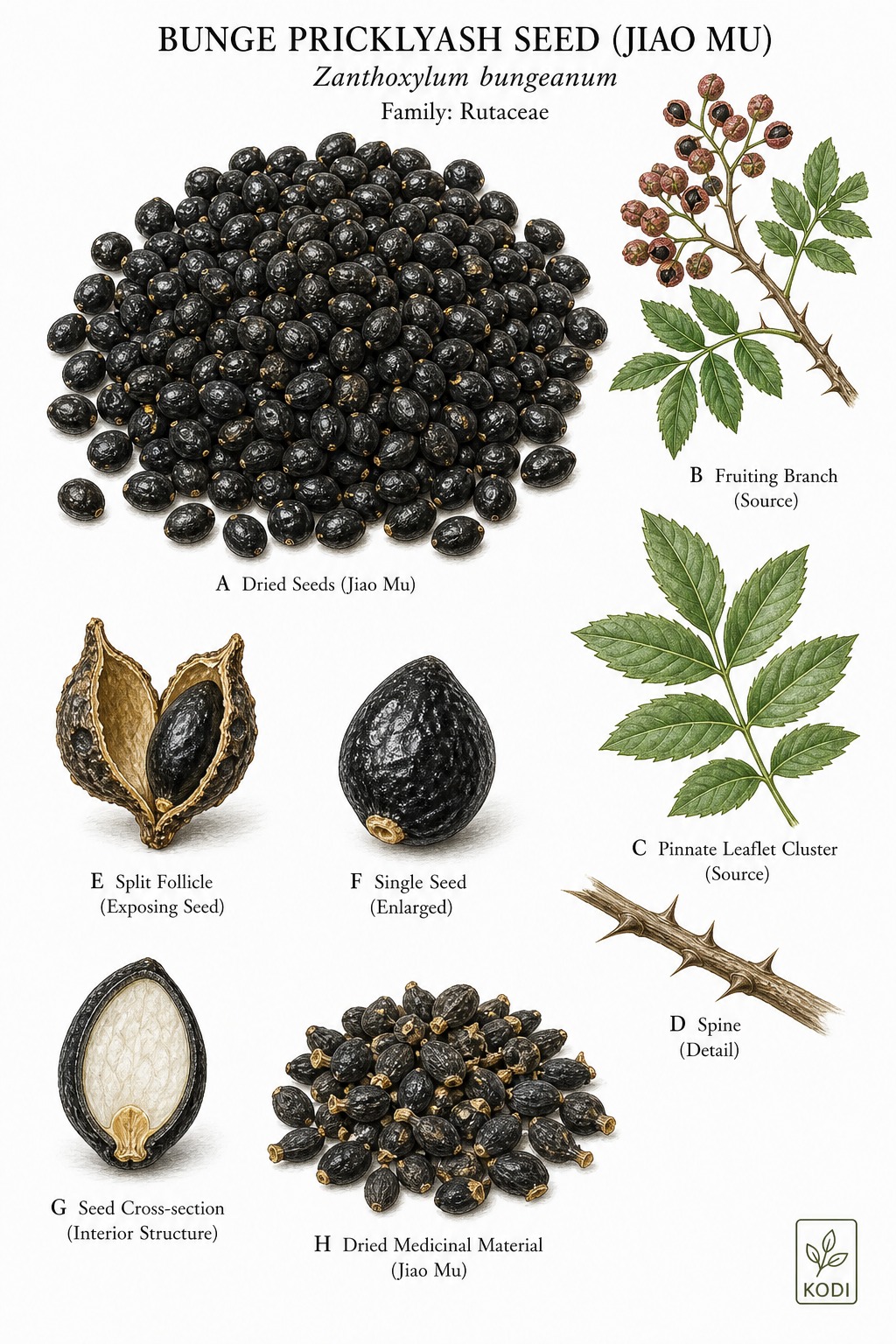
Known in TCM as Jiao Mu (椒目), this bitter and acrid, cold herb enters the Spleen, Urinary Bladder, and Lung. Traditionally, it promotes urination and reduces edema ... Jiao Mu is used when water retention, generalized swelling, or scanty urination reflect impaired fluid movement, most often applied for edema, abdominal distension, and wheezing. Modern research has identified Seed among its active constituents.
Part used: Seed
Also Known As
Latin: Semen Zanthoxyli Bungeani | Pinyin: Jiao Mu | Chinese: 椒目
TCM Properties
- Taste
- bitter, acrid
- Temperature
- cold
- Channels
- Spleen, Urinary Bladder, Lung
Traditional Use
Primary Actions
- Promotes urination and reduces edema ... Jiao Mu is used when water retention, generalized swelling, or scanty urination reflect impaired fluid movement.
- Resolves phlegm-fluid and calms wheezing ... it redirects retained watery fluids away from the lungs and downward through the urinary tract.
- Drains water and reduces abdominal distension ... classical use includes abdominal fullness and fluid accumulation in the belly.
Secondary Actions
- Jiao Mu is the seed lane of Zanthoxylum bungeanum and is much colder and more water-draining than the warming husk or pericarp medicines often grouped under Hua Jiao.
- Its treatment logic is centered on retained fluid and phlegm-fluid, not on warming middle-burner cold.
Classic Formulas
- Ji Jiao Li Huang Wan ... the best-known classical formula featuring Jiao Mu for intestinal or abdominal water retention with distension.
- Wheezing combinations with Ting Li Zi and Sang Bai Pi ... traditional strategy when thin phlegm-fluid surges upward into the lungs.
- Edema pairings with Fang Ji or Fu Ling ... water-draining logic for swelling with scanty urination.
Classical References
- Me and Qi cites the classical teaching that Jiao Mu travels the water pathway rather than the food pathway, capturing its very specific urination-focused direction.
- Because the source plant is the same broader pricklyash tradition as Hua Jiao, this seed record needs to stay distinct from the much warmer husk-based culinary-medicinal lane.
Modern Research
Active Compounds
- Seed oil rich in unsaturated fatty acids ... the main modern analytical focus of Jiao Mu-specific studies
- Polyphenol fractions ... part of the broader anti-inflammatory research around Zanthoxylum bungeanum
- Minor aromatic and lipid-soluble constituents ... investigated mainly through seed-oil and extract models rather than traditional decoction studies
Studied Effects
- A 2014 study profiled Zanthoxylum bungeanum seed chemistry and reported biological activity against asthma in murine models, directly supporting interest in the seed lane rather than only the husk tradition (PMID 24495470).
- A 2016 study found Zanthoxylum bungeanum seed oil inhibited ovalbumin-induced lung inflammation in mice, aligning with the traditional wheezing and phlegm-fluid indication set (PMID 27035565).
- A 2021 study showed Zanthoxylum bungeanum seed oil attenuated inflammatory activation in BEAS-2B airway cells through TLR4/MyD88/NF-kB pathway inhibition, offering a modern mechanism for airway-focused effects (PMID 34603465).
PubMed References
- Phytochemical profiles and biological activity evaluation of Zanthoxylum bungeanum Maxim seed against asthma in murine models. (2014)
- Inhibitory effect of Zanthoxylum bungeanum seed oil on ovalbumin-induced lung inflammation in a murine model of asthma. (2016)
- Zanthoxylum bungeanum Seed Oil Attenuates LPS-Induced BEAS-2B Cell Activation and Inflammation by Inhibiting the TLR4/MyD88/NF-kB Signaling Pathway. (2021)
Safety & Interactions
Contraindications
- Fluid depletion or dryness without retained water
- Marked deficiency-cold without edema or phlegm-fluid accumulation
Cautions
- Jiao Mu should not be confused with warming Hua Jiao husk products simply because both come from pricklyash species.
- Because its action is downward and fluid-draining, prolonged unsupervised use can aggravate dryness or weakness in depleted patients.
- Evidence for modern use is still preclinical and seed-oil focused rather than based on strong human trials.
Drug Interactions
- Diuretic medications ... additive fluid-lowering effects are possible
Conditions
- Edema Traditional ★★★★☆ JSON
- Abdominal Distension Traditional ★★★★☆ JSON
- Wheezing Traditional ★★★☆☆ JSON
- Phlegm Accumulation Traditional ★★★☆☆ JSON
Frequently Asked Questions
What is Bunge Pricklyash Seed used for?
Bunge Pricklyash Seed is traditionally used to Promotes urination and reduces edema ... Jiao Mu is used when water retention, generalized swelling, or scanty urination reflect impaired fluid movement., Resolves phlegm-fluid and calms wheezing ... it redirects retained watery fluids away from the lungs and downward through the urinary tract., Drains water and reduces abdominal distension ... classical use includes abdominal fullness and fluid accumulation in the belly.. Research has investigated its effects on: A 2014 study profiled Zanthoxylum bungeanum seed chemistry and reported biological activity against asthma in murine models, directly supporting interest in the seed lane rather than only the husk tradition (PMID 24495470).; A 2016 study found Zanthoxylum bungeanum seed oil inhibited ovalbumin-induced lung inflammation in mice, aligning with the traditional wheezing and phlegm-fluid indication set (PMID 27035565)..
What are other names for Bunge Pricklyash Seed?
Bunge Pricklyash Seed is also known as Pricklyash Seed, Zanthoxylum bungeanum seed. In TCM: 椒目 (Jiao Mu); Semen Zanthoxyli Bungeani.
Is Bunge Pricklyash Seed safe during pregnancy?
The safety of Bunge Pricklyash Seed during pregnancy has not been established. Consult a qualified healthcare provider before use.
What are the contraindications for Bunge Pricklyash Seed?
Bunge Pricklyash Seed should not be used in: Fluid depletion or dryness without retained water; Marked deficiency-cold without edema or phlegm-fluid accumulation. Consult a qualified healthcare provider before use.
Does Bunge Pricklyash Seed interact with any medications?
Bunge Pricklyash Seed may interact with: Diuretic medications ... additive fluid-lowering effects are possible. Always inform your healthcare provider of any herbal supplements you are taking.