Sargassum Seaweed
- Chinese
- 海藻
- Pinyin
- Hai Zao
- Latin
- Sargassum
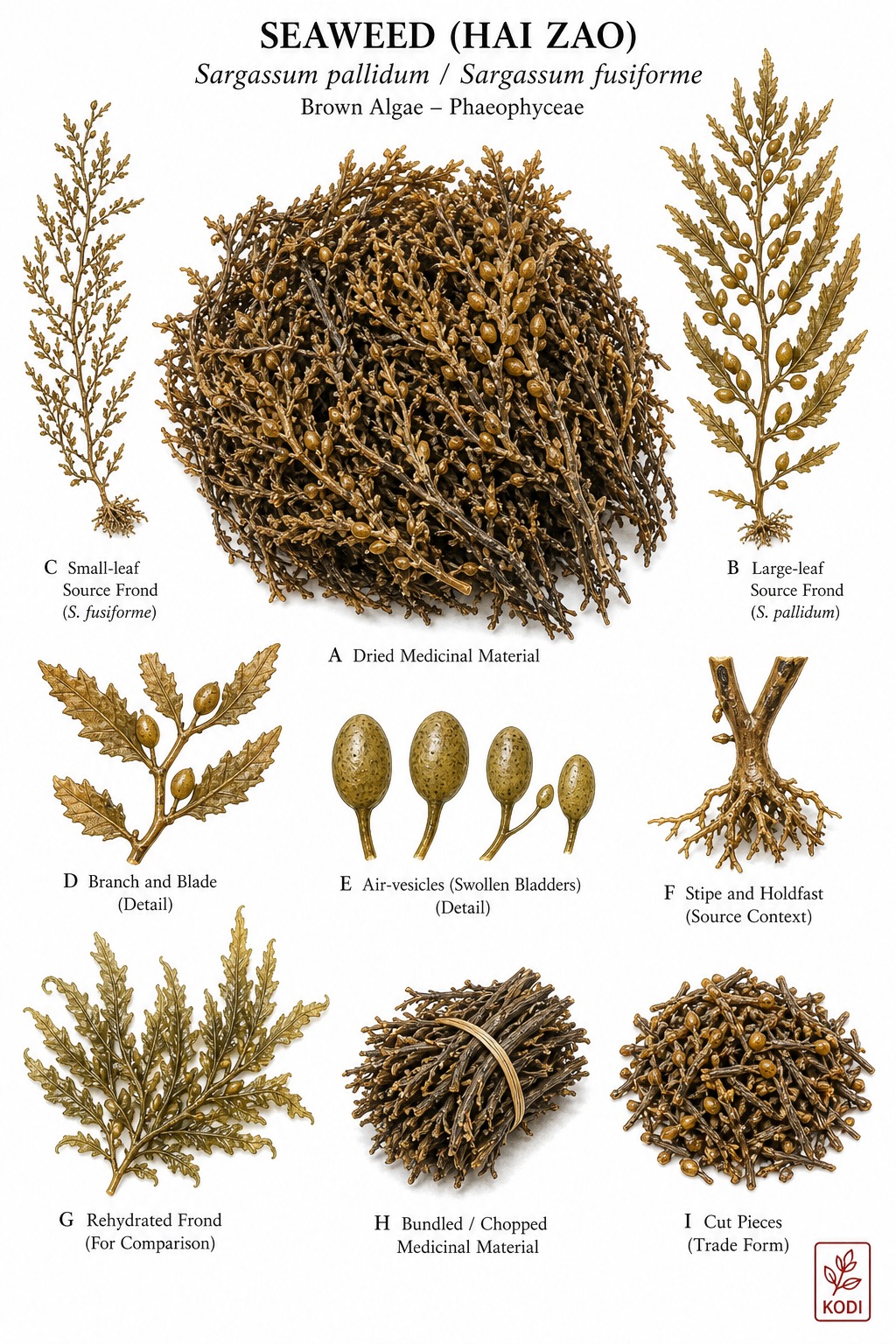
Known in TCM as Hai Zao (海藻), this bitter and salty, cold herb enters the Liver, Stomach, and Kidney. Traditionally, it softens hardness and dissipates nodules ... Hai Zao is classically directed to goiter, thyroid nodules, scrofula, and other hard masses formed from phlegm and constrained Qi, most often applied for thyroid nodule, scrofula, and phlegm accumulation. Modern research has identified Fucoidan-like among its active constituents.
Part used: Seaweed (whole)
Also Known As
Latin: Sargassum | Pinyin: Hai Zao | Chinese: 海藻
TCM Properties
- Taste
- bitter, salty
- Temperature
- cold
- Channels
- Liver, Stomach, Kidney
Traditional Use
Primary Actions
- Softens hardness and dissipates nodules ... Hai Zao is classically directed to goiter, thyroid nodules, scrofula, and other hard masses formed from phlegm and constrained Qi.
- Dissolves phlegm accumulations ... beyond visible mucus, it addresses congealed Phlegm that settles into the neck, lymphatic tissue, or lower burner and forms stubborn swellings.
- Promotes urination and reduces edema ... it supports fluid resolution when retained water and phlegm coexist.
Secondary Actions
- Authentic Hai Zao can derive from Sargassum pallidum or Sargassum fusiforme and should not be casually collapsed into Kun Bu, the kelp/tangle tradition already represented elsewhere in the library.
- Its best traditional fit is hard nodules with phlegm-fire or fluid stagnation, not soft deficiency-type swelling.
Classic Formulas
- Hai Zao Yu Hu Tang ... the classic goiter and thyroid-nodule formula built around Hai Zao's ability to soften hardness and dissolve phlegm masses.
- Neck-mass and scrofula combinations with Kun Bu, Xia Ku Cao, and Zhe Bei Mu ... standard pairing logic for nodules from phlegm and stagnant Qi.
- Adjunctive edema pairings with Fu Ling or Ze Xie ... secondary water-draining use when swelling accompanies phlegm accumulation.
Classical References
- Modern TCM teaching consistently describes Hai Zao as bitter, salty, and cold, entering the Liver, Stomach, and Kidney channels and targeting hard phlegm nodules.
- Hai Zao is one of the classical Eighteen Incompatibilities herbs said to oppose Gan Cao, though some later formulas deliberately combine them in difficult neck-mass disorders.
Modern Research
Active Compounds
- Fucoidan-like polysaccharides ... heavily studied macromolecules linked to immunologic and metabolic interest
- Alginate and related structural polysaccharides ... important to the herb's gel-forming, mineral-rich marine profile
- Phlorotannins and other polyphenols ... antioxidant constituents frequently discussed in brown-seaweed reviews
- Fucoxanthin and related carotenoids ... marine pigments associated with metabolic and anti-inflammatory research
Studied Effects
- A 2020 review summarized the therapeutic and nutraceutical potential of Sargassum fusiforme, highlighting antioxidant, anti-inflammatory, metabolic, and organ-protective signals while noting that much evidence remains preclinical (PMID 33133523).
- A 2023 review detailed the bioactivities of Sargassum fusiforme and reinforced modern interest in cardiovascular, anti-inflammatory, and metabolic applications that only partially overlap with traditional Hai Zao indications (PMID 37876153).
- A 2025 review focused on Sargassum fusiforme polysaccharides and their biological activity, supporting ongoing mechanistic work around immune modulation and metabolic effects (PMID 40137284).
PubMed References
Safety & Interactions
Contraindications
- Classical incompatibility with Gan Cao except under expert-supervised formula logic
- Hyperthyroid states or known iodine sensitivity
- Spleen and Stomach deficiency-cold with weak digestion
Cautions
- Marine iodine content matters ... this record is not a casual dietary seaweed recommendation and should not be equated with unrestricted food use.
- Pregnancy use is best avoided unless a practitioner has a specific reason, because the herb is cold, dispersing, and traditionally used for masses.
- Modern brown-seaweed research often studies Sargassum fusiforme food extracts, which do not map perfectly onto every Hai Zao trade lot or classical formula context.
Drug Interactions
- Thyroid medications ... iodine-rich seaweed may interfere with thyroid hormone or anti-thyroid therapy
- Anticoagulant and antiplatelet drugs ... marine polysaccharides may have mild anticoagulant effects, so concurrent use warrants caution
- Lithium ... iodine-rich materials may alter thyroid-function management in patients taking lithium
Conditions
- Thyroid Nodule Traditional ★★★★☆ JSON
- Scrofula Traditional ★★★★☆ JSON
- Phlegm Accumulation Traditional ★★★☆☆ JSON
- Edema Traditional ★★★☆☆ JSON
Frequently Asked Questions
What is Sargassum Seaweed used for?
Sargassum Seaweed is traditionally used to Softens hardness and dissipates nodules ... Hai Zao is classically directed to goiter, thyroid nodules, scrofula, and other hard masses formed from phlegm and constrained Qi., Dissolves phlegm accumulations ... beyond visible mucus, it addresses congealed Phlegm that settles into the neck, lymphatic tissue, or lower burner and forms stubborn swellings., Promotes urination and reduces edema ... it supports fluid resolution when retained water and phlegm coexist.. Research has investigated its effects on: A 2020 review summarized the therapeutic and nutraceutical potential of Sargassum fusiforme, highlighting antioxidant, anti-inflammatory, metabolic, and organ-protective signals while noting that much evidence remains preclinical (PMID 33133523).; A 2023 review detailed the bioactivities of Sargassum fusiforme and reinforced modern interest in cardiovascular, anti-inflammatory, and metabolic applications that only partially overlap with traditional Hai Zao indications (PMID 37876153)..
What are other names for Sargassum Seaweed?
Sargassum Seaweed is also known as Sargassum pallidum, Sargassum fusiforme. In TCM: 海藻 (Hai Zao); Sargassum.
Is Sargassum Seaweed safe during pregnancy?
The safety of Sargassum Seaweed during pregnancy has not been established. Consult a qualified healthcare provider before use.
What are the contraindications for Sargassum Seaweed?
Sargassum Seaweed should not be used in: Classical incompatibility with Gan Cao except under expert-supervised formula logic; Hyperthyroid states or known iodine sensitivity; Spleen and Stomach deficiency-cold with weak digestion. Consult a qualified healthcare provider before use.
Does Sargassum Seaweed interact with any medications?
Sargassum Seaweed may interact with: Thyroid medications ... iodine-rich seaweed may interfere with thyroid hormone or anti-thyroid therapy; Anticoagulant and antiplatelet drugs ... marine polysaccharides may have mild anticoagulant effects, so concurrent use warrants caution; Lithium ... iodine-rich materials may alter thyroid-function management in patients taking lithium. Always inform your healthcare provider of any herbal supplements you are taking.