Seabuckthorn Fruit
- Chinese
- 醋柳果
- Pinyin
- Cu Liu Guo
- Latin
- Fructus Hippophae
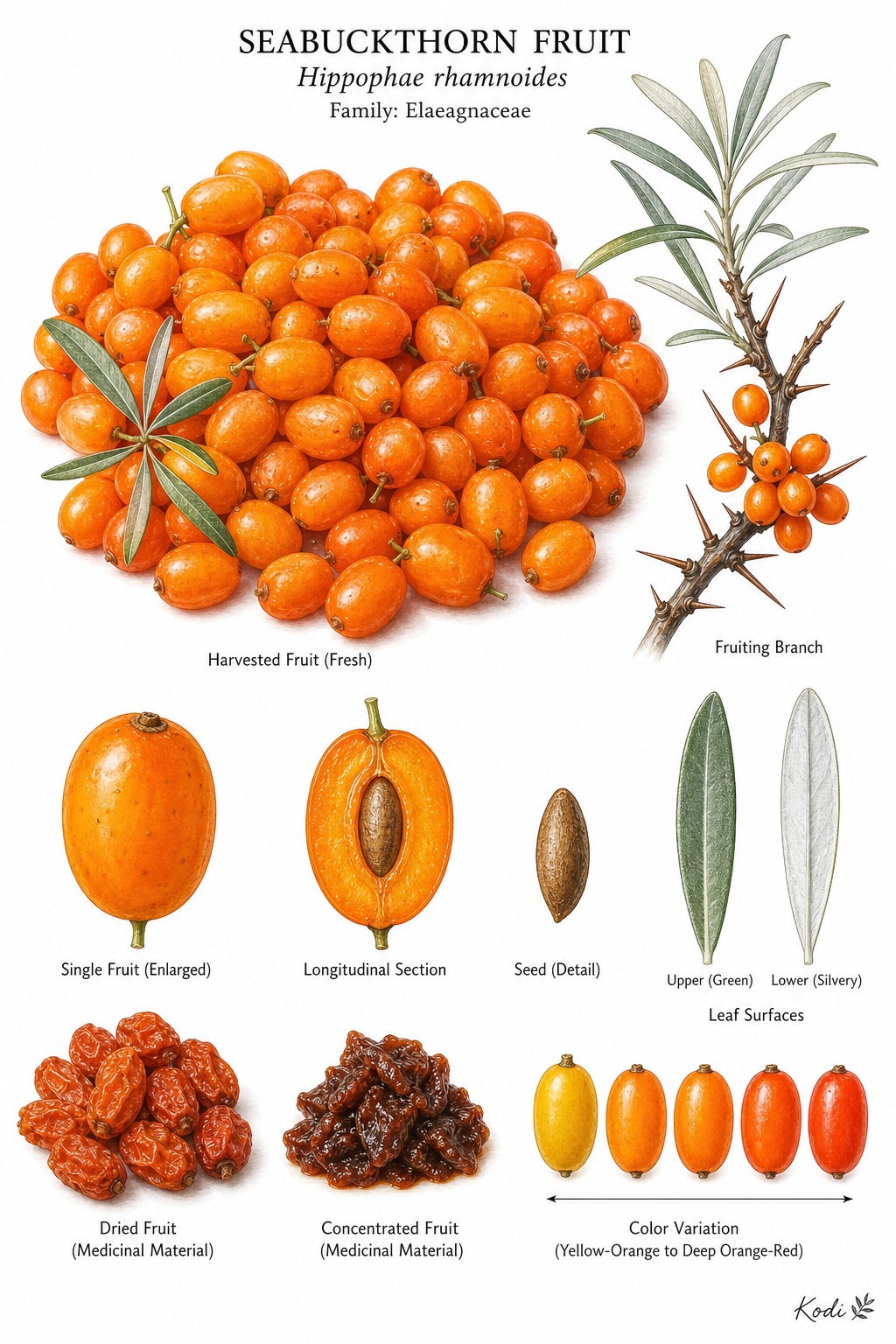
Known in TCM as Cu Liu Guo (醋柳果), this sour and astringent, warm herb enters the Liver, Stomach, Large Intestine, and Small Intestine. Traditionally, it invigorates Blood and disperses stasis ... Cu Liu Guo is used for bruising, swelling, and traumatic pain when stagnant Blood remains after injury, most often applied for productive cough, bronchitis, and indigestion. Modern research has identified Isorhamnetin, among its active constituents.
Part used: Fruit
Also Known As
Latin: Fructus Hippophae | Pinyin: Cu Liu Guo | Chinese: 醋柳果
TCM Properties
- Taste
- sour, astringent
- Temperature
- warm
- Channels
- Liver, Stomach, Large Intestine, Small Intestine
Traditional Use
Primary Actions
- Invigorates Blood and disperses stasis ... Cu Liu Guo is used for bruising, swelling, and traumatic pain when stagnant Blood remains after injury.
- Transforms phlegm and opens the chest ... regional materia medica uses it when cough, abundant sputum, or constrained breathing follow phlegm accumulation.
- Strengthens the Spleen and improves digestion ... it appears when poor appetite, food stagnation, or weak digestion are accompanied by fullness or discomfort after eating.
- Generates fluids and helps restrain intestinal loss ... plateau sources also describe it for thirst after febrile damage and for diarrhea or dysenteric patterns.
Secondary Actions
- Cu Liu Guo is a regional naming lane of sea buckthorn fruit, especially in Tibetan and northwestern Chinese usage, and should be read alongside rather than as a different species from the already-live Sha Ji page.
- Compared with broader modern supplement marketing for sea buckthorn oils and juices, the medicinal dried fruit tradition keeps a more specific focus on cough, digestion, trauma, and Blood stasis.
Classic Formulas
- Regional syrup, paste, or decoction preparations of Cu Liu Guo ... traditional food-medicine use for chronic cough with phlegm, weak recovery, and chest constraint.
- Digestive pairings with Shan Zha or Mai Ya ... used when the fruit's sour-astringent nature is directed toward food stagnation and poor appetite.
- Trauma combinations with Hong Hua or Su Mu ... traditional pairing logic for bruising, swelling, and residual Blood stasis after injury.
Classical References
- Xi Zang Chang Yong Zhong Cao Yao describes Cu Liu Guo as warm and sour-astringent, used to invigorate Blood, transform phlegm, widen the chest, and strengthen digestion.
- Gao Yuan Zhong Cao Yao Zhi Liao Shou Ce records entry into the Liver, Stomach, Large Intestine, and Small Intestine channels and extends use to thirst and diarrhea after heat damage.
- Modern herb references often collapse Cu Liu Guo into Sha Ji because both refer to Fructus Hippophae, but the regional channel emphasis and indication language are not always identical.
Modern Research
Active Compounds
- Isorhamnetin, quercetin, and related flavonols ... prominent antioxidant polyphenols repeatedly highlighted in sea buckthorn fruit research
- Palmitoleic acid and other unsaturated fatty acids ... important lipid constituents, especially in fruit and seed oil fractions
- Carotenoids, vitamin C, and vitamin E ... hallmark nutritive compounds that help explain the fruit's antioxidant and tissue-support interest
- Triterpenes and organic acids ... broader secondary-metabolite groups discussed in digestive and anti-inflammatory research
Studied Effects
- A 2023 comprehensive review summarized sea buckthorn phytochemistry, health benefits, and food applications, highlighting antioxidant, anti-inflammatory, and metabolic support signals while noting that much of the evidence remains preclinical (PMID 36562043).
- A 2020 review examined why sea buckthorn is considered exceptional, emphasizing its dense vitamin, carotenoid, flavonoid, and fatty-acid profile alongside wide but still uneven pharmacologic evidence (PMID 32466930).
- A 2024 review focused on sea buckthorn metabolites in digestive disease, supporting continued modern interest in gastrointestinal and mucosal-protective applications that overlap with traditional Cu Liu Guo digestive use (PMID 41064454).
PubMed References
- Phytochemistry, health benefits, and food applications of sea buckthorn (Hippophae rhamnoides L.): A comprehensive review. (2023)
- Why is sea buckthorn (Hippophae rhamnoides L.) so exceptional? A review. (2020)
- Sea buckthorn bioactive metabolites and their pharmacological potential in digestive diseases. (2024)
Safety & Interactions
Contraindications
- Bleeding disorders or unsupervised use alongside anticoagulant therapy
- Marked acid-sensitive gastritis or peptic irritation aggravated by sour fruit preparations
Cautions
- Modern sea buckthorn juices, oils, capsules, and fortified beverages are not equivalent to the dry medicinal fruit and can deliver very different exposures.
- Because Cu Liu Guo also moves Blood, use in pregnancy should remain practitioner-guided even though hard classical prohibition is not the main historical theme.
- Naming overlap with Sha Ji is real ... the two pages describe the same broad fruit tradition from different import lanes, not two unrelated plants.
Drug Interactions
- Anticoagulant and antiplatelet drugs ... sea buckthorn fruit fractions show antiplatelet and vascular effects in modern research, so concurrent use may increase bleeding tendency
Conditions
- Productive Cough Traditional ★★★★☆ JSON
- Bronchitis Traditional ★★★☆☆ JSON
- Indigestion Traditional ★★★☆☆ JSON
- Traumatic Injury Traditional ★★★☆☆ JSON
- Blood Stasis Traditional ★★☆☆☆ JSON
Frequently Asked Questions
What is Seabuckthorn Fruit used for?
Seabuckthorn Fruit is traditionally used to Invigorates Blood and disperses stasis ... Cu Liu Guo is used for bruising, swelling, and traumatic pain when stagnant Blood remains after injury., Transforms phlegm and opens the chest ... regional materia medica uses it when cough, abundant sputum, or constrained breathing follow phlegm accumulation., Strengthens the Spleen and improves digestion ... it appears when poor appetite, food stagnation, or weak digestion are accompanied by fullness or discomfort after eating., Generates fluids and helps restrain intestinal loss ... plateau sources also describe it for thirst after febrile damage and for diarrhea or dysenteric patterns.. Research has investigated its effects on: A 2023 comprehensive review summarized sea buckthorn phytochemistry, health benefits, and food applications, highlighting antioxidant, anti-inflammatory, and metabolic support signals while noting that much of the evidence remains preclinical (PMID 36562043).; A 2020 review examined why sea buckthorn is considered exceptional, emphasizing its dense vitamin, carotenoid, flavonoid, and fatty-acid profile alongside wide but still uneven pharmacologic evidence (PMID 32466930)..
What are other names for Seabuckthorn Fruit?
Seabuckthorn Fruit is also known as Sha Ji, Sea Buckthorn Berry. In TCM: 醋柳果 (Cu Liu Guo); Fructus Hippophae.
Is Seabuckthorn Fruit safe during pregnancy?
The safety of Seabuckthorn Fruit during pregnancy has not been established. Consult a qualified healthcare provider before use.
What are the contraindications for Seabuckthorn Fruit?
Seabuckthorn Fruit should not be used in: Bleeding disorders or unsupervised use alongside anticoagulant therapy; Marked acid-sensitive gastritis or peptic irritation aggravated by sour fruit preparations. Consult a qualified healthcare provider before use.
Does Seabuckthorn Fruit interact with any medications?
Seabuckthorn Fruit may interact with: Anticoagulant and antiplatelet drugs ... sea buckthorn fruit fractions show antiplatelet and vascular effects in modern research, so concurrent use may increase bleeding tendency. Always inform your healthcare provider of any herbal supplements you are taking.