Sea-Horse
- Chinese
- 海马
- Pinyin
- Hai Ma
- Latin
- Hippocampus spp.
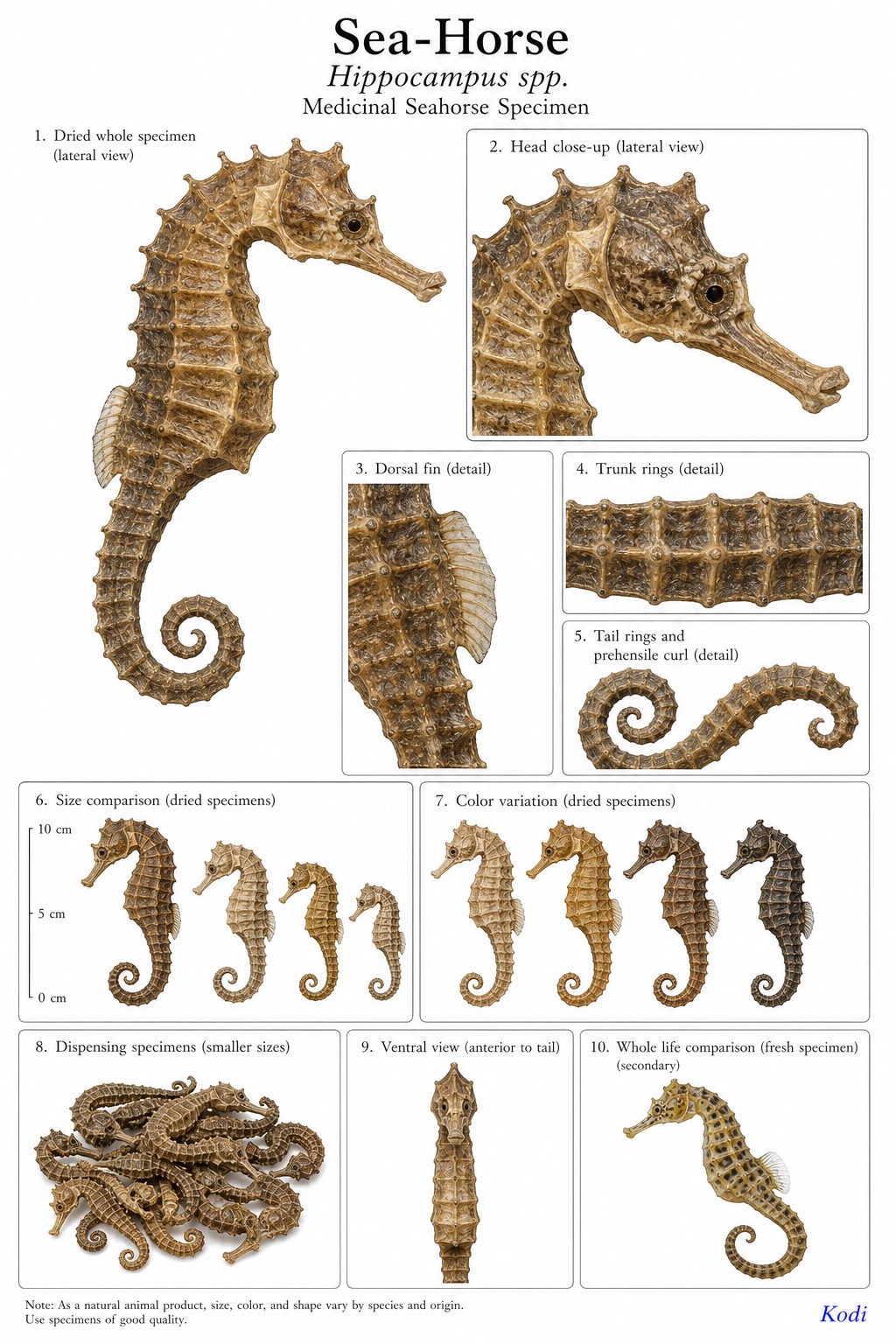
Known in TCM as Hai Ma (海马), this sweet and salty, warm herb enters the Liver and Kidney. Traditionally, it warms the Kidneys and fortifies Yang ... Hai Ma is classically used for impotence, infertility, low libido, and lower-burner cold weakness, most often applied for impotence, infertility, and low back pain. Modern research has identified Protein among its active constituents.
Also Known As
Latin: Hippocampus spp. | Pinyin: Hai Ma | Chinese: 海马
TCM Properties
- Taste
- sweet, salty
- Temperature
- warm
- Channels
- Liver, Kidney
Traditional Use
Primary Actions
- Warms the Kidneys and fortifies Yang ... Hai Ma is classically used for impotence, infertility, low libido, and lower-burner cold weakness.
- Strengthens the low back and supports reproductive vitality ... it is chosen when deep deficiency affects sexual function and physical vigor together.
- Dissolves masses and reduces swelling ... beyond its Yang-tonic lane, Hai Ma is also used for cold-type nodules, fixed swellings, and some traumatic pain patterns.
Secondary Actions
- This page stays on dried medicinal seahorse material and is distinct from the related but separate `pipe-fish` `Hai Long` page.
- The trade name `Hai Ma` covers multiple Hippocampus species in practice, so species authentication and conservation status are central modern concerns.
Classic Formulas
- Kidney-Yang tonic combinations with Lu Rong, Yin Yang Huo, or Gou Qi Zi ... classic reproductive and virility support logic.
- Infertility and cold-uterus pairings ... Hai Ma is used when lower-burner cold and deficiency impair conception and menstrual comfort.
- Topical and internal swelling-reducing traditions ... a reminder that Hai Ma is not only a tonic but also a marine animal medicine with circulation-related use.
Classical References
- Traditional herbology describes Hai Ma as sweet, salty, and warm, entering the Liver and Kidney to support Yang and reproductive function.
- Classical comparison notes often place Hai Ma beside Hai Long, with both warming the Kidneys while Hai Ma is more strongly associated with fertility and virility use.
- The swelling-reducing side of Hai Ma explains why it appears in some nodule and traumatic-obstruction contexts rather than in tonics alone.
Modern Research
Active Compounds
- Protein and peptide fractions ... central to much of the pharmacology literature on Hippocampus
- Sterols, amino acids, and mineral-rich tissue fractions ... repeatedly described in quality and chemistry reviews
- Species-authentication markers ... critically important because medicinal seahorse trade spans multiple species
Studied Effects
- A 2024 comprehensive review summarized the chemistry, pharmacology, and quality-evaluation methods of medicinal Hippocampus species, making it a key modern overview for Hai Ma (PMID 39072207).
- A 2015 review on the genus Hippocampus surveyed traditional medicinal uses, chemical constituents, and pharmacological properties, confirming how long the marine-medicine literature has centered on this group (PMID 25560669).
- A 2025 integrated review examined medicinal seahorses within a species-conservation framework for Alzheimer's disease and related bioactivity research, underscoring that authentication and conservation now sit alongside pharmacology (PMID 41922822).
PubMed References
- Chemical constituents, pharmacological activities and quality evaluation methods of genus Hippocampus: A comprehensive review. (2024)
- The genus Hippocampus--a review on traditional medicinal uses, chemical constituents and pharmacological properties. (2015)
- Medicinal seahorses (Hippocampus spp.) for Alzheimer's disease within species conservation framework: an integrated review of ethnopharmacology, bioactivity, bibliometrics, and network pharmacology. (2025)
Safety & Interactions
Contraindications
- Pregnancy
- Yin deficiency with heat or clear excess-heat patterns
- Unverified or illegally sourced wildlife material
Cautions
- Conservation, legality, and species authentication are major real-world issues for medicinal seahorses.
- Animal-source identity matters because broad common-name trade can hide substitution or protected-species concerns.
- Hai Ma is a specialized animal tonic and should not be treated as a casual virility supplement.
Conditions
- Impotence Traditional ★★★★☆ JSON
- Infertility Traditional ★★★☆☆ JSON
- Low Back Pain Traditional ★★☆☆☆ JSON
- Dysmenorrhea Traditional ★★☆☆☆ JSON
Frequently Asked Questions
What is Sea-Horse used for?
Sea-Horse is traditionally used to Warms the Kidneys and fortifies Yang ... Hai Ma is classically used for impotence, infertility, low libido, and lower-burner cold weakness., Strengthens the low back and supports reproductive vitality ... it is chosen when deep deficiency affects sexual function and physical vigor together., Dissolves masses and reduces swelling ... beyond its Yang-tonic lane, Hai Ma is also used for cold-type nodules, fixed swellings, and some traumatic pain patterns.. Research has investigated its effects on: A 2024 comprehensive review summarized the chemistry, pharmacology, and quality-evaluation methods of medicinal Hippocampus species, making it a key modern overview for Hai Ma (PMID 39072207).; A 2015 review on the genus Hippocampus surveyed traditional medicinal uses, chemical constituents, and pharmacological properties, confirming how long the marine-medicine literature has centered on this group (PMID 25560669)..
What are other names for Sea-Horse?
Sea-Horse is also known as Hai Ma, Seahorse. In TCM: 海马 (Hai Ma); Hippocampus spp..
Is Sea-Horse safe during pregnancy?
Sea-Horse is not recommended during pregnancy.
What are the contraindications for Sea-Horse?
Sea-Horse should not be used in: Pregnancy; Yin deficiency with heat or clear excess-heat patterns; Unverified or illegally sourced wildlife material. Consult a qualified healthcare provider before use.