Sea-Ear Shell
- Chinese
- 石决明
- Pinyin
- Shi Jue Ming
- Latin
- Concha Haliotidis
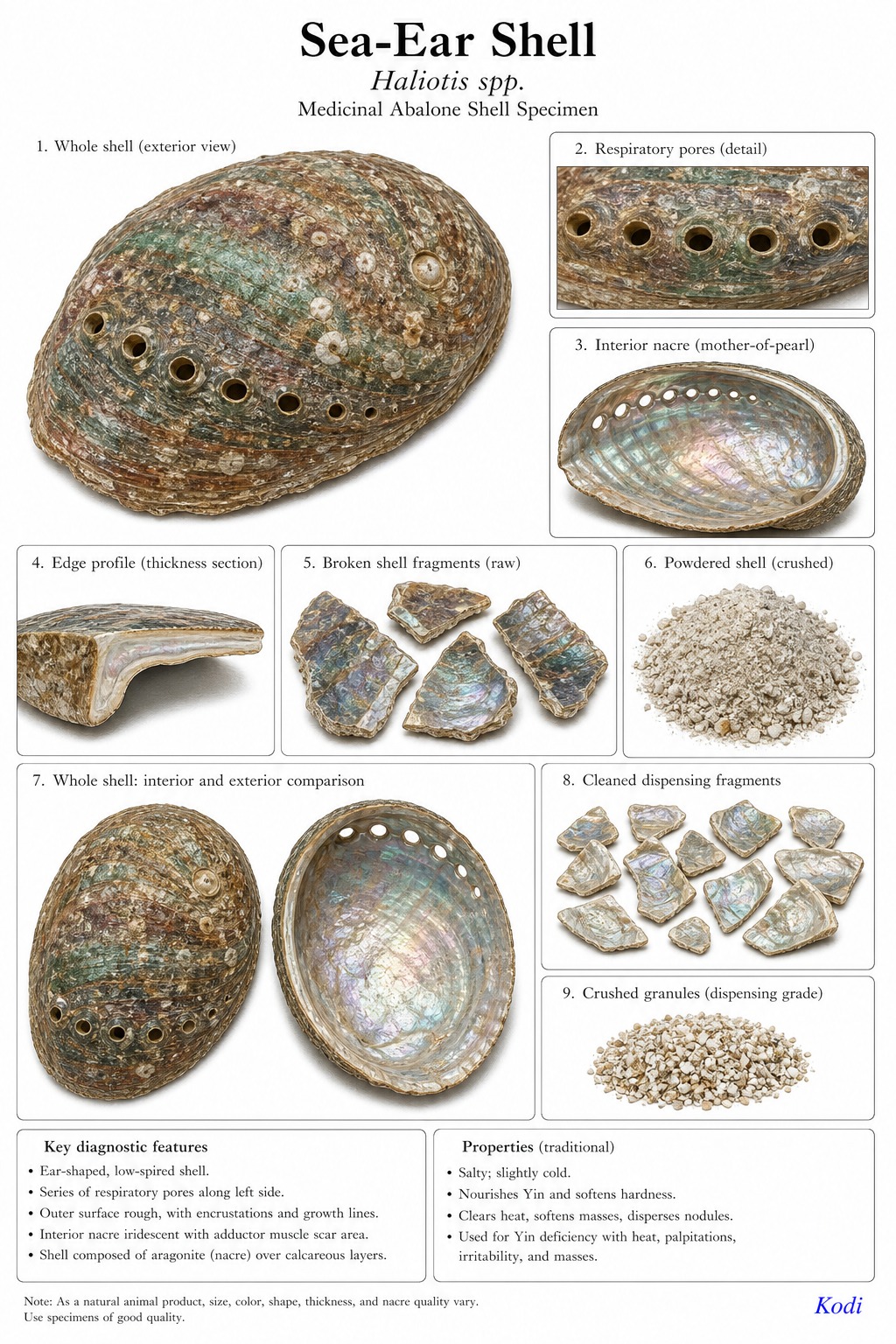
Known in TCM as Shi Jue Ming (石决明), this salty, cold herb enters the Liver. Traditionally, it subdues Liver Yang and anchors rising activity ... Shi Jue Ming is a classic heavy shell medicine for headache, dizziness, irritability, and hypertension-pattern symptoms when Liver Yang rises upward, most often applied for hypertension, blurred vision, and conjunctivitis. Modern research has identified Calcium among its active constituents.
Part used: Shell
Also Known As
Latin: Concha Haliotidis | Pinyin: Shi Jue Ming | Chinese: 石决明
TCM Properties
- Taste
- salty
- Temperature
- cold
- Channels
- Liver
Traditional Use
Primary Actions
- Subdues Liver Yang and anchors rising activity ... Shi Jue Ming is a classic heavy shell medicine for headache, dizziness, irritability, and hypertension-pattern symptoms when Liver Yang rises upward.
- Clears Liver heat and benefits the eyes ... red, painful, swollen eyes and blurred vision are among its best-known indications.
- Supports chronic eye weakness when combined with Yin- or Blood-nourishing herbs ... especially when the eyes are not only inflamed but also undernourished.
Secondary Actions
- The raw heavy shell is the main internal-liver-calming lane, while calcined forms have additional traditional external eye use.
- Shi Jue Ming overlaps conceptually with other eye herbs but is distinguished by its shell heaviness and Yang-anchoring action rather than by gentle seed-like cooling alone.
Classic Formulas
- Jue Ming Wan and related eye-support formulas ... Shi Jue Ming is paired with Blood- and Yin-nourishing herbs for chronic visual decline.
- Liver-Yang-rising formula modifications with Gou Teng, Ju Hua, and Xia Ku Cao ... a common modern-classical pattern for headache, dizziness, and red eyes.
- Topical calcined-powder applications in older ophthalmic practice ... especially for stubborn external eye complaints.
Classical References
- Traditional commentary repeatedly says Shi Jue Ming is one of the key shell medicinals for settling the Liver and brightening the eyes.
- Its salty cold nature is said to enter the blood level of the Liver and thereby clear heat that rises into the eyes.
- The shell's heaviness explains why it is chosen for upward Yang excess rather than for simple mild eye strain alone.
Modern Research
Active Compounds
- Calcium carbonate-rich shell matrix ... the dominant mineral basis of the shell
- Trace minerals including magnesium and other inorganic shell constituents ... supportive but variable components
- Residual shell proteins and organic matrix fractions ... more relevant before heavy processing or calcination
Studied Effects
- A 2014 study reported anti-inflammatory and wound-healing activity from Haliotis shell material in a burn model, giving a modern rationale for some of the shell's external-use traditions (PMID 27894302).
- A 2013 study on shijueming in spontaneously hypertensive rats explored serum-calcium and antihypertensive-related effects, offering a laboratory bridge to the herb's classic Yang-subduing lane (PMID 24024335).
- A 2013 study reported protective effects of haliotidis against oxidative damage in human lens epithelial cells, relevant to the eye-focused classical tradition (PMID 24330932).
PubMed References
- Anti-inflammatory and burn injury wound healing properties of the shell of Haliotis diversicolor. (2014)
- Mechanism and effect of shijueming (Concha Haliotidis) on serum calcium in spontaneously hypertensive rats. (2013)
- [Protective effect of haliotidis on the oxidative damage in the human lens epithelial cells]. (2013)
Safety & Interactions
Contraindications
- Spleen and Stomach deficiency cold without rising-Yang or eye-heat pattern
- Use of poorly cleaned or contaminated shell material
Cautions
- Like other calcium-rich shell medicinals, Shi Jue Ming can interfere with absorption of some medications if taken at the same time.
- Only properly cleaned medicinal shell should be used because marine shell materials can carry contamination if poorly sourced.
- The shell is heavy and typically needs appropriate decoction handling rather than casual powder use.
Drug Interactions
- Fluoroquinolone antibiotics ... calcium-rich shell minerals can reduce drug absorption; separate dosing by several hours
- Tetracycline antibiotics ... shell calcium can chelate the drug and lower bioavailability; stagger dosing
- Levothyroxine ... calcium-containing shell products may impair thyroid hormone absorption; separate by at least 4 hours
- Iron supplements ... concurrent calcium can reduce iron absorption; take at different times
Conditions
- Hypertension Traditional ★★★☆☆ JSON
- Blurred Vision Traditional ★★★★☆ JSON
- Conjunctivitis Traditional ★★★★☆ JSON
- Headache Traditional ★★★☆☆ JSON
Frequently Asked Questions
What is Sea-Ear Shell used for?
Sea-Ear Shell is traditionally used to Subdues Liver Yang and anchors rising activity ... Shi Jue Ming is a classic heavy shell medicine for headache, dizziness, irritability, and hypertension-pattern symptoms when Liver Yang rises upward., Clears Liver heat and benefits the eyes ... red, painful, swollen eyes and blurred vision are among its best-known indications., Supports chronic eye weakness when combined with Yin- or Blood-nourishing herbs ... especially when the eyes are not only inflamed but also undernourished.. Research has investigated its effects on: A 2014 study reported anti-inflammatory and wound-healing activity from Haliotis shell material in a burn model, giving a modern rationale for some of the shell's external-use traditions (PMID 27894302).; A 2013 study on shijueming in spontaneously hypertensive rats explored serum-calcium and antihypertensive-related effects, offering a laboratory bridge to the herb's classic Yang-subduing lane (PMID 24024335)..
What are other names for Sea-Ear Shell?
Sea-Ear Shell is also known as Abalone Shell, Haliotidis Concha. In TCM: 石决明 (Shi Jue Ming); Concha Haliotidis.
Is Sea-Ear Shell safe during pregnancy?
The safety of Sea-Ear Shell during pregnancy has not been established. Consult a qualified healthcare provider before use.
What are the contraindications for Sea-Ear Shell?
Sea-Ear Shell should not be used in: Spleen and Stomach deficiency cold without rising-Yang or eye-heat pattern; Use of poorly cleaned or contaminated shell material. Consult a qualified healthcare provider before use.
Does Sea-Ear Shell interact with any medications?
Sea-Ear Shell may interact with: Fluoroquinolone antibiotics ... calcium-rich shell minerals can reduce drug absorption; separate dosing by several hours; Tetracycline antibiotics ... shell calcium can chelate the drug and lower bioavailability; stagger dosing; Levothyroxine ... calcium-containing shell products may impair thyroid hormone absorption; separate by at least 4 hours; Iron supplements ... concurrent calcium can reduce iron absorption; take at different times. Always inform your healthcare provider of any herbal supplements you are taking.