Scorpion
- Chinese
- 全蝎
- Pinyin
- Quan Xie
- Latin
- Scorpio
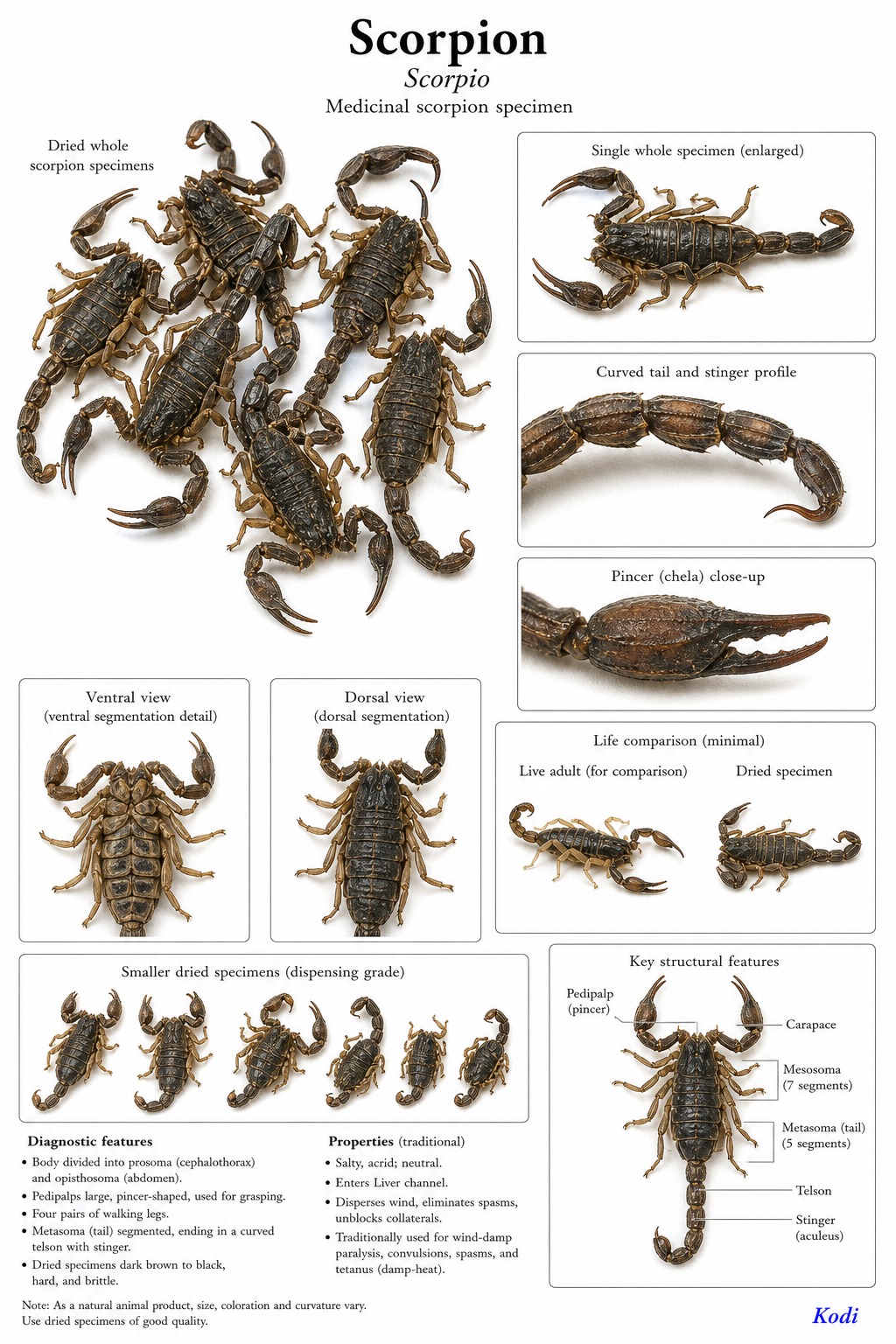
Known in TCM as Quan Xie (全蝎), this acrid and salty, neutral herb enters the Liver. Traditionally, it extinguishes wind and stops spasms ... Quan Xie is classically used for seizure, tetanic spasm, stubborn twitching, and other internal-wind patterns with strong convulsive features, most often applied for facial paralysis, epilepsy, and headache. Modern research has identified Neuroactive among its active constituents.
Also Known As
Latin: Scorpio | Pinyin: Quan Xie | Chinese: 全蝎
TCM Properties
- Taste
- acrid, salty
- Temperature
- neutral
- Channels
- Liver
Traditional Use
Primary Actions
- Extinguishes wind and stops spasms ... Quan Xie is classically used for seizure, tetanic spasm, stubborn twitching, and other internal-wind patterns with strong convulsive features.
- Unblocks collaterals and relieves pain ... facial paralysis, severe headache, and difficult channel obstruction from wind-phlegm are among its classic uses.
- Attacks toxins and disperses stubborn nodules ... tiny directed doses also appear in old practice for hard swellings, persistent sores, and fixed painful obstruction.
Secondary Actions
- This page stays on the dried whole-scorpion `Quan Xie` lane and is intentionally distinct from the clinically processed `prepared-scorpion` sibling.
- Processing, cleaning, and tiny-dose control are central practical points because crude animal medicinals are not interchangeable with prepared dispensary stock.
Classic Formulas
- Qian Zheng San ... classic facial-deviation formula pairing Quan Xie with Bai Fu Zi and Jiang Can.
- Ding Xian Wan and related seizure formulas ... Quan Xie appears in small amounts for internal-wind and convulsive patterns.
- Topical or powdered nodule and channel-obstruction formulas ... old specialty use for stubborn pain and swellings.
Classical References
- Traditional materia medica places Quan Xie among the stronger wind-extinguishing animal substances that stop spasm and unblock the collaterals.
- Its reputation for both pain relief and toxin-attacking explains why it crosses neurologic, painful, and stubborn-swelling patterns.
- Older practice always treated dosing and processing carefully because scorpion was recognized as potent rather than gentle.
Modern Research
Active Compounds
- Neuroactive venom peptides ... the best-known modern constituent family linked to ion-channel activity
- Analgesic-antitumor peptide fractions ... heavily discussed in Buthus martensii pharmacology literature
- Other protein and peptide fractions ... studied for anti-inflammatory, anticonvulsant, and antitumor potential
Studied Effects
- A 2025 review summarized the traditional uses, constituents, pharmacology, and toxicology of Buthus martensii in Chinese medicine, making it the clearest current overview for Quan Xie itself (PMID 41357859).
- A 2020 review focused on the analgesic-antitumor peptide literature of Buthus martensii, illustrating why scorpion-derived fractions still attract modern pain and oncology interest (PMID 33178316).
- A 2021 study reported anti-inflammatory and analgesic activity from isolated scorpion toxins DKK-SP1/2, offering a modern bridge to the classic pain-relieving reputation (PMID 34357970).
PubMed References
- Scorpion (Buthus martensii Karsch) in Chinese medicine: a review of traditional uses, chemical constituents, pharmacology, and toxicology. (2025)
- The Pivotal Potentials of Scorpion Buthus Martensii Karsch-Analgesic-Antitumor Peptide in Pain Management and Cancer. (2020)
- Study of Anti-Inflammatory and Analgesic Activity of Scorpion Toxins DKK-SP1/2 from Scorpion Buthus martensii Karsch (BmK). (2021)
Safety & Interactions
Contraindications
- Pregnancy
- Unexplained seizure, paralysis, or severe pain without professional evaluation
- Use outside controlled prepared-materia-medica supply chains
Cautions
- Raw or simply dried scorpion is not interchangeable with the prepared sibling and may carry greater contamination, handling, and tolerance concerns.
- Quan Xie is potent and normally used in very small doses.
- Animal-source identity, processing, and contamination control matter more here than with ordinary botanical herbs.
Drug Interactions
- Anticonvulsants or sedating neurologic drugs ... additive neuroactive effects are possible, though direct clinical interaction data are limited
- Anticoagulant or antiplatelet therapy ... use caution because venom-derived fractions may complicate bleeding-risk assessment
Conditions
- Facial Paralysis Traditional ★★★★☆ JSON
- Epilepsy Traditional ★★★★☆ JSON
- Headache Traditional ★★★☆☆ JSON
- Rheumatism Traditional ★★☆☆☆ JSON
Frequently Asked Questions
What is Scorpion used for?
Scorpion is traditionally used to Extinguishes wind and stops spasms ... Quan Xie is classically used for seizure, tetanic spasm, stubborn twitching, and other internal-wind patterns with strong convulsive features., Unblocks collaterals and relieves pain ... facial paralysis, severe headache, and difficult channel obstruction from wind-phlegm are among its classic uses., Attacks toxins and disperses stubborn nodules ... tiny directed doses also appear in old practice for hard swellings, persistent sores, and fixed painful obstruction.. Research has investigated its effects on: A 2025 review summarized the traditional uses, constituents, pharmacology, and toxicology of Buthus martensii in Chinese medicine, making it the clearest current overview for Quan Xie itself (PMID 41357859).; A 2020 review focused on the analgesic-antitumor peptide literature of Buthus martensii, illustrating why scorpion-derived fractions still attract modern pain and oncology interest (PMID 33178316)..
What are other names for Scorpion?
Scorpion is also known as Whole Scorpion, Buthus martensii. In TCM: 全蝎 (Quan Xie); Scorpio.
Is Scorpion safe during pregnancy?
Scorpion is not recommended during pregnancy.
What are the contraindications for Scorpion?
Scorpion should not be used in: Pregnancy; Unexplained seizure, paralysis, or severe pain without professional evaluation; Use outside controlled prepared-materia-medica supply chains. Consult a qualified healthcare provider before use.
Does Scorpion interact with any medications?
Scorpion may interact with: Anticonvulsants or sedating neurologic drugs ... additive neuroactive effects are possible, though direct clinical interaction data are limited; Anticoagulant or antiplatelet therapy ... use caution because venom-derived fractions may complicate bleeding-risk assessment. Always inform your healthcare provider of any herbal supplements you are taking.