Schist (Meng Shi Umbrella)
- Chinese
- 礞石
- Pinyin
- Meng Shi
- Latin
- Lapis Micae seu Chloriti
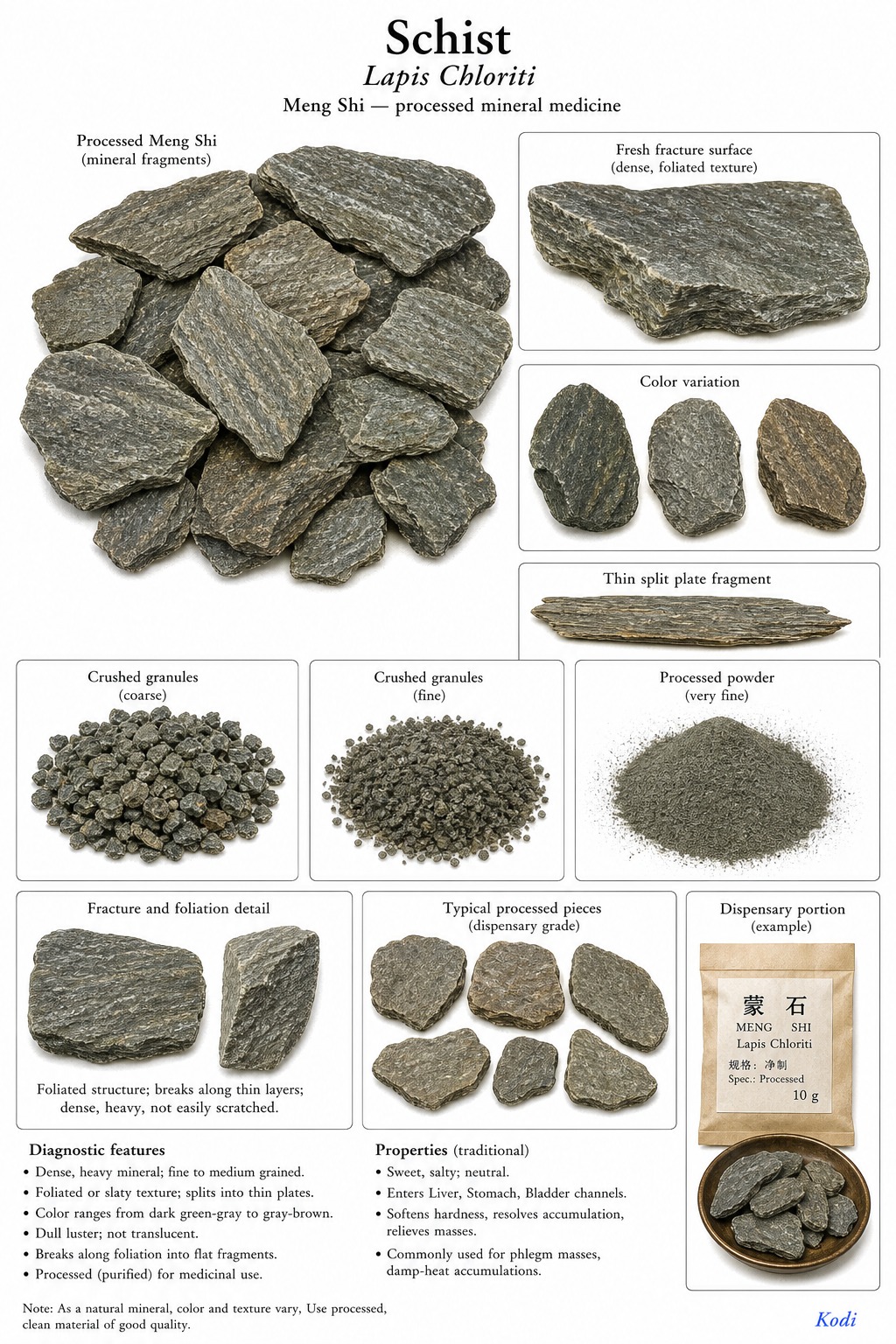
Known in TCM as Meng Shi (礞石), this sweet and salty, neutral herb enters the Liver, Lung, and Stomach. Traditionally, it heavily descends Qi and transforms stubborn phlegm ... generic Meng Shi is reserved for old, thick, clumped phlegm that ordinary phlegm herbs cannot easily clear, most often applied for phlegm accumulation, productive cough, and wheezing. Modern research has identified Mixed among its active constituents.
Part used: Mineral stone
Also Known As
Latin: Lapis Micae seu Chloriti | Pinyin: Meng Shi | Chinese: 礞石
TCM Properties
- Taste
- sweet, salty
- Temperature
- neutral
- Channels
- Liver, Lung, Stomach
Traditional Use
Primary Actions
- Heavily descends Qi and transforms stubborn phlegm ... generic Meng Shi is reserved for old, thick, clumped phlegm that ordinary phlegm herbs cannot easily clear.
- Calms the Liver and stops convulsions ... seizure, mania, agitation, and phlegm-fire obstruction are part of the classic indication set.
- Breaks focal fullness and helps clear constipation linked to phlegm-fire and accumulation ... the mineral's heaviness is central to this downward-driving role.
Secondary Actions
- This umbrella record sits above the already-live chlorite-schist `Qing Meng Shi` and mica-schist `Jin Meng Shi` subtype pages rather than replacing them.
- Internal use nearly always depends on processed or calcined material in pills, powders, or carefully handled decoction methods.
Classic Formulas
- Meng Shi Gun Tan Wan ... the archetypal formula for severe old phlegm, constipation, mania, seizures, and chest obstruction.
- Ding Xian Wan ... seizure-oriented phlegm-fire formula logic in which Meng Shi drags obstructing phlegm downward.
- Dao Tan Tang modifications ... later practice adds Meng Shi when ordinary phlegm-transforming herbs are not enough.
Classical References
- Older sources often use the simple name Meng Shi for material later differentiated more clearly into Qing Meng Shi and Jin Meng Shi.
- Traditional commentary emphasizes heaviness, downward drive, and use only in excess patterns with stubborn phlegm rather than in weak constitutions.
- Modern clinical teaching still treats processed form as essential because the raw mineral is too rough for routine internal use.
Modern Research
Active Compounds
- Mixed chlorite and mica-related silicate mineral matrix ... the broad geologic basis of umbrella Meng Shi material
- Magnesium-, iron-, and aluminum-bearing phyllosilicates ... major inorganic structural components
- Calcined or processed surface mineral phases ... clinically relevant preparation-dependent changes
Studied Effects
- Direct indexed modern research on generic Meng Shi is sparse and focuses far more on identity, processing, and dispensary practice than on modern clinical efficacy trials.
- Contemporary interpretation therefore still relies chiefly on long-standing formula tradition and on the better-characterized subtype records such as Qing Meng Shi and Jin Meng Shi.
- Because mineral Chinese medicinals can vary in impurity burden, quality control and proper processing remain more evidence-supported than broad therapeutic claims.
Safety & Interactions
Contraindications
- Pregnancy
- Qi or Blood deficiency
- Weak Spleen and Stomach digestion
- Dry-phlegm or Yin-deficiency patterns
Cautions
- Meng Shi is a harsh, strongly descending mineral for acute excess patterns rather than for long-term general use.
- Processed form matters clinically and from a safety standpoint.
- Mineral identity and contamination control should be taken seriously because umbrella naming can hide major source variation.
Conditions
- Phlegm Accumulation Traditional ★★★★★ JSON
- Productive Cough Traditional ★★★★☆ JSON
- Wheezing Traditional ★★★☆☆ JSON
- Epilepsy Traditional ★★★☆☆ JSON
- Constipation Traditional ★★☆☆☆ JSON
Frequently Asked Questions
What is Schist (Meng Shi Umbrella) used for?
Schist (Meng Shi Umbrella) is traditionally used to Heavily descends Qi and transforms stubborn phlegm ... generic Meng Shi is reserved for old, thick, clumped phlegm that ordinary phlegm herbs cannot easily clear., Calms the Liver and stops convulsions ... seizure, mania, agitation, and phlegm-fire obstruction are part of the classic indication set., Breaks focal fullness and helps clear constipation linked to phlegm-fire and accumulation ... the mineral's heaviness is central to this downward-driving role.. Research has investigated its effects on: Direct indexed modern research on generic Meng Shi is sparse and focuses far more on identity, processing, and dispensary practice than on modern clinical efficacy trials.; Contemporary interpretation therefore still relies chiefly on long-standing formula tradition and on the better-characterized subtype records such as Qing Meng Shi and Jin Meng Shi..
What are other names for Schist (Meng Shi Umbrella)?
Schist (Meng Shi Umbrella) is also known as Meng Shi, Qing Meng Shi, Jin Meng Shi. In TCM: 礞石 (Meng Shi); Lapis Micae seu Chloriti.
Is Schist (Meng Shi Umbrella) safe during pregnancy?
Schist (Meng Shi Umbrella) is not recommended during pregnancy.
What are the contraindications for Schist (Meng Shi Umbrella)?
Schist (Meng Shi Umbrella) should not be used in: Pregnancy; Qi or Blood deficiency; Weak Spleen and Stomach digestion; Dry-phlegm or Yin-deficiency patterns. Consult a qualified healthcare provider before use.