Scaphoidhelmet Monkshood
- Chinese
- 榜嘎
- Pinyin
- Bang Ga
- Latin
- Herba Aconiti Navicularis
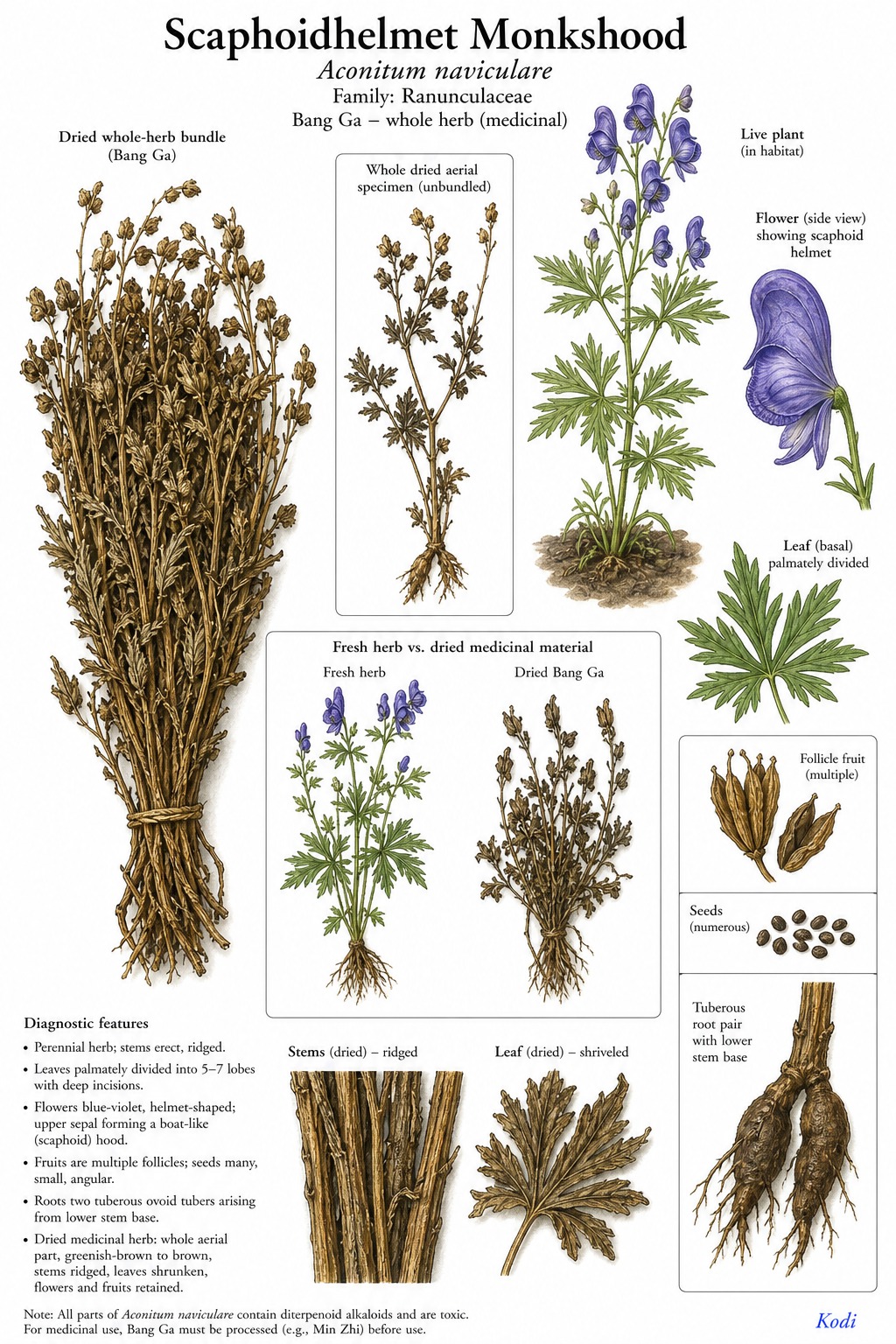
Known in TCM as Bang Ga (榜嘎), this bitter, cool herb enters the Liver and Gallbladder. Traditionally, it clears heat and reduces fever ... Bang Ga is primarily a Tibetan-medicine whole-herb lane used for febrile, inflammatory, and toxic-heat style presentations rather than for aconite-style warming, most often applied for jaundice, headache, and abdominal pain. Modern research has identified Atisine-type among its active constituents.
Part used: Whole herb
Also Known As
Latin: Herba Aconiti Navicularis | Pinyin: Bang Ga | Chinese: 榜嘎
TCM Properties
- Taste
- bitter
- Temperature
- cool
- Channels
- Liver, Gallbladder
Traditional Use
Primary Actions
- Clears heat and reduces fever ... Bang Ga is primarily a Tibetan-medicine whole-herb lane used for febrile, inflammatory, and toxic-heat style presentations rather than for aconite-style warming.
- Relieves pain and helps calm agitation ... traditional use includes headache, body pain, and heat-linked discomfort where the aerial-part herb is chosen as a lower-toxicity Tibetan aconite relative.
- Appears in liver-biliary and gastrointestinal heat formulas ... Tibetan prescribing traditions extend Bang Ga into jaundice, cholecystitis-type patterns, gastroenteritis, food poisoning, and related toxic-heat disorders.
Secondary Actions
- This page stays on the dried whole-herb or aerial-part `Bang Ga` identity and is intentionally distinct from the more root-like aconite pages and from the separate `all-grass-of-scaphoidhelmet-monkshood` lane.
- Even though Bang Ga is traditionally regarded as lower in toxicity than some aconite relatives, it is still an aconite-family medicine and should not be treated as casual self-care.
Classic Formulas
- Shisanwei Bangga San ... classic Tibetan formula family for heat-type liver-biliary disorders in which Bang Ga is the namesake ingredient.
- Tibetan fever and detoxification combinations ... Bang Ga is used with other cooling and liver-clearing herbs for infectious and inflammatory heat patterns.
- Bang Ga decoction-style use of the flowering aerial parts ... preserved in Tibetan practice for cold-season febrile illness and heat-linked pain.
Classical References
- Chinese Academy of Chinese Medical Sciences educational material describes Bang Ga as commonly collected as the aerial parts during flowering and used in Tibetan medicine for sedation, pain relief, and fever reduction.
- Tibetan materia medica classifies Bang Ga among lower-toxicity white aconite types rather than among the stronger root-focused warming aconites used in Han materia medica.
- A 2017 resource study found that traded Bangga can refer to the dried whole plant or aerial part of Aconitum naviculare or A. tanguticum, which is why source authentication matters for this record.
Modern Research
Active Compounds
- Atisine-type and related diterpenoid alkaloids ... key aconite-family constituents discussed in Bang Ga chemistry
- Navicularine diterpenoid alkaloids ... compounds specifically isolated from Aconitum naviculare
- Flavonoid glycosides ... notable non-alkaloid constituents described from the herb
Studied Effects
- A 2017 resource-and-usage study clarified that Tibetan medicinal `Bangga` in trade can derive from the dried whole plant or aerial parts of Aconitum naviculare or A. tanguticum, making it directly relevant to authentication and sourcing (PMID 29493165).
- A 2021 HPLC fingerprint study profiled the chemical components of Bangga and its two original plants, again underscoring that chemistry and identity control dominate the modern literature (PMID 34738398).
- A 2017 phytochemical report identified new navicularine diterpenoid alkaloids from Aconitum naviculare and tested cytotoxic activity in vitro, illustrating that modern work is still chemistry-heavy rather than clinically mature (PMID 28614697).
PubMed References
- [Resources and usage status of Tibetan medicinal plant "Bangga"]. (2017)
- [HPLC fingerprint of Tibetan medicinal plant ″Bangga″ and chemical components analysis of its two original plants by LC-MS/MS]. (2021)
- Navicularines A-C: New diterpenoid alkaloids from Aconitum naviculare and their cytotoxic activities. (2017)
Safety & Interactions
Contraindications
- Pregnancy
- Any unsupervised use of aconite-family medicinals
- Cardiac rhythm disorders, severe weakness, or unexplained neurologic symptoms
Cautions
- Bang Ga belongs to the aconite family, so lower traditional toxicity does not mean low modern risk.
- Species substitution between Aconitum naviculare and related Bangga source plants is documented in the literature and makes authenticated sourcing essential.
- The modern evidence base is much stronger for identity and constituent work than for safe self-use.
Conditions
- Jaundice Traditional ★★★☆☆ JSON
- Headache Traditional ★★☆☆☆ JSON
- Abdominal Pain Traditional ★★☆☆☆ JSON
- Sore Throat Traditional ★☆☆☆☆ JSON
Frequently Asked Questions
What is Scaphoidhelmet Monkshood used for?
Scaphoidhelmet Monkshood is traditionally used to Clears heat and reduces fever ... Bang Ga is primarily a Tibetan-medicine whole-herb lane used for febrile, inflammatory, and toxic-heat style presentations rather than for aconite-style warming., Relieves pain and helps calm agitation ... traditional use includes headache, body pain, and heat-linked discomfort where the aerial-part herb is chosen as a lower-toxicity Tibetan aconite relative., Appears in liver-biliary and gastrointestinal heat formulas ... Tibetan prescribing traditions extend Bang Ga into jaundice, cholecystitis-type patterns, gastroenteritis, food poisoning, and related toxic-heat disorders.. Research has investigated its effects on: A 2017 resource-and-usage study clarified that Tibetan medicinal `Bangga` in trade can derive from the dried whole plant or aerial parts of Aconitum naviculare or A. tanguticum, making it directly relevant to authentication and sourcing (PMID 29493165).; A 2021 HPLC fingerprint study profiled the chemical components of Bangga and its two original plants, again underscoring that chemistry and identity control dominate the modern literature (PMID 34738398)..
What are other names for Scaphoidhelmet Monkshood?
Scaphoidhelmet Monkshood is also known as Bangga, Aconitum naviculare. In TCM: 榜嘎 (Bang Ga); Herba Aconiti Navicularis.
Is Scaphoidhelmet Monkshood safe during pregnancy?
Scaphoidhelmet Monkshood is not recommended during pregnancy.
What are the contraindications for Scaphoidhelmet Monkshood?
Scaphoidhelmet Monkshood should not be used in: Pregnancy; Any unsupervised use of aconite-family medicinals; Cardiac rhythm disorders, severe weakness, or unexplained neurologic symptoms. Consult a qualified healthcare provider before use.