Sappan Wood
- Chinese
- 苏木
- Pinyin
- Su Mu
- Latin
- Lignum Sappan
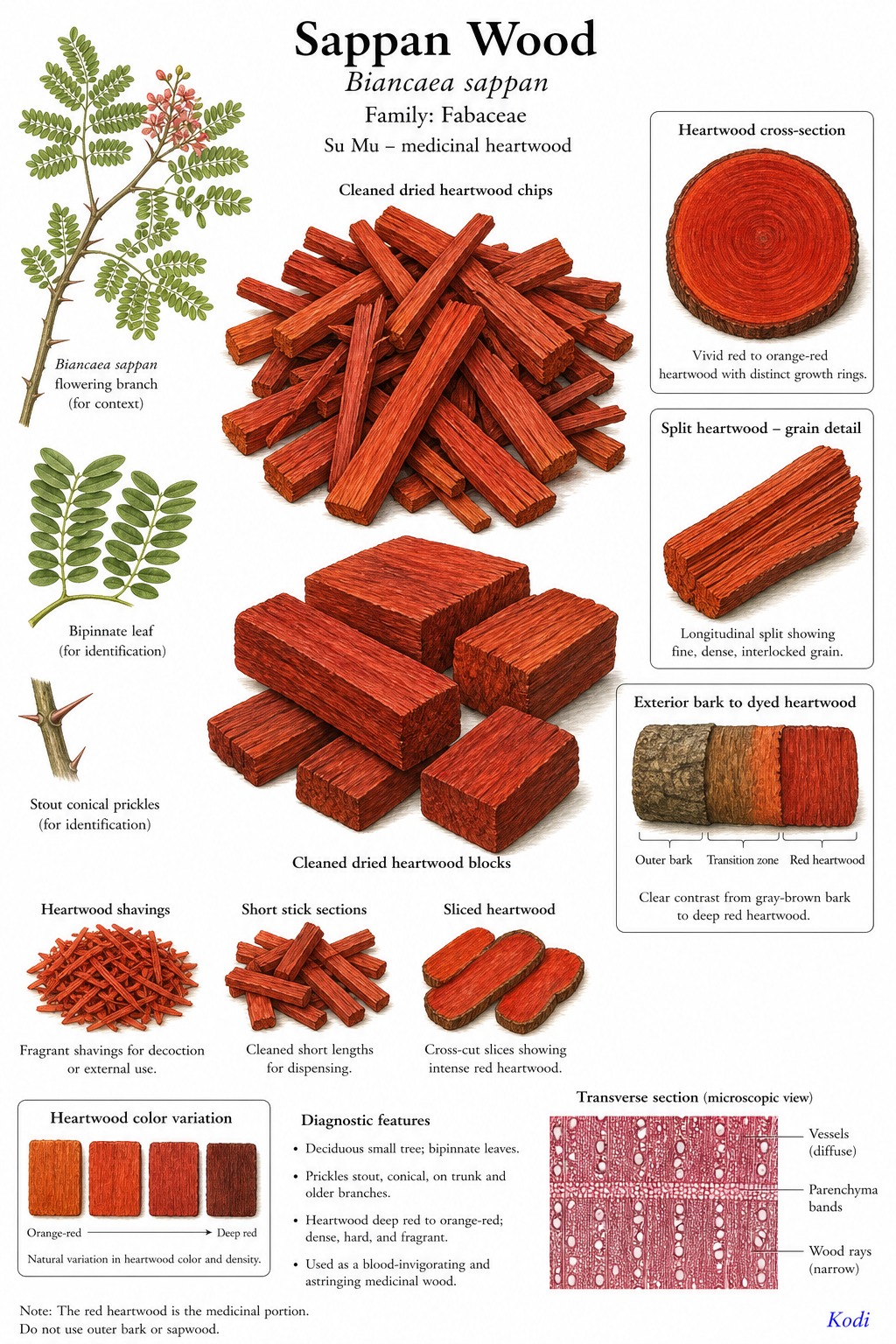
Known in TCM as Su Mu (苏木), this sweet and salty and acrid, neutral herb enters the Heart, Liver, and Spleen. Traditionally, it invigorates blood and dispels stasis ... Su Mu is used for amenorrhea, dysmenorrhea, postpartum retained lochia, and fixed pain from blood stasis, most often applied for traumatic injury, amenorrhea, and dysmenorrhea. Modern research has identified Brazilin among its active constituents.
Part used: Heartwood
Also Known As
Latin: Lignum Sappan | Pinyin: Su Mu | Chinese: 苏木
TCM Properties
- Taste
- sweet, salty, acrid
- Temperature
- neutral
- Channels
- Heart, Liver, Spleen
Traditional Use
Primary Actions
- Invigorates blood and dispels stasis ... Su Mu is used for amenorrhea, dysmenorrhea, postpartum retained lochia, and fixed pain from blood stasis.
- Reduces swelling and alleviates pain after trauma ... fractures, contusions, and sprains are among the classic injury contexts for this red heartwood medicine.
- Opens the collaterals and helps restore circulation through damaged tissue ... especially when bruising, swelling, and pain coexist.
Secondary Actions
- This is the red blood-moving heartwood lane of Biancaea sappan and should not be confused with the pale aromatic `Tan Xiang` sandalwood page.
- Su Mu is often chosen when a blood-moving wood is wanted without the stronger heat of some resins or the harsher attacking quality of heavier stasis-breakers.
Classic Formulas
- Postpartum blood-stasis combinations with Dang Gui, Tao Ren, and Hong Hua ... common traditional logic for retained lochia and pain.
- Trauma formulas pairing Su Mu with Ru Xiang and Mo Yao ... a standard strategy for bruising, fracture, and swelling.
- Amenorrhea and dysmenorrhea prescriptions ... Su Mu appears when clotted, fixed, or stasis-type pain predominates.
Classical References
- Traditional Chinese herbology places Su Mu among the blood-invigorating woods used for traumatic injury, postpartum stagnation, and painful blood stasis.
- Its red color and heartwood identity are repeatedly linked in classical commentary to blood-level movement and swelling reduction.
- Modern teaching generally describes Su Mu as gentler than some stronger stasis-breakers while still being clearly pregnancy-cautioned.
Modern Research
Active Compounds
- Brazilin and brazilein ... signature red phenolic constituents of sappan heartwood
- Sappanchalcone and related chalcones ... important anti-inflammatory and antioxidant research compounds
- Protosappanins and other phenolics ... widely discussed in chemistry and pharmacology reviews
Studied Effects
- A 2025 review summarized traditional use, phytochemistry, and pharmacology of Caesalpinia sappan, providing the clearest modern overview of Su Mu's research profile (PMID 40345215).
- A 2025 comprehensive review emphasized antioxidant and anticancer mechanisms discussed for Caesalpinia sappan extracts and compounds (PMID 39840104).
- A 2023 review catalogued the bioactive compounds reported from Caesalpinia sappan and highlighted how heavily the literature still leans toward preclinical rather than clinical evidence (PMID 37687076).
PubMed References
- Traditional Uses and Phytochemical and Pharmacological Analyses of Caesalpinia sappan Linn. (2025)
- Unlocking the therapeutic mechanism of Caesalpinia sappan: a comprehensive review of its antioxidant and anti-cancer properties, ethnopharmacology, and phytochemistry. (2025)
- A Comprehensive Review on Bioactive Compounds Found in Caesalpinia sappan. (2023)
Safety & Interactions
Contraindications
- Pregnancy
- Heavy menstrual bleeding without blood-stasis pattern
- Active anticoagulant or antiplatelet therapy without supervision
Cautions
- Su Mu is a blood-moving herb and should not be treated like a neutral culinary wood.
- Red dyewood preparations and medicinal-grade heartwood are not automatically equivalent in quality or contaminant control.
- Use is best targeted to clear blood-stasis patterns rather than prolonged unspecific supplementation.
Drug Interactions
- Anticoagulant drugs ... additive bleeding-risk or monitoring issues are possible
- Antiplatelet drugs ... concurrent use may increase bruising or bleeding tendency
Conditions
- Traumatic Injury Traditional ★★★★☆ JSON
- Amenorrhea Traditional ★★★☆☆ JSON
- Dysmenorrhea Traditional ★★★☆☆ JSON
- Blood Stasis Traditional ★★★☆☆ JSON
Frequently Asked Questions
What is Sappan Wood used for?
Sappan Wood is traditionally used to Invigorates blood and dispels stasis ... Su Mu is used for amenorrhea, dysmenorrhea, postpartum retained lochia, and fixed pain from blood stasis., Reduces swelling and alleviates pain after trauma ... fractures, contusions, and sprains are among the classic injury contexts for this red heartwood medicine., Opens the collaterals and helps restore circulation through damaged tissue ... especially when bruising, swelling, and pain coexist.. Research has investigated its effects on: A 2025 review summarized traditional use, phytochemistry, and pharmacology of Caesalpinia sappan, providing the clearest modern overview of Su Mu's research profile (PMID 40345215).; A 2025 comprehensive review emphasized antioxidant and anticancer mechanisms discussed for Caesalpinia sappan extracts and compounds (PMID 39840104)..
What are other names for Sappan Wood?
Sappan Wood is also known as Sappanwood, Biancaea sappan. In TCM: 苏木 (Su Mu); Lignum Sappan.
Is Sappan Wood safe during pregnancy?
Sappan Wood is not recommended during pregnancy.
What are the contraindications for Sappan Wood?
Sappan Wood should not be used in: Pregnancy; Heavy menstrual bleeding without blood-stasis pattern; Active anticoagulant or antiplatelet therapy without supervision. Consult a qualified healthcare provider before use.
Does Sappan Wood interact with any medications?
Sappan Wood may interact with: Anticoagulant drugs ... additive bleeding-risk or monitoring issues are possible; Antiplatelet drugs ... concurrent use may increase bruising or bleeding tendency. Always inform your healthcare provider of any herbal supplements you are taking.