Sanchi
- Chinese
- 三七
- Pinyin
- San Qi
- Latin
- Radix Notoginseng
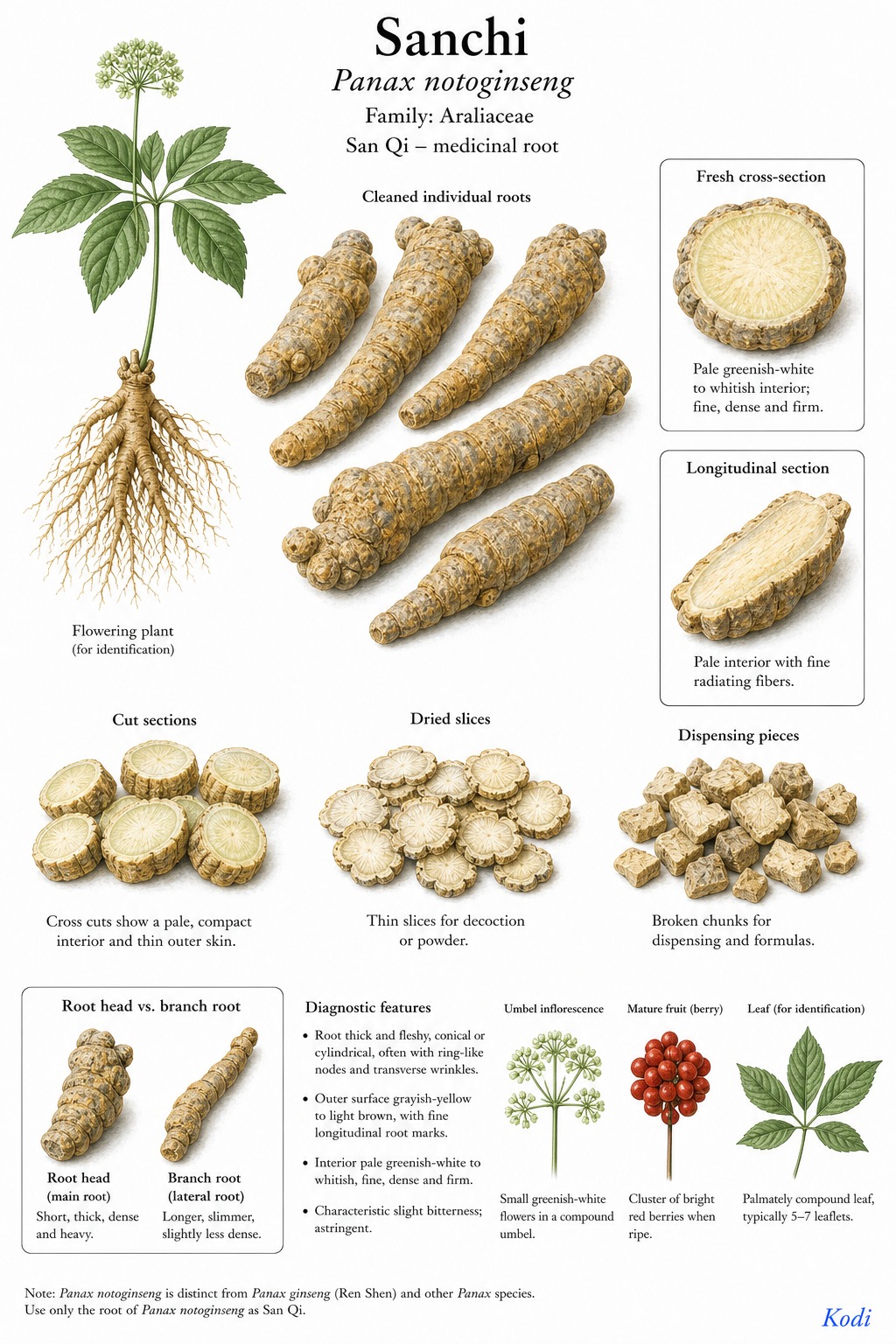
Known in TCM as San Qi (三七), this sweet and slightly bitter, warm herb enters the Liver and Stomach. Traditionally, it stops bleeding without causing blood stasis ... San Qi is one of the classic Chinese hemostatics for traumatic bleeding and internal bleeding when bruising, clots, or stagnant blood are part of the pattern, most often applied for traumatic injury, chest pain, and amenorrhea. Modern research has identified Notoginsenoside among its active constituents.
Part used: Root
Also Known As
Latin: Radix Notoginseng | Pinyin: San Qi | Chinese: 三七
TCM Properties
- Taste
- sweet, slightly bitter
- Temperature
- warm
- Channels
- Liver, Stomach
Traditional Use
Primary Actions
- Stops bleeding without causing blood stasis ... San Qi is one of the classic Chinese hemostatics for traumatic bleeding and internal bleeding when bruising, clots, or stagnant blood are part of the pattern.
- Invigorates blood and alleviates pain ... chest pain, fixed abdominal pain, menstrual stasis, and post-traumatic pain all fall within the herb's core lane.
- Reduces swelling and helps repair damaged tissue ... it is widely used for contusions, fractures, sprains, and other injuries where swelling and pain follow blood extravasation.
Secondary Actions
- This is the main `San Qi` page for accepted Panax notoginseng, while the `Han San Qi` sibling preserves an alternate trade-name lane of the same species.
- The content emphasis here stays closer to the cleaner canonical dispensing identity of San Qi root rather than the fuller root-cluster-forward presentation used on the alias page.
Classic Formulas
- Single-herb San Qi powder ... a classic pragmatic approach for trauma and bleeding patterns.
- Qi Li San ... trauma formula logic built around stopping bleeding, dispersing stasis, and relieving pain.
- Yunnan Bai Yao style hemostatic-trauma combinations ... the best-known modern continuation of the San Qi tradition.
Classical References
- Traditional herbology treats San Qi as one of the rare substances that both stop bleeding and disperse stasis, which explains its prestige in trauma medicine.
- The 2010 Chinese Pharmacopoeia tradition places San Qi among warm sweet slightly bitter blood-regulating roots entering the Liver and Stomach.
- The herb's reputation centers on blood-level regulation and trauma support, not on general ginseng-style Qi tonification.
Modern Research
Active Compounds
- Notoginsenoside R1 ... a characteristic Panax notoginseng saponin often used as a marker constituent
- Ginsenosides Rg1, Rb1, Rd, and Re ... major saponins linked to vascular, neuroprotective, and anti-inflammatory research
- Dencichine ... a small molecule often discussed in relation to hemostatic effects
- Polysaccharides and flavonoids ... supportive secondary fractions in broader pharmacology reviews
Studied Effects
- A 2025 review synthesized the latest evidence on Panax notoginseng extracts and preparations in cardiovascular disease, reflecting the herb's strong modern vascular-research profile (PMID 39903802).
- A 2023 meta-analysis found that Panax notoginseng preparations added to aspirin improved platelet-aggregation and coagulation-related outcomes over aspirin alone in coronary heart disease or ischemic stroke settings, though the evidence still depends heavily on preparation-specific Chinese studies (PMID 36569332).
- A 2025 network meta-analysis evaluated Panax notoginseng saponin-related agents against standard antiplatelet strategies in ischemic stroke, again showing why San Qi remains so prominent in Chinese cerebrovascular research (PMID 40769440).
PubMed References
- Latest Evidence and Perspectives of Panax Notoginseng Extracts and Preparations for the Treatment of Cardiovascular Diseases. (2025)
- Panax notoginseng preparation plus aspirin versus aspirin alone on platelet aggregation and coagulation in patients with coronary heart disease or ischemic stroke: A meta-analysis of randomized controlled trials. (2023)
- Comparative effectiveness of Panax notoginseng saponins-related agents and antiplatelet agents in ischemic stroke: A systematic review and network meta-analysis. (2025)
Safety & Interactions
Contraindications
- Pregnancy
- Active anticoagulant or antiplatelet therapy without supervision
- Upcoming surgery or unexplained internal bleeding
Cautions
- San Qi can affect coagulation and platelet behavior, so it should not be treated as a benign ginseng-like supplement.
- Powder, extract, capsule, and formula preparations can differ substantially in exposure and effect.
- Bleeding and pain symptoms serious enough to suggest GI bleed, stroke, or acute coronary disease need medical evaluation first.
Drug Interactions
- Anticoagulant drugs ... additive bleeding-risk or monitoring issues are possible
- Antiplatelet drugs ... concurrent use may increase bruising or alter bleeding tendency
Conditions
- Traumatic Injury Traditional ★★★★★ JSON
- Chest Pain Research ★★★★☆ JSON
- Amenorrhea Traditional ★★★☆☆ JSON
- Hemoptysis Traditional ★★★☆☆ JSON
Frequently Asked Questions
What is Sanchi used for?
Sanchi is traditionally used to Stops bleeding without causing blood stasis ... San Qi is one of the classic Chinese hemostatics for traumatic bleeding and internal bleeding when bruising, clots, or stagnant blood are part of the pattern., Invigorates blood and alleviates pain ... chest pain, fixed abdominal pain, menstrual stasis, and post-traumatic pain all fall within the herb's core lane., Reduces swelling and helps repair damaged tissue ... it is widely used for contusions, fractures, sprains, and other injuries where swelling and pain follow blood extravasation.. Research has investigated its effects on: A 2025 review synthesized the latest evidence on Panax notoginseng extracts and preparations in cardiovascular disease, reflecting the herb's strong modern vascular-research profile (PMID 39903802).; A 2023 meta-analysis found that Panax notoginseng preparations added to aspirin improved platelet-aggregation and coagulation-related outcomes over aspirin alone in coronary heart disease or ischemic stroke settings, though the evidence still depends heavily on preparation-specific Chinese studies (PMID 36569332)..
What are other names for Sanchi?
Sanchi is also known as Notoginseng, Tian Qi, Panax notoginseng. In TCM: 三七 (San Qi); Radix Notoginseng.
Is Sanchi safe during pregnancy?
Sanchi is not recommended during pregnancy.
What are the contraindications for Sanchi?
Sanchi should not be used in: Pregnancy; Active anticoagulant or antiplatelet therapy without supervision; Upcoming surgery or unexplained internal bleeding. Consult a qualified healthcare provider before use.
Does Sanchi interact with any medications?
Sanchi may interact with: Anticoagulant drugs ... additive bleeding-risk or monitoring issues are possible; Antiplatelet drugs ... concurrent use may increase bruising or alter bleeding tendency. Always inform your healthcare provider of any herbal supplements you are taking.