Saltpeter
- Chinese
- 硝石
- Pinyin
- Xiao Shi
- Latin
- Niter
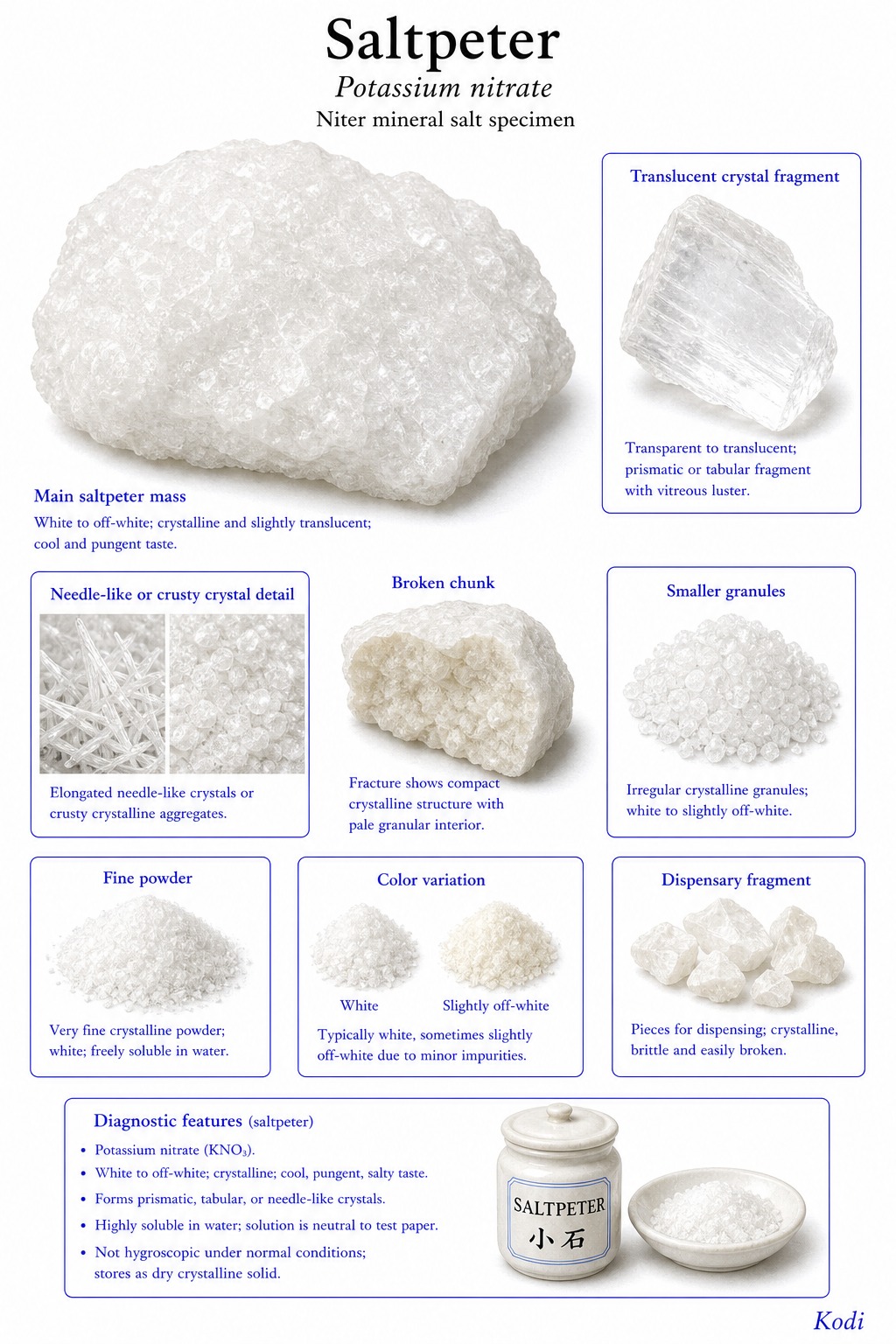
Known in TCM as Xiao Shi (硝石), this bitter and salty, cold herb enters the Heart, Spleen, and Stomach. Traditionally, it breaks accumulations and softens hardness ... Xiao Shi belongs to the older mineral-purgative lane used for hard masses, focal fullness, and dense pathological build-up that needs a downward attack, most often applied for jaundice, abdominal distension, and constipation. Modern research has identified Potassium among its active constituents.
Also Known As
Latin: Niter | Pinyin: Xiao Shi | Chinese: 硝石
TCM Properties
- Taste
- bitter, salty
- Temperature
- cold
- Channels
- Heart, Spleen, Stomach
Traditional Use
Primary Actions
- Breaks accumulations and softens hardness ... Xiao Shi belongs to the older mineral-purgative lane used for hard masses, focal fullness, and dense pathological build-up that needs a downward attack.
- Promotes urination and drains damp-heat downward ... classical indications extend to jaundice, stone-type strangury, dark scanty urine, and lower-burner obstruction from heat and sediment.
- Clears heat and resolves toxic swelling ... prepared Xiao Shi appears in throat obstruction, abscess, and other hot congested states, including some external-use traditions.
Secondary Actions
- This record is for potassium nitrate `Xiao Shi`, not sodium-sulfate `Mang Xiao` or other similarly named nitrate and sulfate minerals.
- Internal use depends on purified, water-processed material in very small doses ... it is a harsh historical mineral rather than a routine bowel or urinary herb.
Classic Formulas
- Da Huang Xiao Shi Tang ... the Jin Gui Yao Lue formula for heat-dominant jaundice with abdominal fullness, constipation, and dark scanty urine.
- Xiao Shi Fan Shi San ... a damp-heat and jaundice mineral pairing preserved in classical formula literature.
- Minute-dose Xiao Shi powder methods for the five stranguries ... older urinary-obstruction practice in which the powder was taken with different liquids depending on the pattern.
Classical References
- Classical texts describe Xiao Shi as a cold bitter-salty mineral that pushes out the old, softens hardness, and opens stool and urine pathways downward.
- The Jin Gui tradition uses it for jaundice and strangury patterns where damp-heat and accumulation are both pronounced.
- Later materia medica repeatedly warns that Xiao Shi must be distinguished from Mang Xiao and from crude industrial-like mineral substitutions.
Modern Research
Active Compounds
- Potassium nitrate ... the defining mineral substance behind the traditional identity of Xiao Shi
- Nitrate ion ... relevant to the material's sharp physiologic and chemical behavior
- Variable crude-mineral impurities ... one reason historical processing and authentication mattered
Studied Effects
- Modern indexed literature on Xiao Shi as a distinct TCM mineral is thin and leans toward historical, textual, or chemical discussion rather than contemporary herb-style efficacy trials.
- Current evidence therefore supports a conservative reading: Xiao Shi remains a historical specialist mineral whose modern interpretation is driven more by preparation, identity, and toxicologic caution than by clinical trial data.
- Its continued mention in jaundice, strangury, and hardness-breaking formulas is rooted chiefly in classical pattern logic rather than in modern controlled studies.
Safety & Interactions
Contraindications
- Pregnancy
- Weak digestion, Qi-Blood deficiency, or frail constitutions
- Kidney impairment or medically complex urinary obstruction
- Any unsupervised use of non-medicinal chemical-grade material
Cautions
- Xiao Shi is a harsh mineral substance used only in very small, processed doses and should not be improvised from industrial or agricultural nitrate sources.
- Historical overlap with Mang Xiao and other nitrate or sulfate salts makes authenticated sourcing essential.
- Because of its purgative and mineral nature, it is inappropriate for casual self-treatment of stones, jaundice, or constipation.
Conditions
- Jaundice Traditional ★★★☆☆ JSON
- Abdominal Distension Traditional ★★☆☆☆ JSON
- Constipation Traditional ★★☆☆☆ JSON
- Hematuria Traditional ★☆☆☆☆ JSON
Frequently Asked Questions
What is Saltpeter used for?
Saltpeter is traditionally used to Breaks accumulations and softens hardness ... Xiao Shi belongs to the older mineral-purgative lane used for hard masses, focal fullness, and dense pathological build-up that needs a downward attack., Promotes urination and drains damp-heat downward ... classical indications extend to jaundice, stone-type strangury, dark scanty urine, and lower-burner obstruction from heat and sediment., Clears heat and resolves toxic swelling ... prepared Xiao Shi appears in throat obstruction, abscess, and other hot congested states, including some external-use traditions.. Research has investigated its effects on: Modern indexed literature on Xiao Shi as a distinct TCM mineral is thin and leans toward historical, textual, or chemical discussion rather than contemporary herb-style efficacy trials.; Current evidence therefore supports a conservative reading: Xiao Shi remains a historical specialist mineral whose modern interpretation is driven more by preparation, identity, and toxicologic caution than by clinical trial data..
What are other names for Saltpeter?
Saltpeter is also known as Niter, Potassium Nitrate, Saltpetre. In TCM: 硝石 (Xiao Shi); Niter.
Is Saltpeter safe during pregnancy?
Saltpeter is not recommended during pregnancy.
What are the contraindications for Saltpeter?
Saltpeter should not be used in: Pregnancy; Weak digestion, Qi-Blood deficiency, or frail constitutions; Kidney impairment or medically complex urinary obstruction; Any unsupervised use of non-medicinal chemical-grade material. Consult a qualified healthcare provider before use.