Salt
- Chinese
- 食盐
- Pinyin
- Shi Yan
- Latin
- Natrii Chloridum
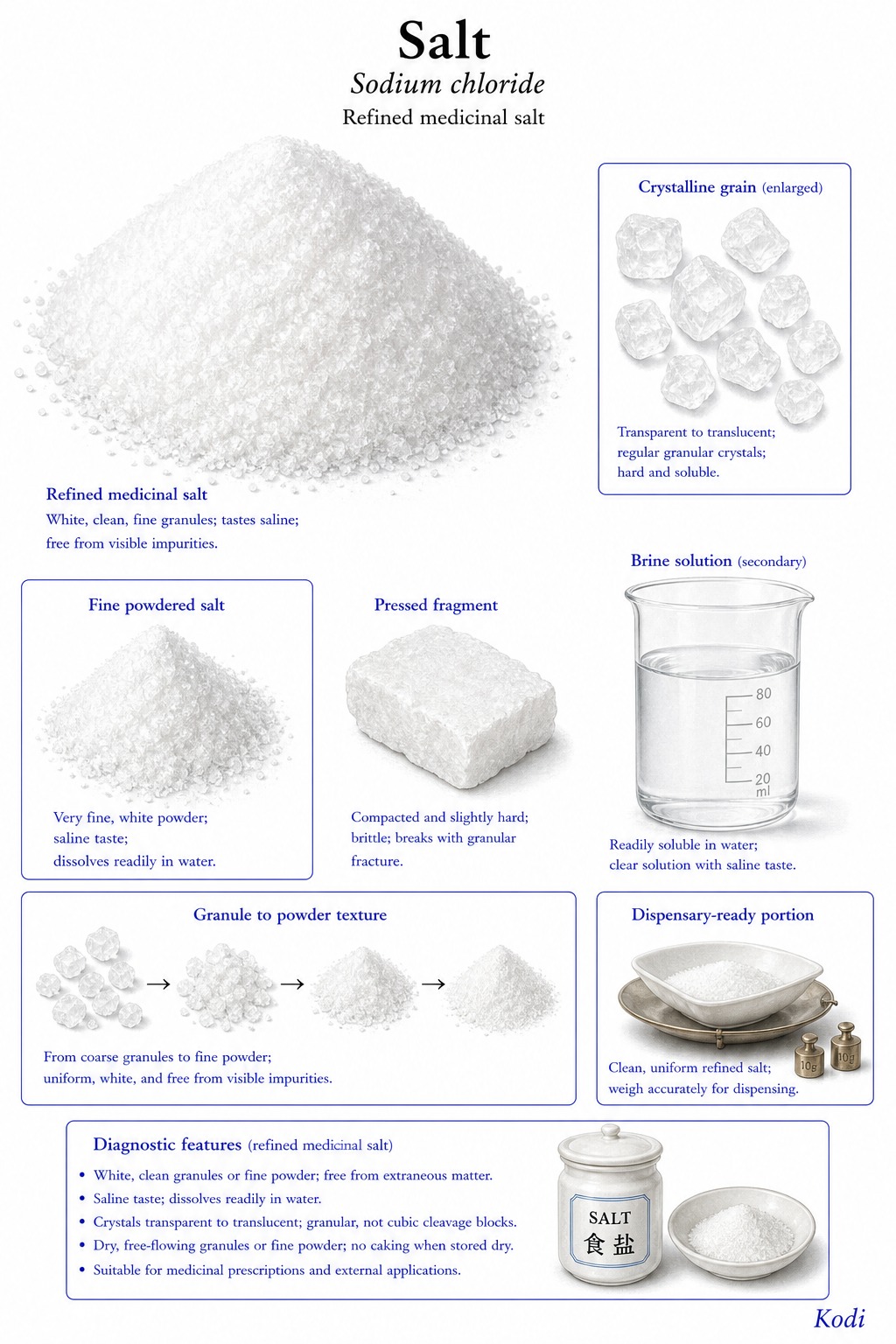
Known in TCM as Shi Yan (食盐), this salty, cold herb enters the Stomach, Kidney, and Large Intestine. Traditionally, it induces vomiting of retained food, phlegm, or certain ingested toxins when used as concentrated salt water ... this is the classic internal Shi Yan lane and is not a casual household remedy, most often applied for sore throat, oral ulcers, and constipation. Modern research has identified Sodium among its active constituents.
Part used: Sodium salt
Also Known As
Latin: Natrii Chloridum | Pinyin: Shi Yan | Chinese: 食盐
TCM Properties
- Taste
- salty
- Temperature
- cold
- Channels
- Stomach, Kidney, Large Intestine
Traditional Use
Primary Actions
- Induces vomiting of retained food, phlegm, or certain ingested toxins when used as concentrated salt water ... this is the classic internal Shi Yan lane and is not a casual household remedy.
- Clears heat and relieves fire-toxic irritation externally ... salt rinses, washes, and powders are recorded for sore throat, mouth ulcers, gum swelling, and some superficial inflammatory complaints.
- Moistens dryness and softens hardness ... small measured use appears in heat-type constipation and in formulas where a salty downward-directing substance is wanted.
Secondary Actions
- This page covers refined medicinal salt `Shi Yan`, distinct from the crude rock-salt and halite lane already represented under `halite`.
- Shi Yan is also important as a processing adjunct because salt-frying is traditionally used to guide certain herbs more strongly toward the Kidneys.
Classic Formulas
- Concentrated salt-water emetic methods ... older emergency practice for retained food, phlegm, or swallowed toxins before modern poison-control standards existed.
- Salt-rinse and salt-powder external methods ... long-standing local-use traditions for throat, mouth, gum, and dental complaints.
- Salt-processing of Kidney-directed medicinals ... a classic preparation strategy rather than a stand-alone formula, but central to Shi Yan's clinical identity.
Classical References
- Classical materia medica places Shi Yan among the emetic and fire-clearing substances, emphasizing vomiting induction, softening, and local cleansing rather than tonic use.
- Later materia medica traditions preserve numerous external applications for teeth, throat, eyes, and sores, reinforcing that medicinal salt was often used topically or in carefully measured doses.
- Processing theory repeatedly states that salt helps direct medicinals toward the Kidney channel, which is one reason Shi Yan remains important beyond its own stand-alone indications.
Modern Research
Active Compounds
- Sodium chloride ... the dominant crystalline component responsible for salinity and osmotic effect
- Trace calcium, magnesium, and potassium salts ... minor mineral fractions that vary by source and refinement
- Purified crystalline mineral matrix ... the defining identity of refined medicinal salt rather than a complex botanical chemistry
Studied Effects
- Direct PubMed-indexed research on Shi Yan as a distinct TCM medicinal is sparse, and modern biomedical literature instead focuses on sodium physiology, fluid balance, and the health effects of excess salt intake.
- The most plausible modern bridge for traditional external use is local osmotic cleansing and mucosal rinsing, but that remains a functional inference rather than a robust herb-specific evidence base.
- Because refined medicinal salt is chemically simple, modern discussion is more about dose, route, and safety than about discovering a unique herb-like pharmacologic signature.
Safety & Interactions
Contraindications
- Severe edema, uncontrolled hypertension, or states requiring strict sodium restriction
- Kidney failure or severe fluid-retention disorders
- Unsupervised self-induced vomiting
Cautions
- Medicinal Shi Yan is not a license for unrestricted dietary salt use, and excessive sodium intake can aggravate hypertension, renal disease, and swelling.
- The classic emetic use is the riskiest part of this record and should be treated as historical clinician-guided practice, not as home first aid.
- Topical saline-style use is generally far safer than internal high-dose use.
Drug Interactions
- Lithium ... major shifts in sodium intake can alter renal lithium handling and destabilize serum levels
Conditions
- Sore Throat Traditional ★★★☆☆ JSON
- Oral Ulcers Traditional ★★★☆☆ JSON
- Constipation Traditional ★★☆☆☆ JSON
Frequently Asked Questions
What is Salt used for?
Salt is traditionally used to Induces vomiting of retained food, phlegm, or certain ingested toxins when used as concentrated salt water ... this is the classic internal Shi Yan lane and is not a casual household remedy., Clears heat and relieves fire-toxic irritation externally ... salt rinses, washes, and powders are recorded for sore throat, mouth ulcers, gum swelling, and some superficial inflammatory complaints., Moistens dryness and softens hardness ... small measured use appears in heat-type constipation and in formulas where a salty downward-directing substance is wanted.. Research has investigated its effects on: Direct PubMed-indexed research on Shi Yan as a distinct TCM medicinal is sparse, and modern biomedical literature instead focuses on sodium physiology, fluid balance, and the health effects of excess salt intake.; The most plausible modern bridge for traditional external use is local osmotic cleansing and mucosal rinsing, but that remains a functional inference rather than a robust herb-specific evidence base..
What are other names for Salt?
Salt is also known as Edible Salt, Common Salt. In TCM: 食盐 (Shi Yan); Natrii Chloridum.
Is Salt safe during pregnancy?
The safety of Salt during pregnancy has not been established. Consult a qualified healthcare provider before use.
What are the contraindications for Salt?
Salt should not be used in: Severe edema, uncontrolled hypertension, or states requiring strict sodium restriction; Kidney failure or severe fluid-retention disorders; Unsupervised self-induced vomiting. Consult a qualified healthcare provider before use.
Does Salt interact with any medications?
Salt may interact with: Lithium ... major shifts in sodium intake can alter renal lithium handling and destabilize serum levels. Always inform your healthcare provider of any herbal supplements you are taking.