Crude Sal Ammoniac
- Chinese
- 硇砂
- Pinyin
- Nao Sha
- Latin
- Sal Ammoniaci
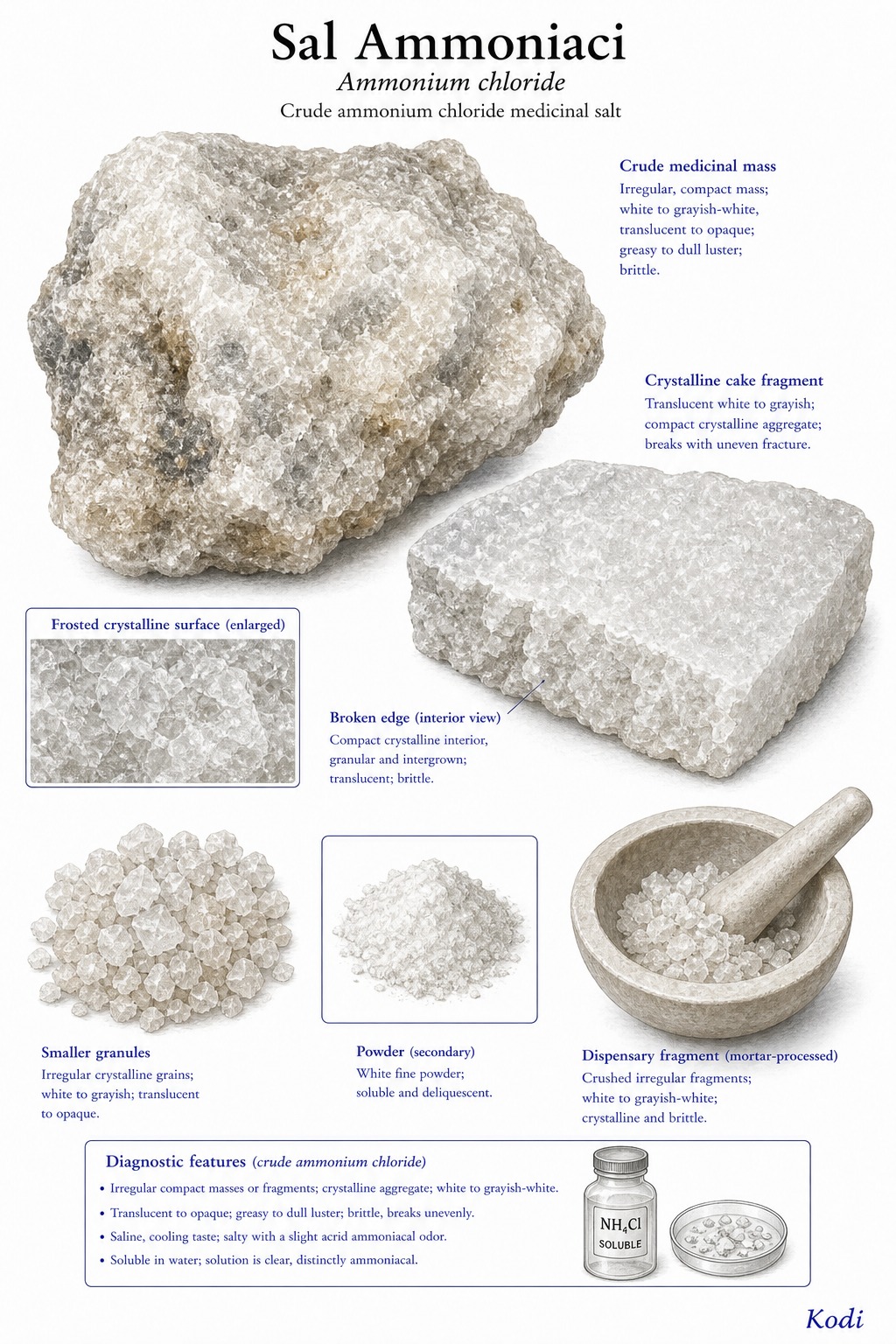
Known in TCM as Nao Sha (硇砂), this salty and bitter, warm herb enters the Liver, Spleen, and Stomach. Traditionally, it dissolves phlegm and softens hardness ... crude Nao Sha belongs to an old harsh mineral lane used for stubborn phlegm, nodules, and obstructive masses rather than for gentle daily tonification, most often applied for phlegm accumulation, productive cough, and thyroid nodule. Modern research has identified Ammonium among its active constituents.
Part used: Salt
Also Known As
Latin: Sal Ammoniaci | Pinyin: Nao Sha | Chinese: 硇砂
TCM Properties
- Taste
- salty, bitter
- Temperature
- warm
- Channels
- Liver, Spleen, Stomach
Traditional Use
Primary Actions
- Dissolves phlegm and softens hardness ... crude Nao Sha belongs to an old harsh mineral lane used for stubborn phlegm, nodules, and obstructive masses rather than for gentle daily tonification.
- Breaks focal obstruction and disperses accumulation ... older formula traditions apply it in minute quantities when food stagnation, phlegm, and epigastric blockage are unusually stubborn.
- Opens difficult swallowing and obstructive throat patterns in older specialty use ... this is part of the same penetrating, dissolving identity.
- Appears in external corrosive applications for warts and thick lesions ... a reminder that this substance was never treated as a mild kitchen-like salt.
Secondary Actions
- This page stays on the rougher, denser, less-purified crude Nao Sha lane rather than the cleaner refined `Xi Sha` sibling.
- Traditional logic around Nao Sha is inseparable from purification, minute dosing, and clinician control ... exactly the opposite of casual self-prescribing.
Classic Formulas
- Xi Sha San and related obstruction-dissolving powder traditions ... older formulas use ammonium-chloride mineral material for difficult phlegm and blockage patterns.
- Minute-dose phlegm and mass-dispersing combinations with Ban Xia or other transforming substances ... highly specialized use rather than routine prescribing.
- Historical external applications for corrosive lesion work ... a traditional lane that requires real caution.
Classical References
- Older materia medica treats Nao Sha as sharp, penetrating, and potentially corrosive, emphasizing that processing and dose are safety-critical.
- The substance's traditional reputation depends on dissolving, softening, and opening blocked patterns, not on nourishment or harmony.
Modern Research
Active Compounds
- Ammonium chloride ... the principal active chemical entity behind both medicinal and adverse effects
- Ammonium ion and chloride fraction ... relevant to systemic acidifying and expectorant behavior
- Crude-material impurities and variable refinement ... one reason the historical mineral record should not be treated like a standardized modern pharmaceutical
Studied Effects
- A 1980 review on tracheobronchial function discussed mucolytic substances including ammonium chloride, supporting the long-standing pharmaceutical rationale for an expectorant effect (PMID 7221201).
- A 1979 case report showed ammonium chloride's use in treating alkalosis, illustrating that systemic acidifying effects are clinically real and not merely theoretical (PMID 436363).
- A 2021 randomized trial studied ammonium chloride as an adjunct in COVID-19 care, reminding us that indexed modern evidence concerns pharmaceutical ammonium chloride broadly rather than this crude TCM-grade mineral distinction (PMID 33878462).
PubMed References
- Tracheobronchial function in health and disease. Effect of mucolytic substances. (1980)
- Treatment of alkalosis with ammonium chloride: a case report. (1979)
- Effect of Ammonium Chloride in addition to standard of care in outpatients and hospitalized COVID-19 patients: A randomized clinical trial. (2021)
Safety & Interactions
Contraindications
- Pregnancy
- Peptic ulcer disease or irritated gastrointestinal mucosa
- Kidney or liver impairment
- Metabolic acidosis or severe respiratory compromise
Cautions
- Crude Nao Sha is a harsh mineral substance with corrosive potential and should not be treated like an ordinary expectorant salt.
- Traditional internal use depends on very small doses and proper processing.
- Modern pharmaceutical data on ammonium chloride do not make crude historical material safe for home experimentation.
Conditions
- Phlegm Accumulation Traditional ★★☆☆☆ JSON
- Productive Cough Research ★★☆☆☆ JSON
- Thyroid Nodule Traditional ★☆☆☆☆ JSON
- Nausea Traditional ★☆☆☆☆ JSON
Frequently Asked Questions
What is Crude Sal Ammoniac used for?
Crude Sal Ammoniac is traditionally used to Dissolves phlegm and softens hardness ... crude Nao Sha belongs to an old harsh mineral lane used for stubborn phlegm, nodules, and obstructive masses rather than for gentle daily tonification., Breaks focal obstruction and disperses accumulation ... older formula traditions apply it in minute quantities when food stagnation, phlegm, and epigastric blockage are unusually stubborn., Opens difficult swallowing and obstructive throat patterns in older specialty use ... this is part of the same penetrating, dissolving identity., Appears in external corrosive applications for warts and thick lesions ... a reminder that this substance was never treated as a mild kitchen-like salt.. Research has investigated its effects on: A 1980 review on tracheobronchial function discussed mucolytic substances including ammonium chloride, supporting the long-standing pharmaceutical rationale for an expectorant effect (PMID 7221201).; A 1979 case report showed ammonium chloride's use in treating alkalosis, illustrating that systemic acidifying effects are clinically real and not merely theoretical (PMID 436363)..
What are other names for Crude Sal Ammoniac?
Crude Sal Ammoniac is also known as Nao Sha, Crude Ammonium Chloride, Sal Ammoniac. In TCM: 硇砂 (Nao Sha); Sal Ammoniaci.
Is Crude Sal Ammoniac safe during pregnancy?
Crude Sal Ammoniac is not recommended during pregnancy.
What are the contraindications for Crude Sal Ammoniac?
Crude Sal Ammoniac should not be used in: Pregnancy; Peptic ulcer disease or irritated gastrointestinal mucosa; Kidney or liver impairment; Metabolic acidosis or severe respiratory compromise. Consult a qualified healthcare provider before use.