Saffron
- Chinese
- 西红花
- Pinyin
- Xi Hong Hua
- Latin
- Stigma Croci
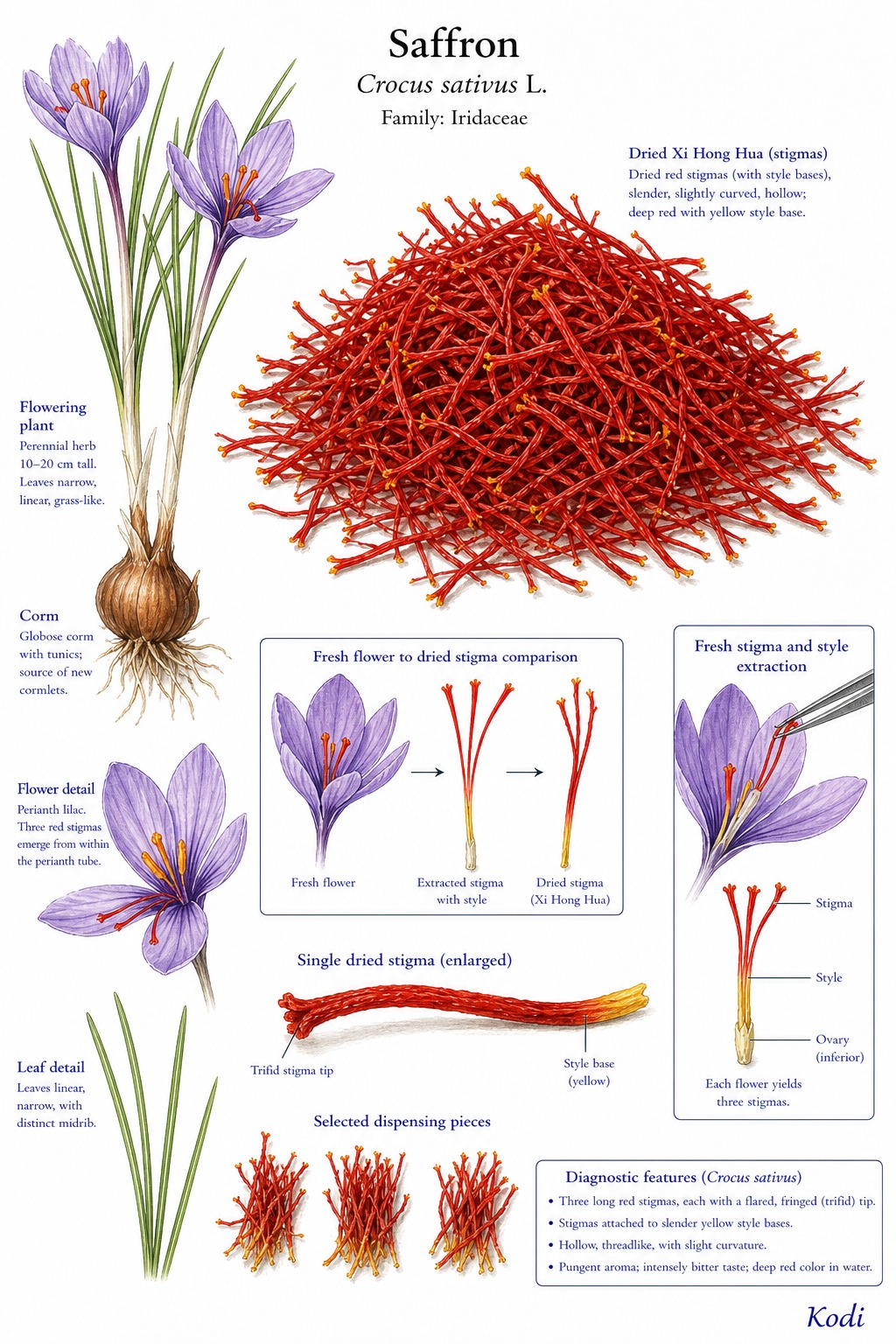
Known in TCM as Xi Hong Hua (西红花), this sweet, neutral herb enters the Heart and Liver. Traditionally, it invigorates Blood and dispels stasis ... Xi Hong Hua is used for painful menstruation, dark clotting, and fixed stasis patterns where a finer more precious blood-moving material is desired, most often applied for depression, dysmenorrhea, and amenorrhea. Modern research has identified Crocin among its active constituents.
Part used: Stigma
Also Known As
Latin: Stigma Croci | Pinyin: Xi Hong Hua | Chinese: 西红花
TCM Properties
- Taste
- sweet
- Temperature
- neutral
- Channels
- Heart, Liver
Traditional Use
Primary Actions
- Invigorates Blood and dispels stasis ... Xi Hong Hua is used for painful menstruation, dark clotting, and fixed stasis patterns where a finer more precious blood-moving material is desired.
- Relieves constrained mood and opens the chest-Heart axis ... traditional and modern Chinese use both connect saffron with stagnation, irritability, and emotional oppression.
- Cools Blood and reduces depressed heat within stasis patterns ... this helps distinguish it from the warmer, rougher Hong Hua safflower lane.
- Supports trauma and collateral-opening use in smaller precise doses ... it is potent by reputation even when the physical dose looks tiny.
Secondary Actions
- This page must stay separate from safflower ... both are sold under Hong Hua-type naming, but Xi Hong Hua is the true saffron stigma lane and not a floral substitute.
- Modern supplement culture often overgeneralizes saffron as a mood product, but the traditional identity remains rooted in Blood movement and constrained-heat relief.
Classic Formulas
- Blood-stasis menstrual pairings with Dang Gui, Chi Shao, or Dan Shen ... used when stasis and emotional constraint overlap.
- Mood-constriction combinations with Yu Jin or He Huan Pi ... a traditional-modern bridge when depression-like stagnation coexists with Blood stasis.
- Fine trauma and stasis formulas where a small amount of saffron is chosen for quality over bulk.
Classical References
- Traditional Chinese use treats Xi Hong Hua as a precious imported blood-moving flower material distinct from ordinary Hong Hua safflower.
- Its Heart-Liver emphasis explains the recurring connection between Blood stasis, mood constraint, and menstrual pain.
Modern Research
Active Compounds
- Crocin ... the best-known saffron carotenoid glycoside in modern neuropsychologic and antioxidant research
- Crocetin ... major apocarotenoid linked to circulation and anti-inflammatory interest
- Safranal and picrocrocin ... key volatile and bitter constituents contributing to aroma and quality
Studied Effects
- A 2010 comprehensive review of Crocus sativus summarized saffron's chemistry, traditional use, and wide-ranging pharmacology interest, establishing a strong baseline for the modern evidence base (PMID 22228962).
- A 2021 evidence-mapping review of saffron and health outcomes found a large but uneven literature, with the strongest human interest clustering around mood, metabolic, and inflammatory outcomes (PMID 34419735).
- A 2014 systematic review of clinical studies on saffron for depression highlighted one of the most mature modern human-research lanes for Xi Hong Hua (PMID 25384672).
PubMed References
- Crocus sativus L.: A comprehensive review. (2010)
- Saffron (Crocus sativus L.) and health outcomes: a meta-research review of meta-analyses and an evidence mapping study. (2021)
- Saffron (Crocus sativus) for depression: a systematic review of clinical studies and examination of underlying antidepressant mechanisms of action. (2014)
Safety & Interactions
Contraindications
- Pregnancy
- Active bleeding without stasis
Cautions
- Authentic saffron is potent, expensive, and commonly adulterated, so sourcing is a real clinical issue.
- Mood-related supplement claims should not hide the fact that Xi Hong Hua is still a blood-moving medicinal material.
Conditions
- Depression Research ★★★☆☆ JSON
- Dysmenorrhea Traditional ★★★☆☆ JSON
- Amenorrhea Traditional ★★☆☆☆ JSON
- Chest Pain Traditional ★★☆☆☆ JSON
- Menstrual Irregularities Traditional ★★☆☆☆ JSON
Frequently Asked Questions
What is Saffron used for?
Saffron is traditionally used to Invigorates Blood and dispels stasis ... Xi Hong Hua is used for painful menstruation, dark clotting, and fixed stasis patterns where a finer more precious blood-moving material is desired., Relieves constrained mood and opens the chest-Heart axis ... traditional and modern Chinese use both connect saffron with stagnation, irritability, and emotional oppression., Cools Blood and reduces depressed heat within stasis patterns ... this helps distinguish it from the warmer, rougher Hong Hua safflower lane., Supports trauma and collateral-opening use in smaller precise doses ... it is potent by reputation even when the physical dose looks tiny.. Research has investigated its effects on: A 2010 comprehensive review of Crocus sativus summarized saffron's chemistry, traditional use, and wide-ranging pharmacology interest, establishing a strong baseline for the modern evidence base (PMID 22228962).; A 2021 evidence-mapping review of saffron and health outcomes found a large but uneven literature, with the strongest human interest clustering around mood, metabolic, and inflammatory outcomes (PMID 34419735)..
What are other names for Saffron?
Saffron is also known as Xi Hong Hua, Crocus Stigma, Saffron Stigma. In TCM: 西红花 (Xi Hong Hua); Stigma Croci.
Is Saffron safe during pregnancy?
Saffron is not recommended during pregnancy.
What are the contraindications for Saffron?
Saffron should not be used in: Pregnancy; Active bleeding without stasis. Consult a qualified healthcare provider before use.