Royal Jelly
- Chinese
- 蜂王浆
- Pinyin
- Feng Wang Jiang
- Latin
- Lac Regis Apis
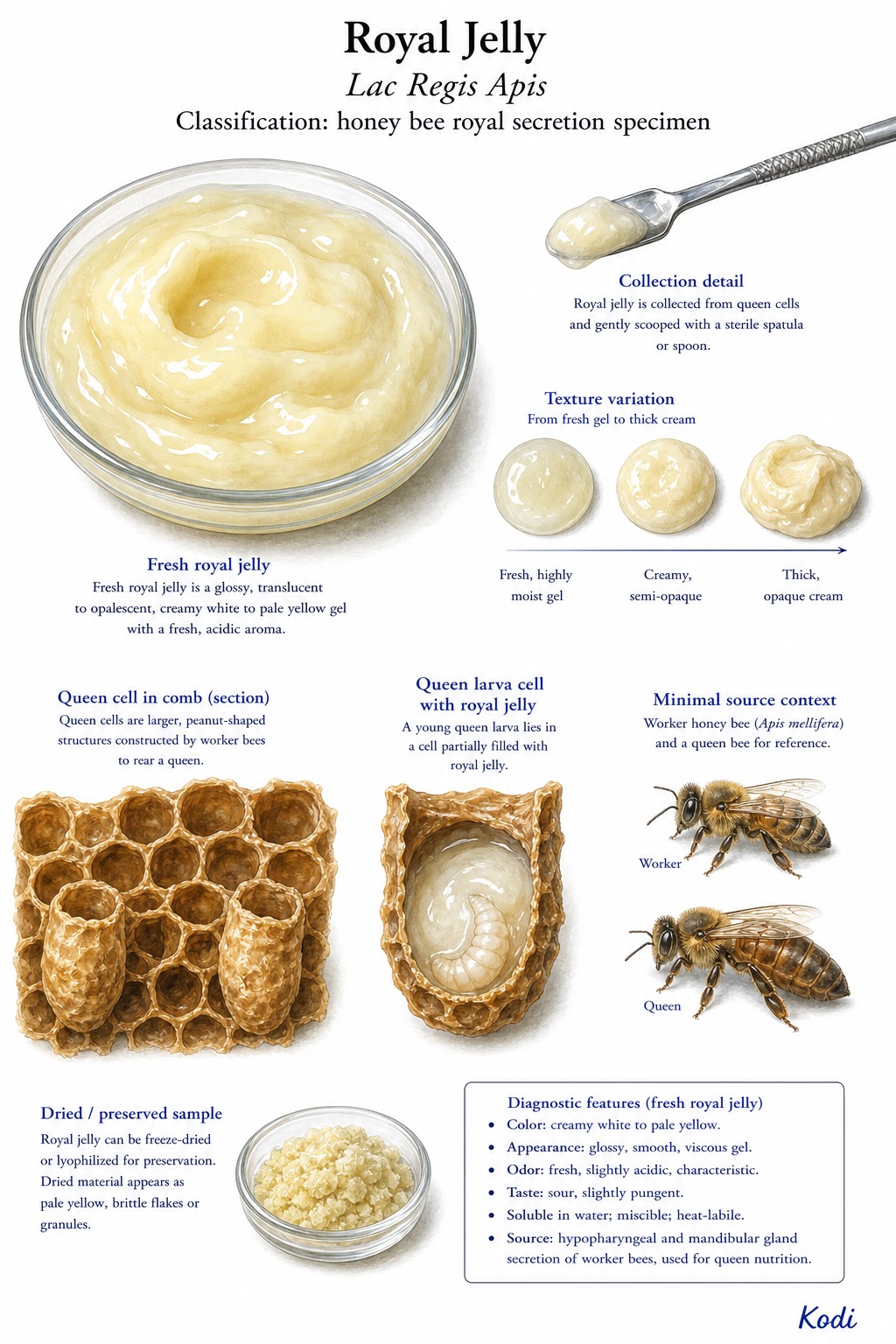
Known in TCM as Feng Wang Jiang (蜂王浆), this sweet, neutral herb enters the Lung, Spleen, and Kidney. Traditionally, it used in modern Chinese health-food and apitherapy traditions to supplement weakness and support recovery ... royal jelly is treated more as a nutritive tonic substance than as a classical decoction herb, most often applied for fatigue, menopausal symptoms, and immune deficiency. Modern research has identified Major among its active constituents.
Part used: Milk/Secretion
Also Known As
Latin: Lac Regis Apis | Pinyin: Feng Wang Jiang | Chinese: 蜂王浆
TCM Properties
- Taste
- sweet
- Temperature
- neutral
- Channels
- Lung, Spleen, Kidney
Traditional Use
Primary Actions
- Used in modern Chinese health-food and apitherapy traditions to supplement weakness and support recovery ... royal jelly is treated more as a nutritive tonic substance than as a classical decoction herb.
- Supports fluids and tissue repair in household and topical use ... oral and skin applications are part of its broader restorative reputation.
- Associated with vitality, reproductive support, and age-related depletion in contemporary use ... these claims are common in modern materia-medica discussion, though not all are strongly validated.
- Functions more like a modern bee-derived tonic material than like a classical ben cao root, bark, or flower.
Secondary Actions
- This page reflects modern Chinese medicinal-food usage and apitherapy language rather than a major Zhang Zhongjing or Shen Nong Ben Cao Jing formula tradition.
- The strongest real-world safety issue is allergy and anaphylaxis ... not simply whether the pattern is warm, cold, excess, or deficient.
Classic Formulas
- Royal jelly is not a standard classical decoction ingredient ... it is more often taken directly, mixed into modern tonics, or used in topical preparations.
- Contemporary combinations with honey, bee pollen, or propolis belong to modern health-product practice rather than to canonical TCM formulas.
- External use for minor oral or skin lesions is mostly a household or apitherapy extension rather than a named classical prescription tradition.
Classical References
- Modern Chinese materia medica and apitherapy writing treat royal jelly as a nutritive restorative material more than as a traditional core herbal drug.
- Because it is a bee secretion rather than a plant part, identity, freshness, and contamination control matter here as much as pattern theory.
Modern Research
Active Compounds
- Major royal jelly proteins ... the dominant protein fraction behind much immunologic and nutraceutical interest
- 10-HDA and related fatty acids ... signature constituents repeatedly used as quality markers
- Peptides, amino acids, vitamins, and trace minerals ... supportive nutritive components in the broader royal-jelly profile
Studied Effects
- A 2024 review summarized royal jelly's biological actions and health benefits, including reproductive, liver, kidney, and wound-healing interest, while also keeping the discussion largely in mixed clinical and preclinical territory (PMID 38892209).
- A 2025 systematic review and meta-analysis found that royal-jelly consumption can influence inflammation and oxidative-stress markers, but the evidence base remains heterogeneous and product-dependent (PMID 40656618).
- A 2021 review highlighted the health-promoting properties of bee royal jelly and its continuing relevance in Chinese medicine and apitherapy contexts (PMID 33562330).
PubMed References
Safety & Interactions
Contraindications
- Known allergy to bee products
- History of asthma, anaphylaxis, or severe atopic reactions to bee-derived materials
Cautions
- Royal jelly can trigger serious allergic reactions including anaphylaxis in susceptible people.
- Powders, capsules, fresh jelly, and blended energy products are not interchangeable in dose, purity, or risk profile.
- Modern marketing claims often run far ahead of the strongest clinical evidence.
Conditions
- Fatigue Traditional ★★☆☆☆ JSON
- Menopausal Symptoms Research ★★☆☆☆ JSON
- Immune Deficiency Traditional ★☆☆☆☆ JSON
- Oral Ulcers Traditional ★☆☆☆☆ JSON
Frequently Asked Questions
What is Royal Jelly used for?
Royal Jelly is traditionally used to Used in modern Chinese health-food and apitherapy traditions to supplement weakness and support recovery ... royal jelly is treated more as a nutritive tonic substance than as a classical decoction herb., Supports fluids and tissue repair in household and topical use ... oral and skin applications are part of its broader restorative reputation., Associated with vitality, reproductive support, and age-related depletion in contemporary use ... these claims are common in modern materia-medica discussion, though not all are strongly validated., Functions more like a modern bee-derived tonic material than like a classical ben cao root, bark, or flower.. Research has investigated its effects on: A 2024 review summarized royal jelly's biological actions and health benefits, including reproductive, liver, kidney, and wound-healing interest, while also keeping the discussion largely in mixed clinical and preclinical territory (PMID 38892209).; A 2025 systematic review and meta-analysis found that royal-jelly consumption can influence inflammation and oxidative-stress markers, but the evidence base remains heterogeneous and product-dependent (PMID 40656618)..
What are other names for Royal Jelly?
Royal Jelly is also known as Royal Bee Jelly, Feng Wang Jiang, Feng Ru. In TCM: 蜂王浆 (Feng Wang Jiang); Lac Regis Apis.
Is Royal Jelly safe during pregnancy?
The safety of Royal Jelly during pregnancy has not been established. Consult a qualified healthcare provider before use.
What are the contraindications for Royal Jelly?
Royal Jelly should not be used in: Known allergy to bee products; History of asthma, anaphylaxis, or severe atopic reactions to bee-derived materials. Consult a qualified healthcare provider before use.