Round Cardamom Capsule
- Chinese
- 豆蔻
- Pinyin
- Dou Kou
- Latin
- Fructus Amomi Rotundus
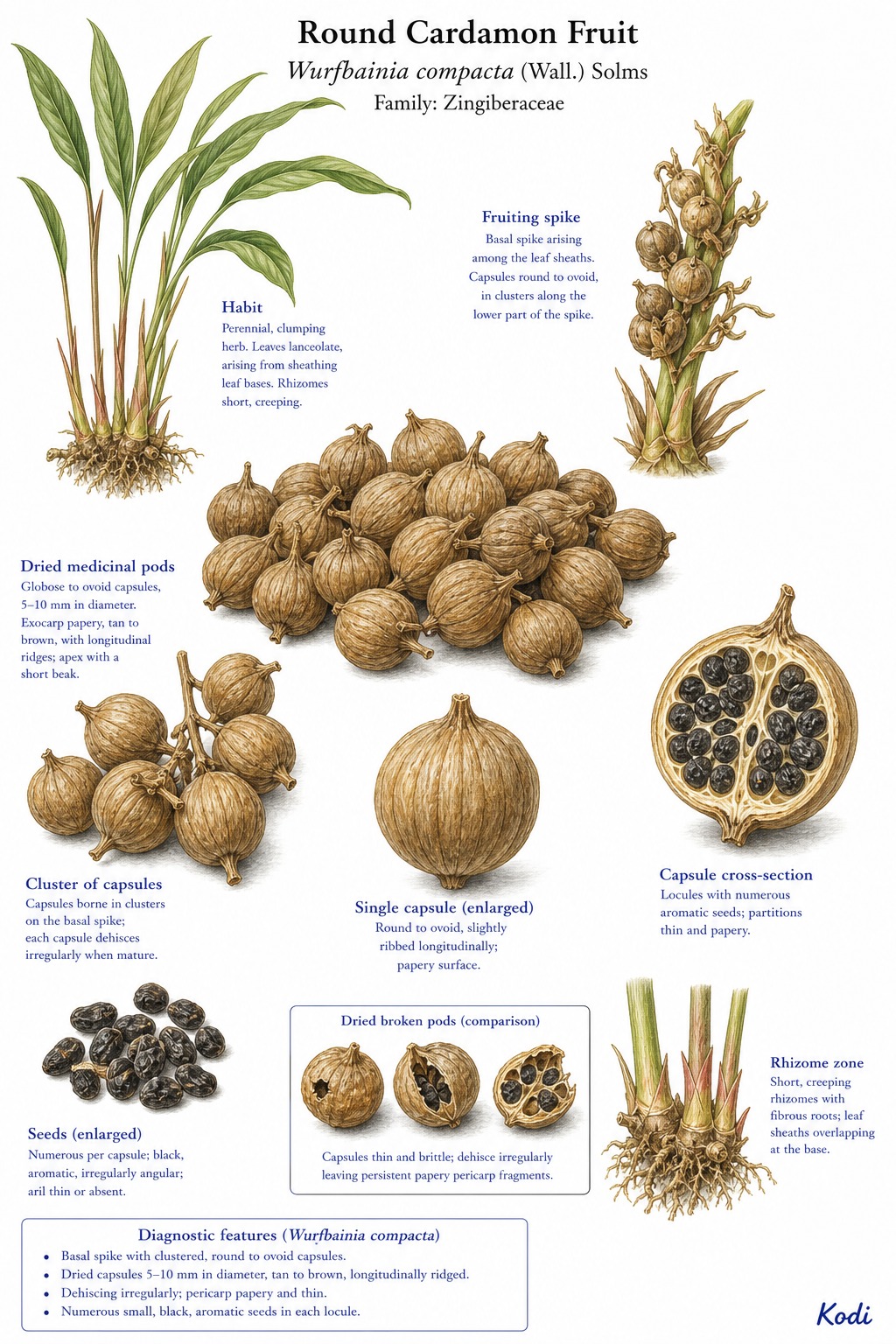
Known in TCM as Dou Kou (豆蔻), this pungent and aromatic, warm herb enters the Lung, Spleen, and Stomach. Traditionally, it transforms dampness and awakens the Spleen ... Dou Kou is used for heavy epigastric fullness, poor appetite, and middle-burner stagnation with a greasy obstructive feel, most often applied for nausea, abdominal distension, and poor appetite. Modern research has identified 1,8-Cineole among its active constituents.
Part used: Fruit
Also Known As
Latin: Fructus Amomi Rotundus | Pinyin: Dou Kou | Chinese: 豆蔻
TCM Properties
- Taste
- pungent, aromatic
- Temperature
- warm
- Channels
- Lung, Spleen, Stomach
Traditional Use
Primary Actions
- Transforms dampness and awakens the Spleen ... Dou Kou is used for heavy epigastric fullness, poor appetite, and middle-burner stagnation with a greasy obstructive feel.
- Moves Qi and relieves fullness ... the aromatic capsules are chosen when the chest or upper abdomen feels blocked, swollen, or turbid with dampness.
- Warms the Stomach and stops vomiting ... nausea, retching, and cold-damp digestive upset are classic indications.
- Treats early damp-warmth with damp predominance ... it is used when heaviness, fullness, and appetite loss outweigh strong fever signs.
Secondary Actions
- This page keeps the shorter `Dou Kou` medicinal-capsule lane distinct from the already-live `fruit-of-round-cardamon` / `Bai Dou Kou` page by emphasizing the dispensing pod lot rather than the broader source-plant portrait.
- It should also stay separate from `Hong Dou Kou` and `Cao Dou Kou` ... the names overlap enough to cause real confusion, but their medicinal emphasis is not identical.
Classic Formulas
- San Ren Tang ... a classic damp-warmth formula that uses aromatic Dou Kou to open the middle and transform dampness.
- Digestive damp-obstruction combinations with Huo Xiang, Chen Pi, or Sha Ren ... used when nausea, poor appetite, and fullness dominate.
- Cold-damp middle-burner formulas with Hou Po or Gan Jiang ... used when the Stomach is heavy, cool, and vomiting-prone.
Classical References
- Traditional herbology consistently treats Dou Kou as a warm aromatic middle-burner herb whose effect depends on preserving volatile oils.
- The medicated part is the aromatic capsule lot itself, which is why crushing and late addition in decoction are common handling instructions.
Modern Research
Active Compounds
- 1,8-Cineole ... a major volatile constituent in modern Amomi Fructus Rotundus analysis
- Beta-pinene and alpha-pinene ... prominent aromatic terpenes in essential-oil profiling
- D-limonene and related volatile compounds ... supportive constituents behind fragrance and current pharmacology interest
Studied Effects
- A 2026 GC-MS study of Amomi Fructus Rotundus essential oil identified 32 compounds and linked the oil to anti-gastritis and antibacterial activity in preclinical work (PMID 41918280).
- A 2023 study found that 1,8-cineole, a major volatile from Amomum compactum, reduced experimental colon injury through anti-inflammatory signaling effects, supporting modern interest in the herb's aromatic fraction (PMID 37842654).
- A 2022 volatilomics and in silico study of Indonesian Zingiberaceae spices highlighted antioxidant and antidiabetic candidate compounds in Amomum compactum, showing how much of the current literature still sits in chemistry and preclinical space (PMID 35342880).
PubMed References
- Chemical Composition Analysis of Amomi Fructus Rotundus Essential Oil at Different States by GC-MS and Its Anti-Gastritis Mechanism and Antibacterial Activity Based on Network Pharmacology and Molecular Docking. (2026)
- 1,8-cineole ameliorates colon injury by downregulating macrophage M1 polarization via inhibiting the HSP90-NLRP3-SGT1 complex. (2023)
- Antioxidant and antidiabetic compounds identification in several Indonesian underutilized Zingiberaceae spices using SPME-GC/MS-based volatilomics and in silico methods. (2022)
Safety & Interactions
Contraindications
- Yin deficiency or dryness-heat without cold-damp or Qi stagnation
- Vomiting caused by clear excess heat rather than damp-cold Stomach disharmony
Cautions
- Because Dou Kou depends on volatile oils, excessive simmering weakens the herb and invites unnecessary overuse.
- Culinary spice, essential oil, and decoction use are not interchangeable in potency or safety.
Conditions
- Nausea Traditional ★★★★☆ JSON
- Abdominal Distension Traditional ★★★★☆ JSON
- Poor Appetite Traditional ★★★☆☆ JSON
- Dyspepsia Traditional ★★★☆☆ JSON
- Acid Reflux Traditional ★★☆☆☆ JSON
Frequently Asked Questions
What is Round Cardamom Capsule used for?
Round Cardamom Capsule is traditionally used to Transforms dampness and awakens the Spleen ... Dou Kou is used for heavy epigastric fullness, poor appetite, and middle-burner stagnation with a greasy obstructive feel., Moves Qi and relieves fullness ... the aromatic capsules are chosen when the chest or upper abdomen feels blocked, swollen, or turbid with dampness., Warms the Stomach and stops vomiting ... nausea, retching, and cold-damp digestive upset are classic indications., Treats early damp-warmth with damp predominance ... it is used when heaviness, fullness, and appetite loss outweigh strong fever signs.. Research has investigated its effects on: A 2026 GC-MS study of Amomi Fructus Rotundus essential oil identified 32 compounds and linked the oil to anti-gastritis and antibacterial activity in preclinical work (PMID 41918280).; A 2023 study found that 1,8-cineole, a major volatile from Amomum compactum, reduced experimental colon injury through anti-inflammatory signaling effects, supporting modern interest in the herb's aromatic fraction (PMID 37842654)..
What are other names for Round Cardamom Capsule?
Round Cardamom Capsule is also known as Dou Kou, Amomi Rotundus Capsule, Wurfbainia compacta Capsule. In TCM: 豆蔻 (Dou Kou); Fructus Amomi Rotundus.
Is Round Cardamom Capsule safe during pregnancy?
The safety of Round Cardamom Capsule during pregnancy has not been established. Consult a qualified healthcare provider before use.
What are the contraindications for Round Cardamom Capsule?
Round Cardamom Capsule should not be used in: Yin deficiency or dryness-heat without cold-damp or Qi stagnation; Vomiting caused by clear excess heat rather than damp-cold Stomach disharmony. Consult a qualified healthcare provider before use.