Rugosa Rosebud
- Chinese
- 玫瑰花
- Pinyin
- Mei Gui Hua
- Latin
- Flos Rosae Rugosae
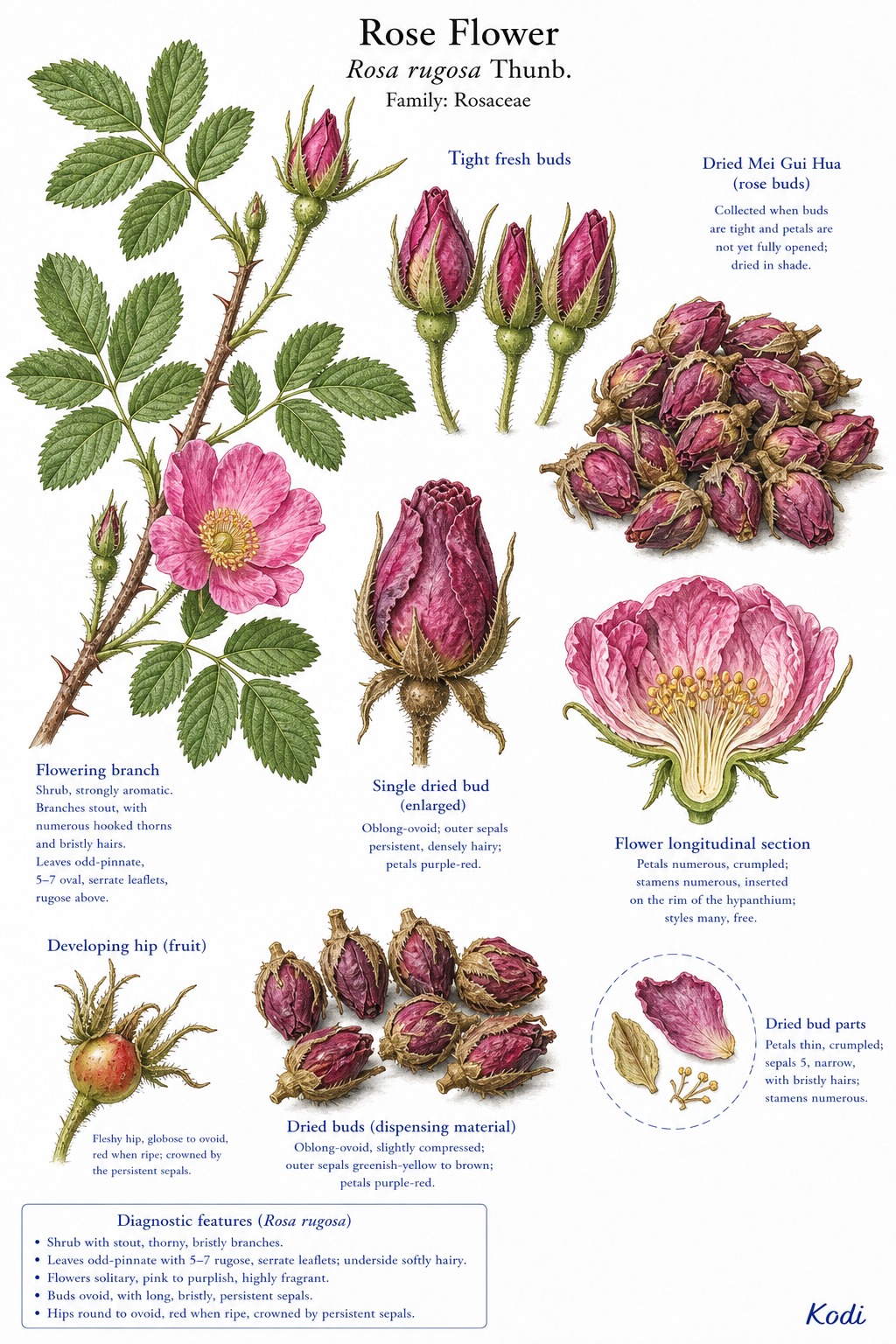
Known in TCM as Mei Gui Hua (玫瑰花), this sweet and slightly bitter, warm herb enters the Liver and Spleen. Traditionally, it soothes the Liver and regulates Qi ... Mei Gui Hua is chosen for emotional constraint, chest or hypochondriac tightness, and digestive discomfort arising from stagnant Liver Qi, most often applied for liver qi stagnation, dysmenorrhea, and poor appetite. Modern research has identified Flavonoids among its active constituents.
Part used: Flower
Also Known As
Latin: Flos Rosae Rugosae | Pinyin: Mei Gui Hua | Chinese: 玫瑰花
TCM Properties
- Taste
- sweet, slightly bitter
- Temperature
- warm
- Channels
- Liver, Spleen
Traditional Use
Primary Actions
- Soothes the Liver and regulates Qi ... Mei Gui Hua is chosen for emotional constraint, chest or hypochondriac tightness, and digestive discomfort arising from stagnant Liver Qi.
- Harmonizes Blood and gently regulates menstruation ... it is used for mild dysmenorrhea, irregular flow, and breast discomfort when Qi stagnation is the main driver rather than heavy fixed stasis.
- Awakens the Spleen and improves appetite ... floral aromatics give it a useful role in poor appetite, nausea, and fullness linked to emotional tension and weak middle-burner movement.
- Relieves mild pain and swelling in constrained patterns ... breast tenderness and light stagnant discomfort are classic extensions of the same Qi-regulating lane.
Secondary Actions
- This page must stay distinct from the already-live `chinese-rose-flower` / Yue Ji Hua sibling ... Mei Gui Hua is gentler and more Qi-regulating, while Yue Ji Hua is the more overtly blood-moving flower.
- The medicinal material is the dried rugosa rosebud rather than a decorative open-blossom display bloom.
Classic Formulas
- Liver-Qi stagnation tea and powder traditions with Xiang Fu, Fo Shou, or Chen Pi ... classic gentle use for constrained digestion and mood-related tension.
- Menstrual-comfort combinations with Dang Gui and Bai Shao ... used when mild pain and irregularity arise from constrained Qi with secondary blood disharmony.
- Breast and chest constraint pairings with Qing Pi or Ju He ... selected when tenderness and distending discomfort outweigh obvious heat or severe stasis.
Classical References
- Traditional herbology places Mei Gui Hua among fragrant flowers that course Liver Qi, harmonize Blood, and wake the middle rather than among the stronger blood-breaking medicinals.
- Its classical comparison with Yue Ji Hua is clinically useful ... Mei Gui Hua is the gentler emotional-constraint flower, not the more forcefully stasis-moving one.
Modern Research
Active Compounds
- Flavonoids and flavonoid glycosides ... the best-known modern compound group in Rosa rugosa flower research
- Polyphenols and tannins ... major antioxidant and astringent constituents
- Volatile aromatic compounds ... likely important to the flower's traditional fragrance-based use
Studied Effects
- A 2025 comprehensive review on total flavonoids from Rosa rugosa summarized extraction, composition, biological effects, and applications, confirming strong modern interest in the flower's flavonoid-rich fractions (PMID 39432067).
- A 2015 rat study reported anti-hyperplasia effects of Rosa rugosa polyphenols, illustrating why breast and reproductive-system interest sometimes appears in modern discussion of the flower (PMID 25828785).
- A 2005 study found that Rosa rugosa flower extract increased antioxidant-enzyme activity and reduced lipid peroxidation, supporting the flower's broader antioxidant reputation (PMID 15746969).
PubMed References
- Total flavonoids from Rosa rugosa Thunb.: A comprehensive review of its extraction and purification process, chemical composition, biological effect and applications. (2025)
- Anti-hyperplasia effects of Rosa rugosa polyphenols in rats with hyperplasia of mammary gland. (2015)
- Rose (Rosa rugosa)-flower extract increases the activities of antioxidant enzymes and their gene expression and reduces lipid peroxidation. (2005)
Safety & Interactions
Contraindications
- Pregnancy without professional supervision
- Marked Yin-deficient heat or severe fluid depletion where warm fragrant movement is irritating
Cautions
- Mei Gui Hua is milder than many blood-moving herbs, but it still courses Qi and harmonizes Blood and should not be treated as a mere culinary garnish in concentrated doses.
- Patients needing a stronger blood-stasis flower should not assume this gentle rosebud can substitute for Yue Ji Hua or Hong Hua.
Conditions
- Liver Qi Stagnation Traditional ★★★★☆ JSON
- Dysmenorrhea Traditional ★★★☆☆ JSON
- Poor Appetite Traditional ★★☆☆☆ JSON
- Chest Pain Traditional ★★☆☆☆ JSON
- Menstrual Irregularities Traditional ★★☆☆☆ JSON
Frequently Asked Questions
What is Rugosa Rosebud used for?
Rugosa Rosebud is traditionally used to Soothes the Liver and regulates Qi ... Mei Gui Hua is chosen for emotional constraint, chest or hypochondriac tightness, and digestive discomfort arising from stagnant Liver Qi., Harmonizes Blood and gently regulates menstruation ... it is used for mild dysmenorrhea, irregular flow, and breast discomfort when Qi stagnation is the main driver rather than heavy fixed stasis., Awakens the Spleen and improves appetite ... floral aromatics give it a useful role in poor appetite, nausea, and fullness linked to emotional tension and weak middle-burner movement., Relieves mild pain and swelling in constrained patterns ... breast tenderness and light stagnant discomfort are classic extensions of the same Qi-regulating lane.. Research has investigated its effects on: A 2025 comprehensive review on total flavonoids from Rosa rugosa summarized extraction, composition, biological effects, and applications, confirming strong modern interest in the flower's flavonoid-rich fractions (PMID 39432067).; A 2015 rat study reported anti-hyperplasia effects of Rosa rugosa polyphenols, illustrating why breast and reproductive-system interest sometimes appears in modern discussion of the flower (PMID 25828785)..
What are other names for Rugosa Rosebud?
Rugosa Rosebud is also known as Mei Gui Hua, Rosa rugosa Bud, Rose Bud. In TCM: 玫瑰花 (Mei Gui Hua); Flos Rosae Rugosae.
Is Rugosa Rosebud safe during pregnancy?
Rugosa Rosebud is not recommended during pregnancy.
What are the contraindications for Rugosa Rosebud?
Rugosa Rosebud should not be used in: Pregnancy without professional supervision; Marked Yin-deficient heat or severe fluid depletion where warm fragrant movement is irritating. Consult a qualified healthcare provider before use.