Xi Dang Root
- Chinese
- 西党参
- Pinyin
- Xi Dang
- Latin
- Radix Codonopsis Pilosulae
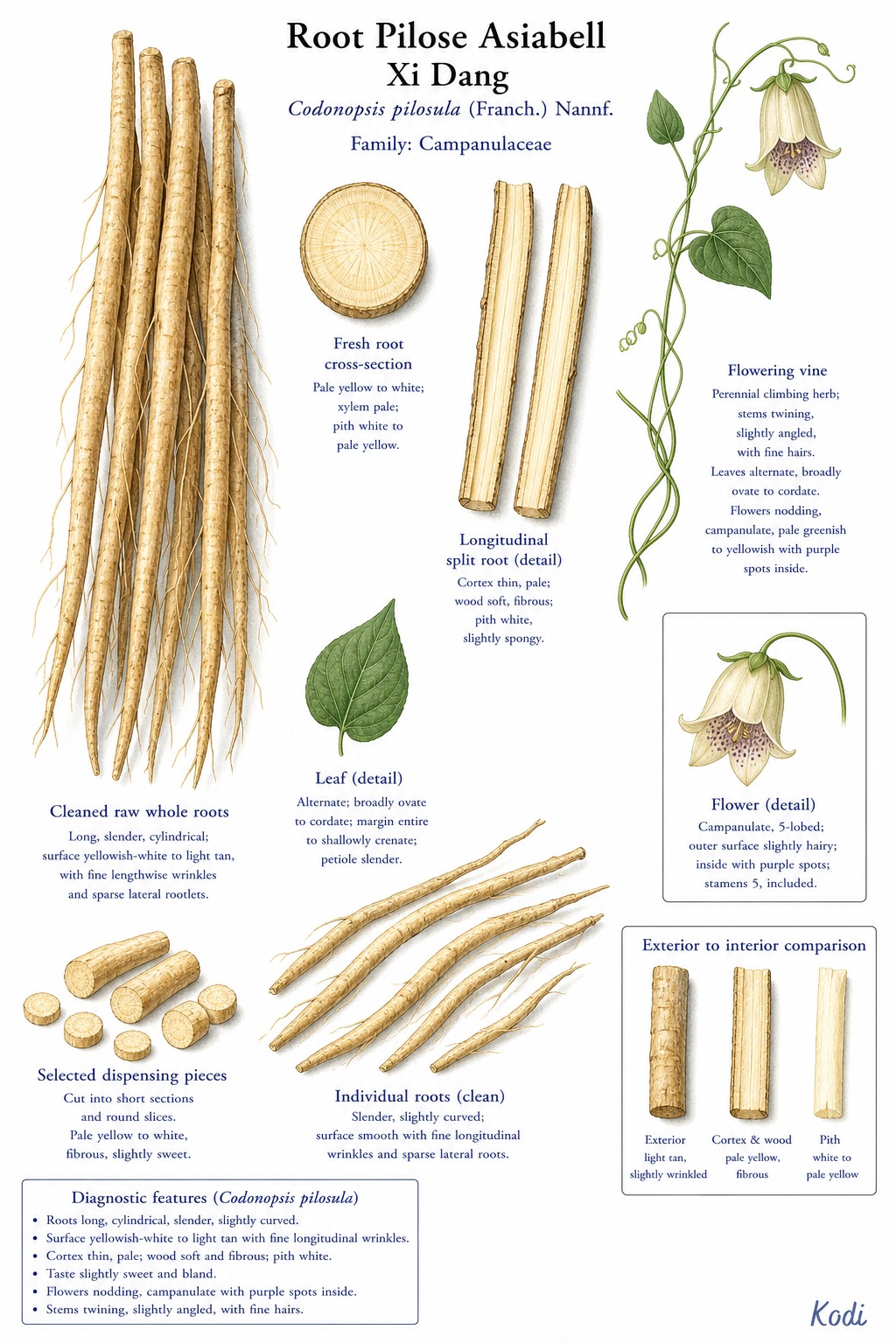
Known in TCM as Xi Dang (西党参), this sweet, neutral herb enters the Spleen and Lung. Traditionally, it supports Spleen and Lung Qi in the ordinary Dang Shen family lane ... Xi Dang is used for fatigue, weak appetite, loose stool, and soft deficiency cough, most often applied for fatigue, poor appetite, and digestive weakness. Modern research has identified Codonopsis among its active constituents.
Part used: Root
Also Known As
Latin: Radix Codonopsis Pilosulae | Pinyin: Xi Dang | Chinese: 西党参
TCM Properties
- Taste
- sweet
- Temperature
- neutral
- Channels
- Spleen, Lung
Traditional Use
Primary Actions
- Supports Spleen and Lung Qi in the ordinary Dang Shen family lane ... Xi Dang is used for fatigue, weak appetite, loose stool, and soft deficiency cough.
- Generates fluids and assists recovery after illness ... like other Codonopsis roots, it is valued when weakness and mild dryness coexist.
- Gently supports blood and pulse through Qi restoration ... traditional use extends to pale fatigue, mild palpitations, and convalescent depletion.
- Serves as a trade and regional presentation of Dang Shen rather than as a different tonic species ... the emphasis is on cleaner, slimmer roots rather than a different function set.
Secondary Actions
- This page stays on the slimmer cleaner `Xi Dang` visual and trade lane from the local prompt, not on the fuller premium `Dang Shen` root bundles and not on crown-heavy `Dang Shen Lu Tou` material.
- Modern inference ... the research base is on Codonopsis root broadly, so any finer claim about Xi Dang quality remains a trade interpretation rather than a separately validated pharmacology.
Classic Formulas
- Si Jun Zi Tang and Shen Ling Bai Zhu San style formulas ... Xi Dang serves the same broad qi-tonic role when this particular trade grade is dispensed.
- Convalescence formulas with Huang Qi, Bai Zhu, or Shan Yao ... traditional pairing logic for digestive weakness and depleted Qi.
- Lung-Spleen support combinations with Mai Dong or Wu Wei Zi ... used when weak cough and dryness sit on a fatigue background.
Classical References
- Chinese trade language distinguishes eastern, western, Tai, Lu, and other Dang Shen grades mainly by origin, form, and quality rather than by creating wholly separate herb families.
- Xi Dang therefore belongs inside the larger Dang Shen tradition even though the market recognizes it as a distinct dispensing lane.
Modern Research
Active Compounds
- Codonopsis polysaccharides ... still the dominant modern research fraction across Dang Shen grades
- Tangshenoside I and lobetyolin ... standard marker compounds for Codonopsis quality assessment
- Saponins and smaller phytochemical fractions ... supportive compounds in broad species-level literature
Studied Effects
- A 2025 comprehensive review of Codonopsis Radix provides the best modern context for Xi Dang because the published evidence base is built around the root tradition as a whole rather than this regional grade alone (PMID 41275746).
- A 2024 systematic review of Codonopsis pilosula mechanisms reinforces that immune, anti-inflammatory, and restorative effects are being studied at the species level, not by trade-name subgrade (PMID 38803438).
- A 2021 polysaccharide review further explains why the most cited modern evidence still focuses on full-root chemistry shared across Dang Shen lanes (PMID 33766352).
PubMed References
- Codonopsis Radix: A comprehensive review for its ethnopharmacology, phytochemistry, pharmacodynamics, pharmacokinetics, toxicity and potential clinical applications. (2025)
- A systematic review of the mechanism of action and potential medicinal value of codonopsis pilosula in diseases. (2024)
- Extraction, purification, structural characteristics and biological properties of the polysaccharides from Codonopsis pilosula: A review. (2021)
Safety & Interactions
Contraindications
- Acute excess patterns or heavy damp stagnation without Qi deficiency
Cautions
- Xi Dang should not be oversold as a pharmacologically separate herb when the evidence really belongs to Codonopsis root more broadly.
- Like other Dang Shen roots, quality and sourcing affect value ... the smaller cleaner form does not automatically mean stronger medicinal action.
Conditions
- Fatigue Traditional ★★★☆☆ JSON
- Poor Appetite Traditional ★★★☆☆ JSON
- Digestive Weakness Traditional ★★★☆☆ JSON
- Dry Cough Traditional ★★☆☆☆ JSON
- Palpitations Traditional ★★☆☆☆ JSON
Frequently Asked Questions
What is Xi Dang Root used for?
Xi Dang Root is traditionally used to Supports Spleen and Lung Qi in the ordinary Dang Shen family lane ... Xi Dang is used for fatigue, weak appetite, loose stool, and soft deficiency cough., Generates fluids and assists recovery after illness ... like other Codonopsis roots, it is valued when weakness and mild dryness coexist., Gently supports blood and pulse through Qi restoration ... traditional use extends to pale fatigue, mild palpitations, and convalescent depletion., Serves as a trade and regional presentation of Dang Shen rather than as a different tonic species ... the emphasis is on cleaner, slimmer roots rather than a different function set.. Research has investigated its effects on: A 2025 comprehensive review of Codonopsis Radix provides the best modern context for Xi Dang because the published evidence base is built around the root tradition as a whole rather than this regional grade alone (PMID 41275746).; A 2024 systematic review of Codonopsis pilosula mechanisms reinforces that immune, anti-inflammatory, and restorative effects are being studied at the species level, not by trade-name subgrade (PMID 38803438)..
What are other names for Xi Dang Root?
Xi Dang Root is also known as Xi Dang, Western Codonopsis Root, Xi Dang Shen. In TCM: 西党参 (Xi Dang); Radix Codonopsis Pilosulae.
Is Xi Dang Root safe during pregnancy?
The safety of Xi Dang Root during pregnancy has not been established. Consult a qualified healthcare provider before use.
What are the contraindications for Xi Dang Root?
Xi Dang Root should not be used in: Acute excess patterns or heavy damp stagnation without Qi deficiency. Consult a qualified healthcare provider before use.