Dang Shen Root
- Chinese
- 党参
- Pinyin
- Dang Shen
- Latin
- Radix Codonopsis Pilosulae
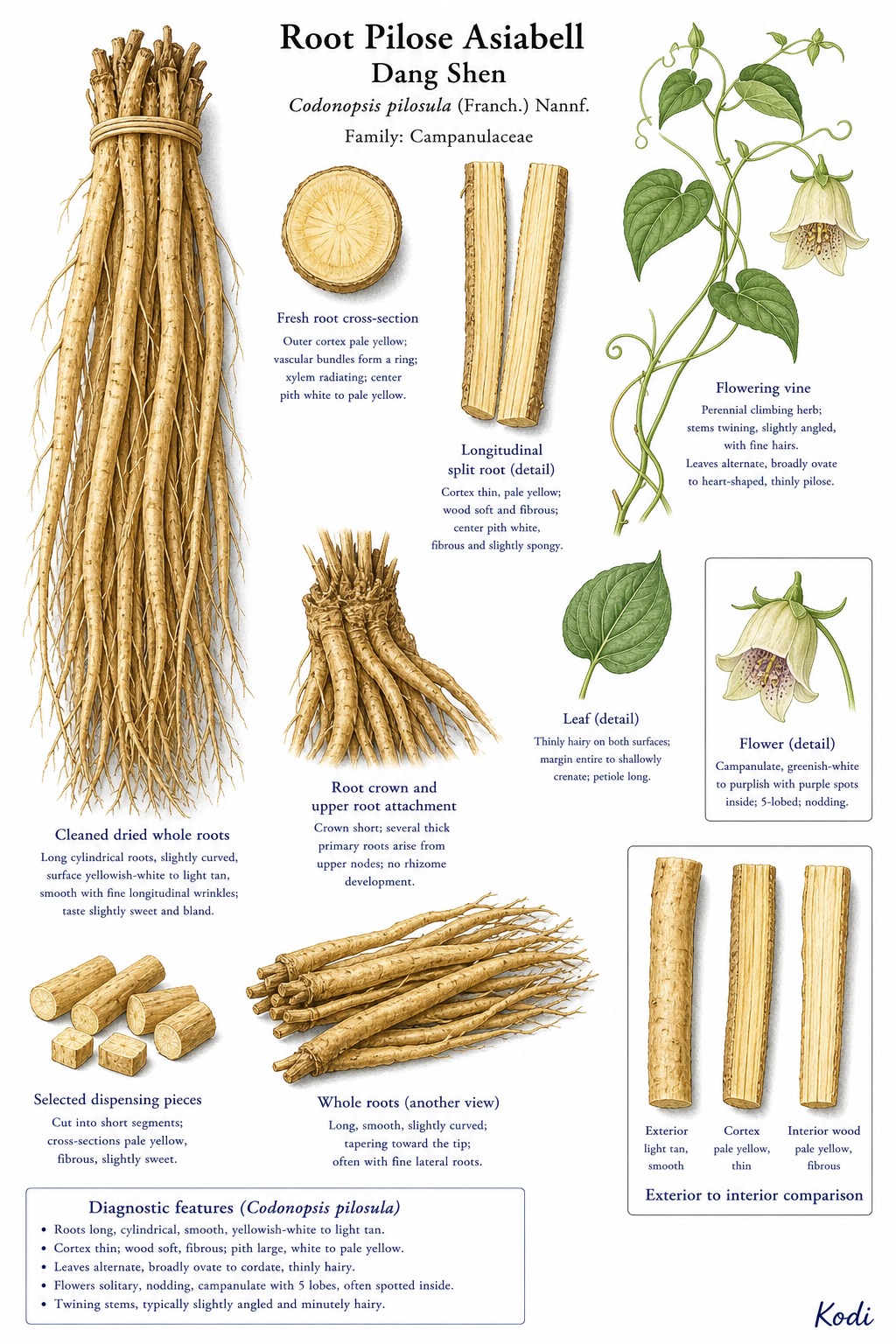
Known in TCM as Dang Shen (党参), this sweet, neutral herb enters the Spleen and Lung. Traditionally, it tonifies middle-burner Qi and strengthens the Spleen ... Dang Shen is a classic substitute-leaning Qi tonic for fatigue, poor appetite, loose stool, and post-illness weakness, most often applied for fatigue, poor appetite, and dry cough. Modern research has identified Codonopsis among its active constituents.
Part used: Root
Also Known As
Latin: Radix Codonopsis Pilosulae | Pinyin: Dang Shen | Chinese: 党参
TCM Properties
- Taste
- sweet
- Temperature
- neutral
- Channels
- Spleen, Lung
Traditional Use
Primary Actions
- Tonifies middle-burner Qi and strengthens the Spleen ... Dang Shen is a classic substitute-leaning Qi tonic for fatigue, poor appetite, loose stool, and post-illness weakness.
- Benefits Lung Qi and supports weak cough ... it is used when breath, voice, and recovery have become soft or depleted rather than when a strong dispersing herb is needed.
- Generates fluids and nourishes Blood secondarily ... beyond pure Qi tonification, Dang Shen is used when chronic illness has left dryness, thirst, pallor, or mild blood deficiency.
- Supports steady recovery more gently than Ren Shen ... this milder character is exactly why it is widely used in longer-course formulas and food-medicine contexts.
Secondary Actions
- This page stays on the fuller more robust full-root Dang Shen lane, not the crown-material `Dang Shen Lu Tou` page and not the slimmer `Xi Dang` sibling.
- Its importance in practice comes partly from reliability ... Dang Shen is a foundational everyday tonic root rather than an obscure regional variant.
Classic Formulas
- Si Jun Zi Tang ... one of the core Qi-tonic formulas in which Dang Shen often stands in for or alongside stronger ginseng-type roots.
- Shen Ling Bai Zhu San ... classic Spleen-qi and dampness-support formula for weak digestion and loose stool.
- Gui Pi Tang and Bu Zhong Yi Qi Tang style formulas ... used when fatigue, weak appetite, breathlessness, palpitations, and overwork-type depletion overlap.
Classical References
- Traditional herbology places Dang Shen among the key Qi tonics that strengthen the Spleen and Lung while also generating fluids and assisting blood recovery.
- Compared with Ren Shen, Dang Shen is usually framed as gentler, steadier, and more suitable for broader everyday deficiency patterns.
Modern Research
Active Compounds
- Codonopsis polysaccharides ... the most intensively studied major bioactive fraction
- Tangshenoside I and lobetyolin ... widely used marker compounds in quality and mechanism studies
- Saponins, alkaloids, and smaller phenolic constituents ... supportive compounds in the broader Codonopsis profile
Studied Effects
- A 2025 comprehensive review of Codonopsis Radix surveyed ethnopharmacology, phytochemistry, pharmacodynamics, pharmacokinetics, toxicity, and clinical potential, confirming that modern research on Dang Shen is now extensive by TCM-tonic standards (PMID 41275746).
- A 2024 systematic review summarized disease-model mechanisms and potential medicinal value of Codonopsis pilosula, reinforcing its strong anti-inflammatory, immunomodulatory, and recovery-oriented research profile (PMID 38803438).
- A 2021 review focused on Codonopsis polysaccharides and their biological properties, showing why most modern mechanistic interest still centers on full-root extracts rather than on trimmed secondary materials (PMID 33766352).
PubMed References
- Codonopsis Radix: A comprehensive review for its ethnopharmacology, phytochemistry, pharmacodynamics, pharmacokinetics, toxicity and potential clinical applications. (2025)
- A systematic review of the mechanism of action and potential medicinal value of codonopsis pilosula in diseases. (2024)
- Extraction, purification, structural characteristics and biological properties of the polysaccharides from Codonopsis pilosula: A review. (2021)
Safety & Interactions
Contraindications
- Acute excess patterns or heavy damp stagnation without Qi deficiency
Cautions
- Dang Shen is gentler than Ren Shen, but it is still an active medicinal root rather than a neutral soup ingredient in all doses.
- Quality grading matters ... full-root material is traditionally preferred over crown trimmings or poorly sourced substitutes.
Conditions
- Fatigue Traditional ★★★★☆ JSON
- Poor Appetite Traditional ★★★★☆ JSON
- Dry Cough Traditional ★★★☆☆ JSON
- Digestive Weakness Traditional ★★★☆☆ JSON
- Palpitations Traditional ★★☆☆☆ JSON
Frequently Asked Questions
What is Dang Shen Root used for?
Dang Shen Root is traditionally used to Tonifies middle-burner Qi and strengthens the Spleen ... Dang Shen is a classic substitute-leaning Qi tonic for fatigue, poor appetite, loose stool, and post-illness weakness., Benefits Lung Qi and supports weak cough ... it is used when breath, voice, and recovery have become soft or depleted rather than when a strong dispersing herb is needed., Generates fluids and nourishes Blood secondarily ... beyond pure Qi tonification, Dang Shen is used when chronic illness has left dryness, thirst, pallor, or mild blood deficiency., Supports steady recovery more gently than Ren Shen ... this milder character is exactly why it is widely used in longer-course formulas and food-medicine contexts.. Research has investigated its effects on: A 2025 comprehensive review of Codonopsis Radix surveyed ethnopharmacology, phytochemistry, pharmacodynamics, pharmacokinetics, toxicity, and clinical potential, confirming that modern research on Dang Shen is now extensive by TCM-tonic standards (PMID 41275746).; A 2024 systematic review summarized disease-model mechanisms and potential medicinal value of Codonopsis pilosula, reinforcing its strong anti-inflammatory, immunomodulatory, and recovery-oriented research profile (PMID 38803438)..
What are other names for Dang Shen Root?
Dang Shen Root is also known as Codonopsis Root, Codonopsis pilosula Root, Dang Shen. In TCM: 党参 (Dang Shen); Radix Codonopsis Pilosulae.
Is Dang Shen Root safe during pregnancy?
The safety of Dang Shen Root during pregnancy has not been established. Consult a qualified healthcare provider before use.
What are the contraindications for Dang Shen Root?
Dang Shen Root should not be used in: Acute excess patterns or heavy damp stagnation without Qi deficiency. Consult a qualified healthcare provider before use.