Reddrop Barberry Root Bark
- Chinese
- 三颗针
- Pinyin
- San Ke Zhen
- Latin
- Cortex Berberidis
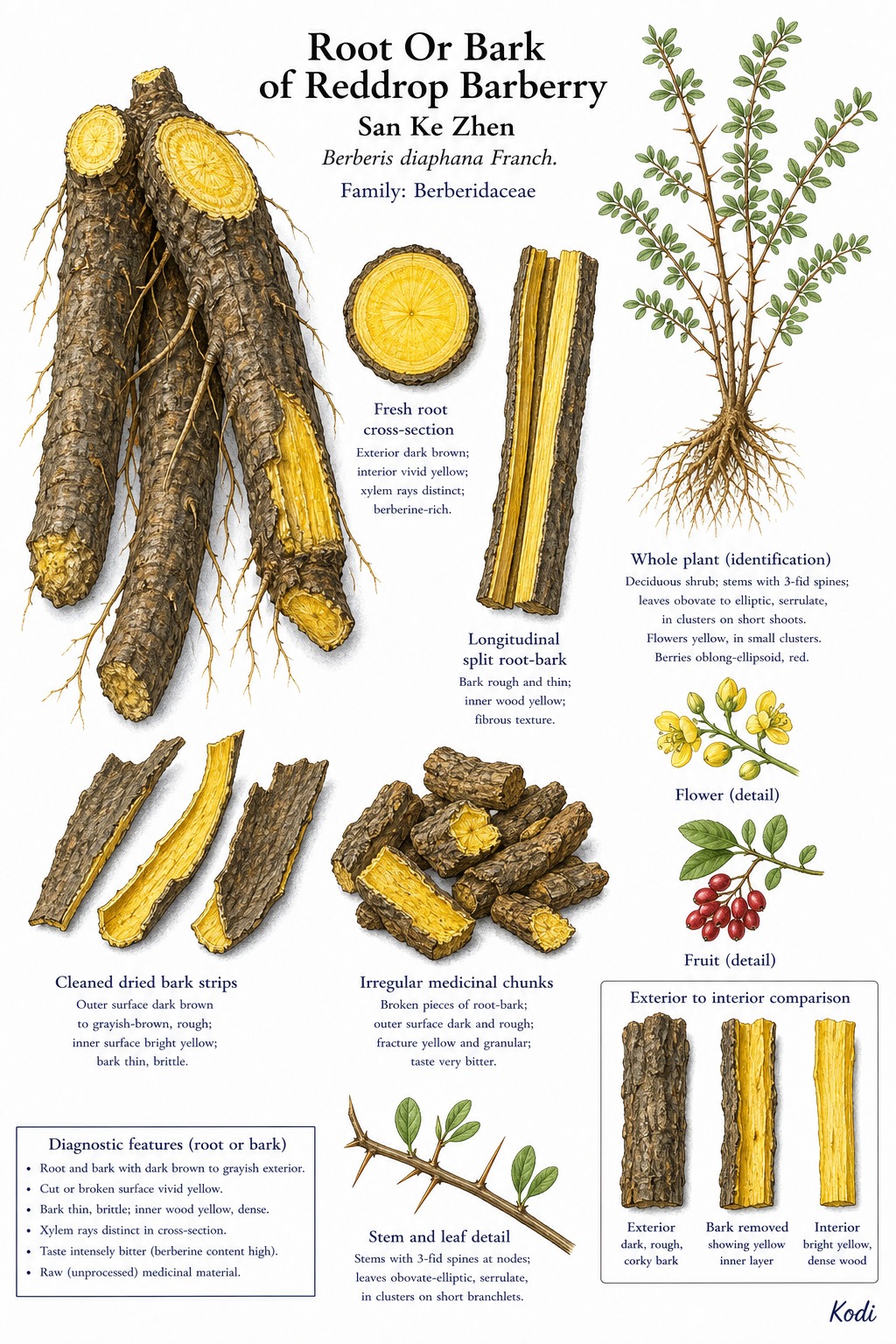
Known in TCM as San Ke Zhen (三颗针), this bitter, cold herb enters the Large Intestine, Liver, and Stomach. Traditionally, it clears heat and dries damp ... San Ke Zhen is directed toward damp-heat diarrhea, dysentery, jaundice, and other yellow or burning lower-tract presentations, most often applied for dysentery, jaundice, and eczema. Modern research has identified Berberine among its active constituents.
Part used: Bark
Also Known As
Latin: Cortex Berberidis | Pinyin: San Ke Zhen | Chinese: 三颗针
TCM Properties
- Taste
- bitter
- Temperature
- cold
- Channels
- Large Intestine, Liver, Stomach
Traditional Use
Primary Actions
- Clears heat and dries damp ... San Ke Zhen is directed toward damp-heat diarrhea, dysentery, jaundice, and other yellow or burning lower-tract presentations.
- Drains fire and resolves toxicity ... the vivid yellow alkaloid-rich root bark is used for sore, inflamed, and toxic lesions where bitter-cold draining is appropriate.
- Reduces inflammatory swelling in the digestive tract and skin ... traditional use extends to bowel heat, skin eruptions, and local hot lesions rather than tonic use.
- Supports treatment of lower-burner heat patterns ... urinary irritation and damp-heat signs are a classic extension of its bitter-cold profile.
Secondary Actions
- This page stays on the local `Berberis diaphana` San Ke Zhen lane rather than collapsing into Huang Lian, Huang Bai, or generic barberry imagery.
- Modern research often treats Berberidis Cortex as a species complex, so the evidence base is better for the broader alkaloid-rich barberry group than for this exact species alone.
Classic Formulas
- Regional dysentery and damp-heat bowel formulas with Huang Qin, Mu Xiang, or other bitter-cold herbs ... used when foul stool and heat are obvious.
- Jaundice and Liver-Gallbladder damp-heat combinations with Yin Chen or Zhi Zi ... a common traditional direction for yellowing and hot stagnation.
- Topical or wash-style detoxifying use with Ku Shen or Huang Bai ... used when skin heat and toxic swelling predominate.
Classical References
- Traditional herb summaries classify San Ke Zhen as bitter, cold, and mildly toxic, entering the Liver, Stomach, and Large Intestine to drain damp-heat and resolve toxin.
- Its strongest logic is in hot bowel, skin, and lower-burner patterns rather than in everyday digestive support.
Modern Research
Active Compounds
- Berberine ... the best-known protoberberine alkaloid in barberry-family roots and bark
- Berbamine and related alkaloids ... important bioactive compounds in broader Berberis pharmacology
- Additional yellow isoquinoline alkaloids ... major constituents behind both the color cue and much of the modern research interest
Studied Effects
- A 2025 study on Tibetan medicinal Berberis cortex varieties used site-specific PCR for fluorescence-based identification, underscoring that authentication remains a live issue for Berberidis Cortex materials (PMID 40533248).
- A 2018 comparative study analyzed genetic and chemical differences among four Berberis herbs, supporting the view that the San Ke Zhen family should not be treated as chemically uniform (PMID 30259882).
- A 2020 metabolomics and anti-diabetic quality study compared different Berberidis Cortex species, again showing that species-complex evidence is more realistic here than pretending to have abundant direct human trials on `Berberis diaphana` alone (PMID 33164432).
PubMed References
- Fluorescence Visual Identification of Four Main Varieties of Tibetan Medicinal Berberis cortex Based on Site-Specific PCR Technology. (2025)
- Comparative Analysis of Genetic and Chemical Differences between Four Berberis Herbs Based on Molecular Phylogenetic and HPLC Methods. (2018)
- [Quality evaluation of different Berberidis Cortex species based on ~1H-NMR metabolomics and anti-diabetic activity]. (2020)
Safety & Interactions
Contraindications
- Cold deficiency diarrhea or weak digestion without damp-heat
- Use during pregnancy without professional supervision
Cautions
- This is a bitter-cold alkaloid-rich bark lane, not a gentle digestive herb.
- Species-complex and regional-sourcing issues matter here ... different Berberis barks can vary materially in chemistry and quality.
Conditions
Frequently Asked Questions
What is Reddrop Barberry Root Bark used for?
Reddrop Barberry Root Bark is traditionally used to Clears heat and dries damp ... San Ke Zhen is directed toward damp-heat diarrhea, dysentery, jaundice, and other yellow or burning lower-tract presentations., Drains fire and resolves toxicity ... the vivid yellow alkaloid-rich root bark is used for sore, inflamed, and toxic lesions where bitter-cold draining is appropriate., Reduces inflammatory swelling in the digestive tract and skin ... traditional use extends to bowel heat, skin eruptions, and local hot lesions rather than tonic use., Supports treatment of lower-burner heat patterns ... urinary irritation and damp-heat signs are a classic extension of its bitter-cold profile.. Research has investigated its effects on: A 2025 study on Tibetan medicinal Berberis cortex varieties used site-specific PCR for fluorescence-based identification, underscoring that authentication remains a live issue for Berberidis Cortex materials (PMID 40533248).; A 2018 comparative study analyzed genetic and chemical differences among four Berberis herbs, supporting the view that the San Ke Zhen family should not be treated as chemically uniform (PMID 30259882)..
What are other names for Reddrop Barberry Root Bark?
Reddrop Barberry Root Bark is also known as San Ke Zhen, Berberis diaphana Root Bark, Barberry Root Bark. In TCM: 三颗针 (San Ke Zhen); Cortex Berberidis.
Is Reddrop Barberry Root Bark safe during pregnancy?
The safety of Reddrop Barberry Root Bark during pregnancy has not been established. Consult a qualified healthcare provider before use.
What are the contraindications for Reddrop Barberry Root Bark?
Reddrop Barberry Root Bark should not be used in: Cold deficiency diarrhea or weak digestion without damp-heat; Use during pregnancy without professional supervision. Consult a qualified healthcare provider before use.