Clethra Loosestrife Herb
- Chinese
- 珍珠菜
- Pinyin
- Zhen Zhu Cai
- Latin
- Herba Lysimachiae Clethroidis
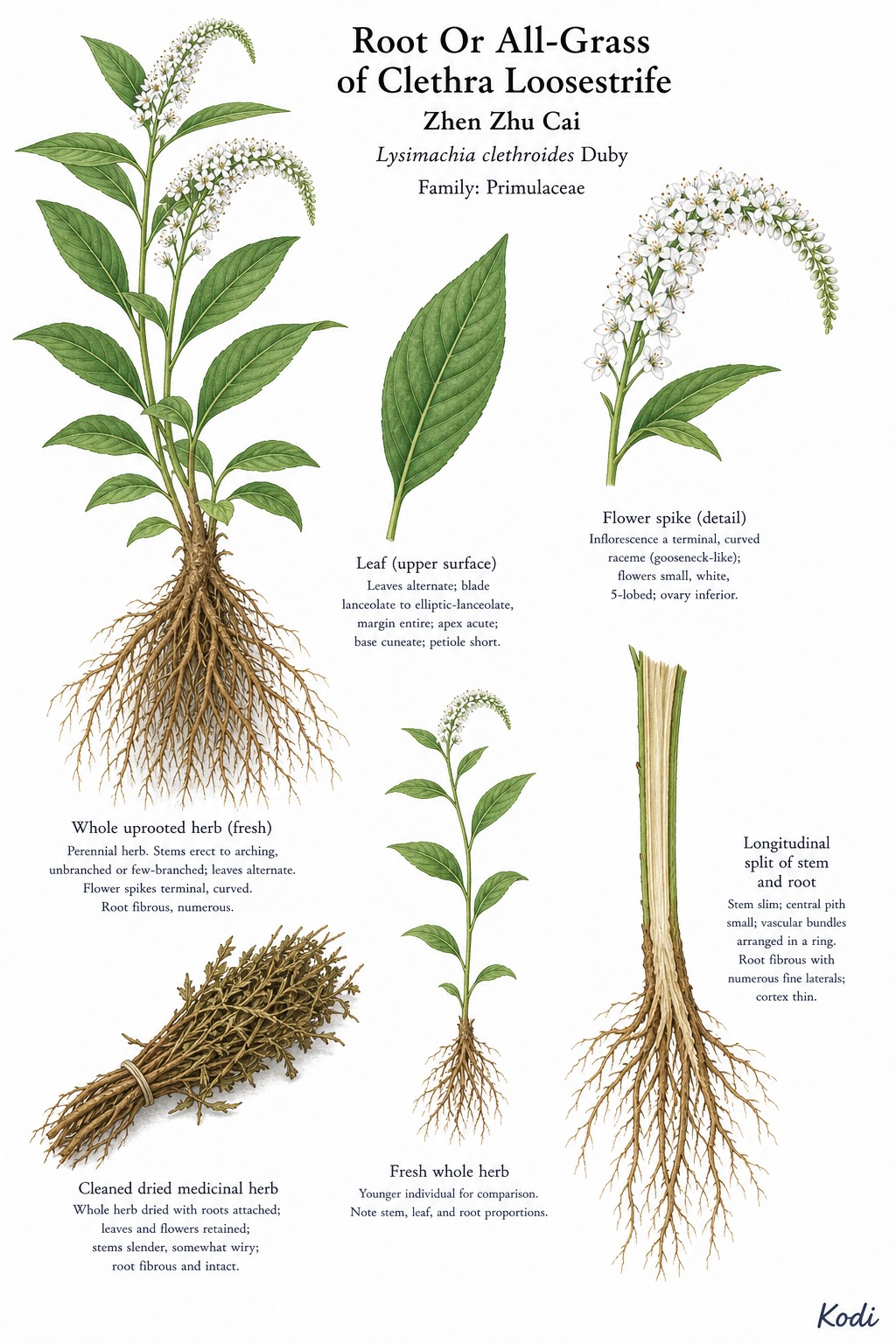
Known in TCM as Zhen Zhu Cai (珍珠菜), this bitter and pungent, neutral herb enters the Liver and Spleen. Traditionally, it clears heat and promotes urination ... Zhen Zhu Cai is a folk herb for edema, damp accumulation, urinary irritation, and heat-lodged water metabolism problems, most often applied for edema, traumatic injury, and mastitis. Modern research has identified Flavonoids among its active constituents.
Part used: Whole herb
Also Known As
Latin: Herba Lysimachiae Clethroidis | Pinyin: Zhen Zhu Cai | Chinese: 珍珠菜
TCM Properties
- Taste
- bitter, pungent
- Temperature
- neutral
- Channels
- Liver, Spleen
Traditional Use
Primary Actions
- Clears heat and promotes urination ... Zhen Zhu Cai is a folk herb for edema, damp accumulation, urinary irritation, and heat-lodged water metabolism problems.
- Invigorates Blood and reduces swelling ... traditional use extends to bruising, traumatic pain, and lingering fixed swelling where stasis has formed.
- Resolves toxicity and dissipates abscesses ... it is applied to mastitis, inflamed swellings, and hot suppurative lesions in regional practice.
- Relieves rheumatic pain and mild channel obstruction ... some traditions extend it to joint soreness and painful wind-damp patterns.
Secondary Actions
- This page stays on the medicinal root-or-whole-herb identity of `Lysimachia clethroides`, not on the ornamental flower-spike garden plant alone.
- Zhen Zhu Cai is more regional and folk-medicine oriented than many standardized national herbs, so modern evidence should be read as supportive rather than definitive.
Classic Formulas
- Edema and damp-heat pairings with Che Qian Cao or Jin Qian Cao ... common logic when heat, swelling, and urinary difficulty coexist.
- Trauma and swelling combinations with Ru Xiang, Mo Yao, or Ji Xue Teng ... used when pain, bruising, and fixed tenderness are the priority.
- Heat-toxin and breast-swelling formulas with Pu Gong Ying or Jin Yin Hua ... a regional extension of the herb's detoxifying role.
Classical References
- Southern and folk materia medica sources describe Zhen Zhu Cai as bitter-pungent and neutral, using the root or whole herb to clear damp-heat, move Blood, and resolve swelling.
- Its strongest identity is as a practical regional herb for edema, injury, and local inflammatory lesions rather than as a famous canonical formula ingredient.
Modern Research
Active Compounds
- Flavonoids and phenolic acids ... major classes discussed in anti-inflammatory and hepatoprotective interest around the species
- Triterpenoid saponins ... characteristic constituents linked to cytotoxicity studies
- Additional polar extract fractions ... associated with vascular and inflammation research
Studied Effects
- A 2013 study reported that Lysimachia clethroides extract attenuated inflammatory responses in macrophages and in an acute-lung-injury model, supporting the herb's traditional heat-toxin and swelling lane (PMID 24145006).
- A 2010 study found vascular-relaxation effects through an endothelium-dependent mechanism, showing that the species has physiologic actions beyond simple folk categorization (PMID 20164788).
- A 2011 paper identified cytotoxic triterpenoid saponins from Lysimachia clethroides, reinforcing the need to describe the species as pharmacologically active rather than as a harmless ornamental (PMID 21928797).
PubMed References
- Lysimachia clethroides Duby extract attenuates inflammatory response in Raw 264.7 macrophages stimulated with lipopolysaccharide and in acute lung injury mouse model. (2013)
- Lysimachia clethroides extract promote vascular relaxation via endothelium-dependent mechanism. (2010)
- Cytotoxic triterpenoid saponins from Lysimachia clethroides. (2011)
Safety & Interactions
Contraindications
- Clear cold deficiency patterns without damp-heat, swelling, or toxin
Cautions
- Direct human clinical evidence is limited, so modern dosing and long-term use are less standardized than with major pharmacopoeia herbs.
- The same plant is often grown ornamentally, but ornamental familiarity should not be mistaken for proof of casual medicinal safety.
Conditions
- Edema Traditional ★★★☆☆ JSON
- Traumatic Injury Traditional ★★★☆☆ JSON
- Mastitis Traditional ★★☆☆☆ JSON
- Joint Pain Traditional ★★☆☆☆ JSON
- Jaundice Traditional ★★☆☆☆ JSON
Frequently Asked Questions
What is Clethra Loosestrife Herb used for?
Clethra Loosestrife Herb is traditionally used to Clears heat and promotes urination ... Zhen Zhu Cai is a folk herb for edema, damp accumulation, urinary irritation, and heat-lodged water metabolism problems., Invigorates Blood and reduces swelling ... traditional use extends to bruising, traumatic pain, and lingering fixed swelling where stasis has formed., Resolves toxicity and dissipates abscesses ... it is applied to mastitis, inflamed swellings, and hot suppurative lesions in regional practice., Relieves rheumatic pain and mild channel obstruction ... some traditions extend it to joint soreness and painful wind-damp patterns.. Research has investigated its effects on: A 2013 study reported that Lysimachia clethroides extract attenuated inflammatory responses in macrophages and in an acute-lung-injury model, supporting the herb's traditional heat-toxin and swelling lane (PMID 24145006).; A 2010 study found vascular-relaxation effects through an endothelium-dependent mechanism, showing that the species has physiologic actions beyond simple folk categorization (PMID 20164788)..
What are other names for Clethra Loosestrife Herb?
Clethra Loosestrife Herb is also known as Zhen Zhu Cai, Lysimachia clethroides Herb, Gooseneck Loosestrife Herb. In TCM: 珍珠菜 (Zhen Zhu Cai); Herba Lysimachiae Clethroidis.
Is Clethra Loosestrife Herb safe during pregnancy?
The safety of Clethra Loosestrife Herb during pregnancy has not been established. Consult a qualified healthcare provider before use.
What are the contraindications for Clethra Loosestrife Herb?
Clethra Loosestrife Herb should not be used in: Clear cold deficiency patterns without damp-heat, swelling, or toxin. Consult a qualified healthcare provider before use.