Xiao Gan Cao Root
- Chinese
- 小甘草
- Pinyin
- Xiao Gan Cao
- Latin
- Radix Glycyrrhizae
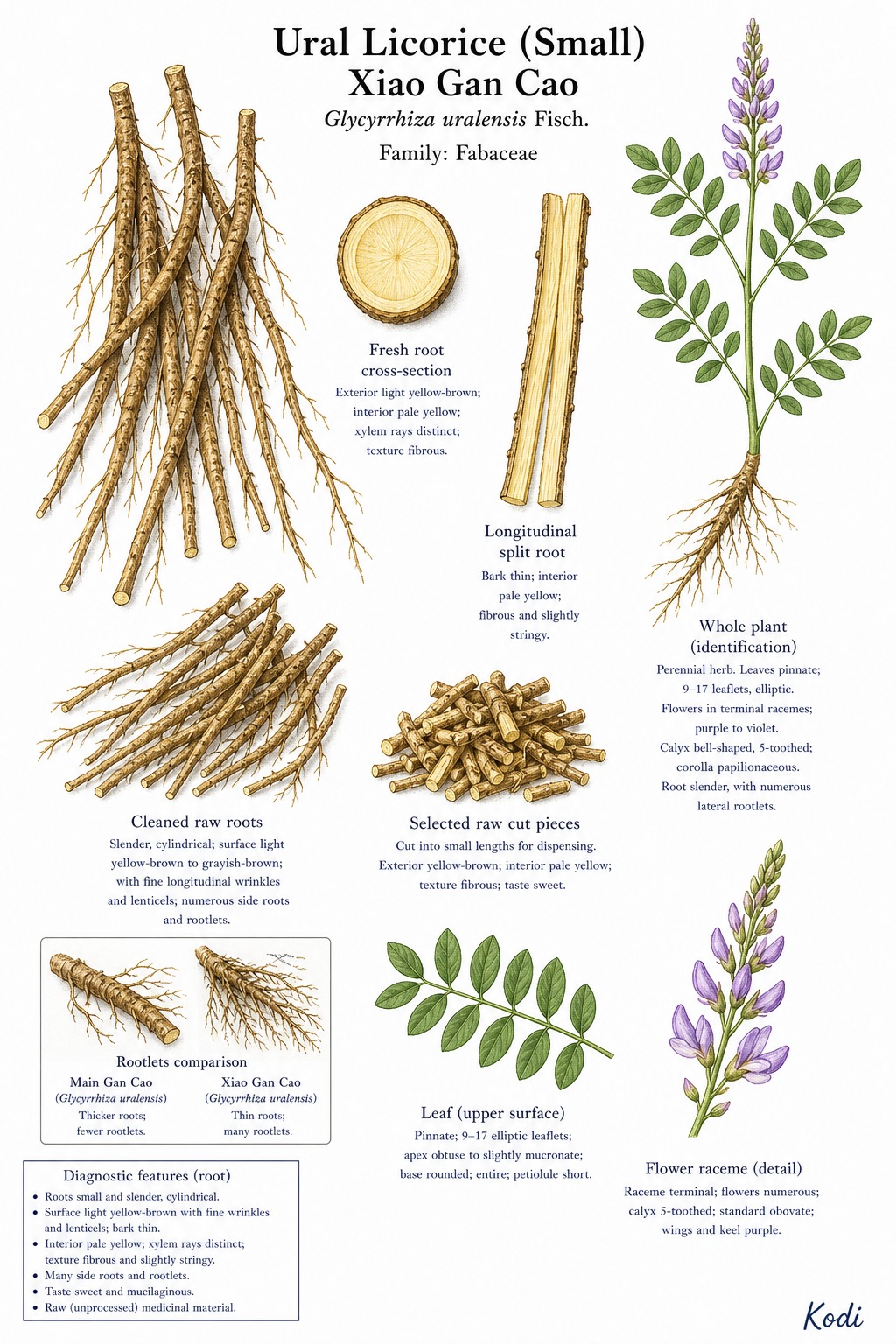
Known in TCM as Xiao Gan Cao (小甘草), this sweet, neutral herb enters the Heart, Lung, Spleen, and Stomach. Traditionally, it supports the Spleen and gently supplements Qi ... Xiao Gan Cao stays inside the same raw licorice family as Gan Cao but is presented here as a smaller thinner dispensing-root lane rather than a separate species, most often applied for cough, sore throat, and poor appetite. Modern research has identified Glycyrrhizin among its active constituents.
Part used: Root
Also Known As
Latin: Radix Glycyrrhizae | Pinyin: Xiao Gan Cao | Chinese: 小甘草
TCM Properties
- Taste
- sweet
- Temperature
- neutral
- Channels
- Heart, Lung, Spleen, Stomach
Traditional Use
Primary Actions
- Supports the Spleen and gently supplements Qi ... Xiao Gan Cao stays inside the same raw licorice family as Gan Cao but is presented here as a smaller thinner dispensing-root lane rather than a separate species.
- Relieves cough and soothes the throat ... the thinner roots still follow the familiar licorice use for cough, hoarseness, and mild irritative heat in the throat.
- Moderates spasm and harmonizes formulas ... this lane fits ordinary dispensing practice where smaller raw roots are selected for everyday formula use.
- Retains a mild detoxifying direction because it is unprepared licorice ... unlike prepared siblings, this page should not drift into honey-fried or plain-processed identity.
Secondary Actions
- The real distinction from the main Gan Cao page is trade form and root size rather than a fundamentally different pharmacology.
- It should also stay separate from `tip-of-licorice-root` ... Xiao Gan Cao is still a whole smaller raw-root lane, not just root-tip trimming.
Classic Formulas
- Everyday cough and harmonizing formulas that call for raw licorice ... Xiao Gan Cao fits this ordinary dispensing lane well.
- Shao Yao Gan Cao Tang style cramp-relieving logic ... the sweet moderating role remains intact regardless of the thinner trade grade.
- Throat-soothing combinations with Jie Geng or Niu Bang Zi ... a standard raw-licorice application when irritation and mild toxin are present.
Classical References
- Traditional use does not treat Xiao Gan Cao as a separate ben cao category so much as a recognized smaller raw-root presentation inside the Gan Cao trade.
- Its practical importance is therefore grading and dispensing identity, not a claim of unique standalone chemistry.
Modern Research
Active Compounds
- Glycyrrhizin ... principal triterpene saponin across licorice-root grades
- Glycyrrhetinic acid ... key metabolite tied to adverse-effect risk
- Liquiritin-class flavonoids ... major supportive compounds in broad licorice pharmacology
Studied Effects
- A 2020 review of corroborative clinical findings supports licorice root's broad anti-inflammatory and harmonizing roles, but the evidence applies to licorice root generally rather than to this smaller trade grade specifically (PMID 31874059).
- A 2020 phytochemical review reinforces how chemically rich licorice is as a medicinal root, again at the broad Gan Cao level rather than at Xiao Gan Cao grade level (PMID 31811935).
- A 2021 narrative review on pseudoaldosteronism remains fully relevant here ... smaller raw roots do not escape the core glycyrrhizin safety problem (PMID 34604277).
PubMed References
- A Review of the Pharmacological Efficacy and Safety of Licorice Root from Corroborative Clinical Trial Findings. (2020)
- An "essential herbal medicine"-licorice: A review of phytochemicals and its effects in combination preparations. (2020)
- Clinical Risk Factors of Licorice-Induced Pseudoaldosteronism Based on Glycyrrhizin-Metabolite Concentrations: A Narrative Review. (2021)
Safety & Interactions
Contraindications
- Uncontrolled hypertension, edema, hypokalemia, or severe heart failure
- High-dose or prolonged unsupervised use
Cautions
- Smaller raw roots are not safer just because they look lighter or more modest than large Gan Cao slices.
- If multiple products contain licorice, total glycyrrhizin exposure can still become clinically significant.
Drug Interactions
- Loop or thiazide diuretics ... additive potassium loss and arrhythmia risk
- Digoxin and other cardiac glycosides ... hypokalemia may increase toxicity risk
- Corticosteroids ... additive mineralocorticoid-like effects
- Antihypertensives or antiarrhythmics ... electrolyte shifts may complicate therapy
Conditions
- Cough Traditional ★★★☆☆ JSON
- Sore Throat Traditional ★★★☆☆ JSON
- Poor Appetite Traditional ★★☆☆☆ JSON
- Abdominal Pain Traditional ★★☆☆☆ JSON
Frequently Asked Questions
What is Xiao Gan Cao Root used for?
Xiao Gan Cao Root is traditionally used to Supports the Spleen and gently supplements Qi ... Xiao Gan Cao stays inside the same raw licorice family as Gan Cao but is presented here as a smaller thinner dispensing-root lane rather than a separate species., Relieves cough and soothes the throat ... the thinner roots still follow the familiar licorice use for cough, hoarseness, and mild irritative heat in the throat., Moderates spasm and harmonizes formulas ... this lane fits ordinary dispensing practice where smaller raw roots are selected for everyday formula use., Retains a mild detoxifying direction because it is unprepared licorice ... unlike prepared siblings, this page should not drift into honey-fried or plain-processed identity.. Research has investigated its effects on: A 2020 review of corroborative clinical findings supports licorice root's broad anti-inflammatory and harmonizing roles, but the evidence applies to licorice root generally rather than to this smaller trade grade specifically (PMID 31874059).; A 2020 phytochemical review reinforces how chemically rich licorice is as a medicinal root, again at the broad Gan Cao level rather than at Xiao Gan Cao grade level (PMID 31811935)..
What are other names for Xiao Gan Cao Root?
Xiao Gan Cao Root is also known as Xiao Gan Cao, Small Raw Licorice Root, Fine Licorice Root. In TCM: 小甘草 (Xiao Gan Cao); Radix Glycyrrhizae.
Is Xiao Gan Cao Root safe during pregnancy?
The safety of Xiao Gan Cao Root during pregnancy has not been established. Consult a qualified healthcare provider before use.
What are the contraindications for Xiao Gan Cao Root?
Xiao Gan Cao Root should not be used in: Uncontrolled hypertension, edema, hypokalemia, or severe heart failure; High-dose or prolonged unsupervised use. Consult a qualified healthcare provider before use.
Does Xiao Gan Cao Root interact with any medications?
Xiao Gan Cao Root may interact with: Loop or thiazide diuretics ... additive potassium loss and arrhythmia risk; Digoxin and other cardiac glycosides ... hypokalemia may increase toxicity risk; Corticosteroids ... additive mineralocorticoid-like effects; Antihypertensives or antiarrhythmics ... electrolyte shifts may complicate therapy. Always inform your healthcare provider of any herbal supplements you are taking.