Raw Fleeceflower Root
- Chinese
- 何首乌
- Pinyin
- He Shou Wu
- Latin
- Radix Polygoni Multiflori
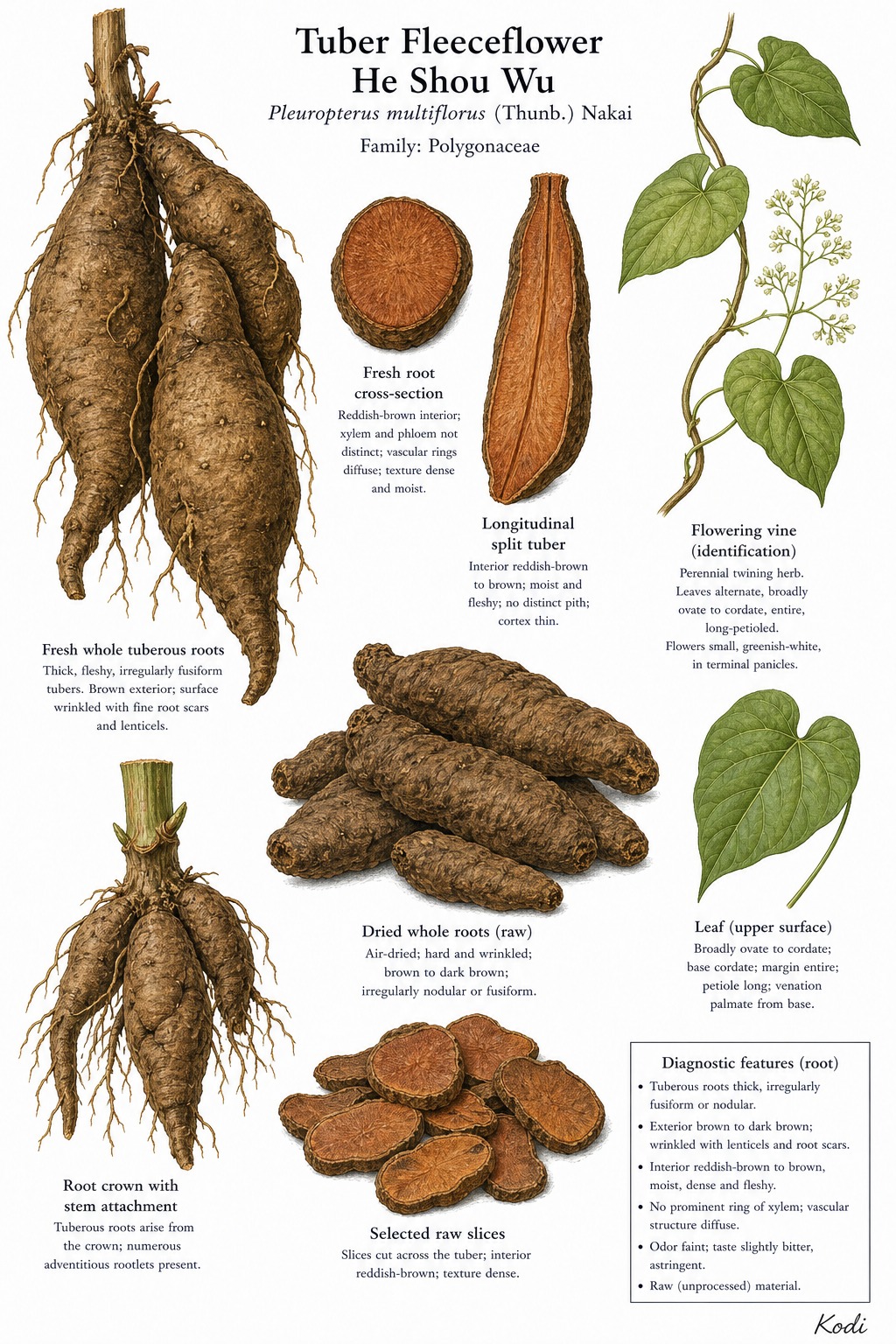
Known in TCM as He Shou Wu (何首乌), this sweet and bitter and astringent, slightly warm herb enters the Liver, Kidney, and Large Intestine. Traditionally, it detoxifies and reduces sores ... raw He Shou Wu is the traditional choice for carbuncles, chronic skin lesions, and toxic accumulations where the prepared tonic form would be the wrong direction, most often applied for constipation, carbuncle, and oral ulcers. Modern research has identified Stilbene among its active constituents.
Part used: Root
Also Known As
Latin: Radix Polygoni Multiflori | Pinyin: He Shou Wu | Chinese: 何首乌
TCM Properties
- Taste
- sweet, bitter, astringent
- Temperature
- slightly warm
- Channels
- Liver, Kidney, Large Intestine
Traditional Use
Primary Actions
- Detoxifies and reduces sores ... raw He Shou Wu is the traditional choice for carbuncles, chronic skin lesions, and toxic accumulations where the prepared tonic form would be the wrong direction.
- Moistens the intestines and relieves constipation ... the unprocessed root keeps the more descending, bowel-moving side of the herb family.
- Nourishes blood and essence in a rougher, less tonic way than the prepared form ... some lineages still use the raw root in deficiency patterns, but classical distinction strongly favors processed He Shou Wu for long-term tonic work.
- Supports weakness, dizziness, and premature graying only with care ... the raw and prepared forms share a family identity, but their practical emphasis is not interchangeable.
Secondary Actions
- This page must stay separate from `prepared-fleeceflower-root` ... raw He Shou Wu is more detoxifying and bowel-moistening, while the prepared sibling is the classic Liver-Kidney tonic lane.
- The same distinction that matters traditionally also matters for safety ... raw and prepared Polygonum multiflorum products do not carry identical chemical balance or risk.
Classic Formulas
- Bowel-moistening combinations with Huo Ma Ren or Dang Gui ... the raw root is used when dryness and constipation coexist with deficiency.
- Heat-toxin and sore-resolving pairings with Tu Fu Ling, Jin Yin Hua, or other detoxifying herbs ... a classic reason to keep raw He Shou Wu distinct from the prepared tonic form.
- Hair and essence formulas traditionally favor the processed root ... that distinction is itself a key classical instruction for this herb family.
Classical References
- Materia medica tradition sharply distinguishes raw and prepared He Shou Wu ... raw for toxin and bowel-moistening use, prepared for tonifying blood, essence, and hair.
- Processing with black soybean juice is specifically intended to redirect the herb away from this raw harsher profile.
Modern Research
Active Compounds
- Stilbene glycosides such as THSG ... signature constituents discussed across both pharmacology and toxicity literature
- Anthraquinones including emodin and physcion derivatives ... major compounds tied to purgative direction and hepatotoxicity concern
- Tannins, phospholipids, and flavonoids ... additional compound groups discussed in larger reviews
- Processing-sensitive constituent fractions ... chemically important because raw and processed products do not behave identically
Studied Effects
- A 2015 review summarized the traditional uses, phytochemistry, pharmacology, and toxicology of Polygonum multiflorum, making clear that the celebrated reputation of He Shou Wu has always been shadowed by real safety complexity (PMID 25449462).
- A 2017 review concluded that Heshouwu can show both hepatoprotective and hepatotoxic behavior depending on context, preparation, and exposure, which is exactly why the raw page cannot be treated casually (PMID 27484243).
- A 2020 study found that liver injury from Polygonum multiflorum was inversely related to processing time, supporting the traditional claim that raw material carries a different and riskier profile than well-processed product (PMID 32215041).
PubMed References
- Traditional usages, botany, phytochemistry, pharmacology and toxicology of Polygonum multiflorum Thunb.: a review. (2015)
- Hepatoprotection and hepatotoxicity of Heshouwu, a Chinese medicinal herb: Context of the paradoxical effect. (2017)
- Effects of Different Processed Products of Polygonum multiflorum on the Liver. (2020)
Safety & Interactions
Contraindications
- Active liver disease or unexplained liver-enzyme elevation
- Chronic loose stools or diarrhea from deficiency
- Long-term unsupervised tonic use
Cautions
- Raw He Shou Wu has one of the clearest herb-safety controversies in this library and should not be romanticized as a harmless longevity root.
- Correct processing may reduce but does not erase risk ... the raw form deserves even more caution than the prepared sibling.
- Product authentication, dose control, and liver-function awareness matter more here than with most ordinary tonic roots.
Conditions
- Constipation Traditional ★★★★☆ JSON
- Carbuncle Traditional ★★★☆☆ JSON
- Oral Ulcers Traditional ★★☆☆☆ JSON
- Low Back Pain Traditional ★★☆☆☆ JSON
Frequently Asked Questions
What is Raw Fleeceflower Root used for?
Raw Fleeceflower Root is traditionally used to Detoxifies and reduces sores ... raw He Shou Wu is the traditional choice for carbuncles, chronic skin lesions, and toxic accumulations where the prepared tonic form would be the wrong direction., Moistens the intestines and relieves constipation ... the unprocessed root keeps the more descending, bowel-moving side of the herb family., Nourishes blood and essence in a rougher, less tonic way than the prepared form ... some lineages still use the raw root in deficiency patterns, but classical distinction strongly favors processed He Shou Wu for long-term tonic work., Supports weakness, dizziness, and premature graying only with care ... the raw and prepared forms share a family identity, but their practical emphasis is not interchangeable.. Research has investigated its effects on: A 2015 review summarized the traditional uses, phytochemistry, pharmacology, and toxicology of Polygonum multiflorum, making clear that the celebrated reputation of He Shou Wu has always been shadowed by real safety complexity (PMID 25449462).; A 2017 review concluded that Heshouwu can show both hepatoprotective and hepatotoxic behavior depending on context, preparation, and exposure, which is exactly why the raw page cannot be treated casually (PMID 27484243)..
What are other names for Raw Fleeceflower Root?
Raw Fleeceflower Root is also known as Raw He Shou Wu, Pleuropterus multiflorus Root, Fo-Ti Root (raw). In TCM: 何首乌 (He Shou Wu); Radix Polygoni Multiflori.
Is Raw Fleeceflower Root safe during pregnancy?
The safety of Raw Fleeceflower Root during pregnancy has not been established. Consult a qualified healthcare provider before use.
What are the contraindications for Raw Fleeceflower Root?
Raw Fleeceflower Root should not be used in: Active liver disease or unexplained liver-enzyme elevation; Chronic loose stools or diarrhea from deficiency; Long-term unsupervised tonic use. Consult a qualified healthcare provider before use.