Triquetrous Tadehagi Herb
- Chinese
- 葫芦茶
- Pinyin
- Hu Lu Cha
- Latin
- Herba Tadehagi Triquetri
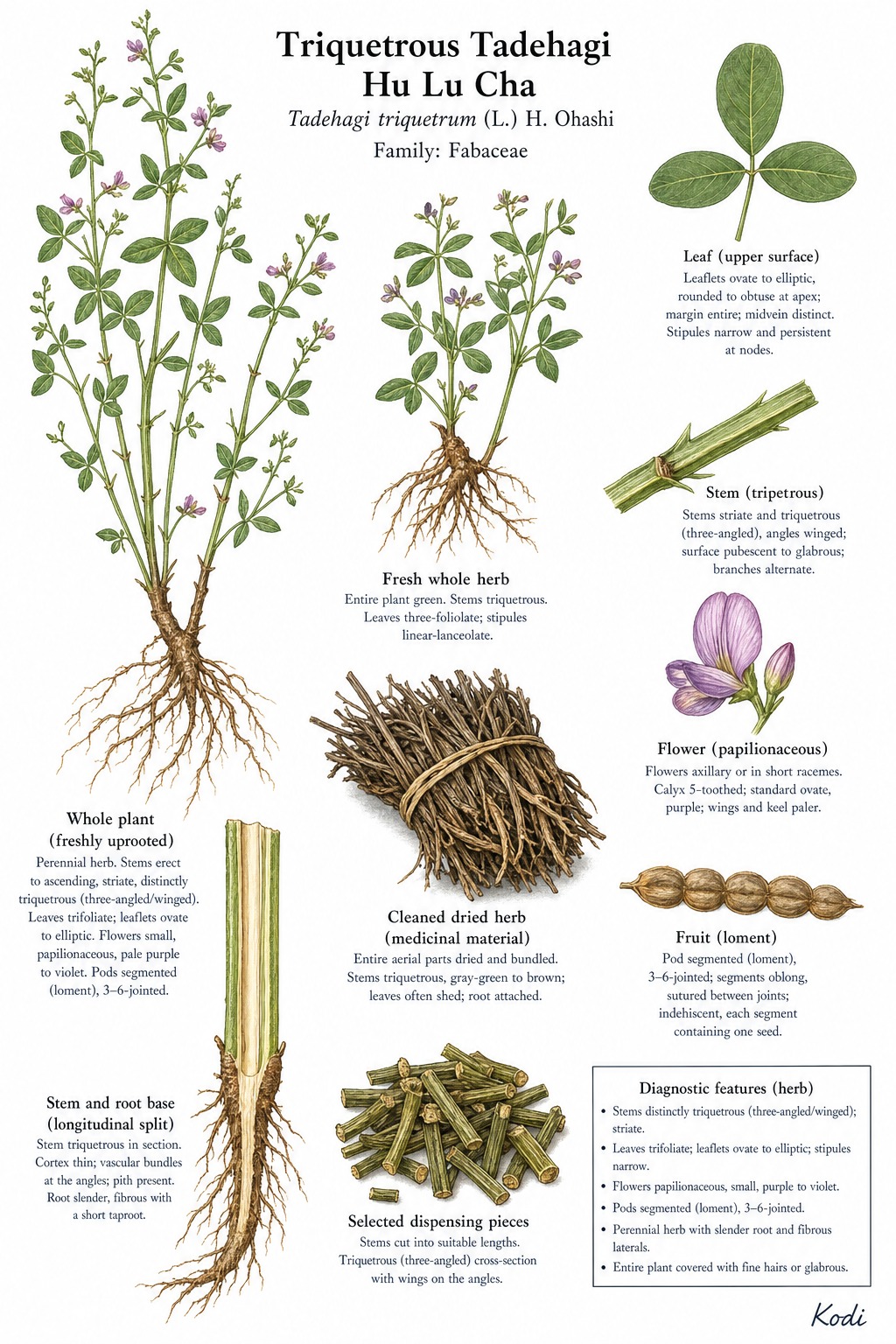
Known in TCM as Hu Lu Cha (葫芦茶), this bitter and astringent, cool herb enters the Lung, Liver, and Bladder. Traditionally, it clears heat and resolves toxicity ... Hu Lu Cha is used for sore throat, summer-heat, upper-respiratory irritation, and inflamed damp-heat presentations in southern herbal-tea traditions, most often applied for sore throat, hepatitis, and dysentery. Modern research has identified Tadehaginosides among its active constituents.
Part used: Whole herb
Also Known As
Latin: Herba Tadehagi Triquetri | Pinyin: Hu Lu Cha | Chinese: 葫芦茶
TCM Properties
- Taste
- bitter, astringent
- Temperature
- cool
- Channels
- Lung, Liver, Bladder
Traditional Use
Primary Actions
- Clears heat and resolves toxicity ... Hu Lu Cha is used for sore throat, summer-heat, upper-respiratory irritation, and inflamed damp-heat presentations in southern herbal-tea traditions.
- Promotes urination and relieves dampness ... it is directed toward jaundice, nephritic edema, scanty dark urine, and other lower-burner damp-heat patterns.
- Harmonizes the intestines and addresses enteritis and dysentery ... folk use includes diarrhea, abdominal upset, and chronic digestive weakness complicated by dampness or heat.
- Reduces accumulation and helps expel parasites ... regional traditions extend it to childhood nutritional stagnation, hookworm, and low-grade lingering accumulation patterns.
Secondary Actions
- Despite the inherited slug, this medicinal identity is the whole aerial herb tradition of Hu Lu Cha rather than an isolated woody root drug.
- Hu Lu Cha remains especially strong in Lingnan and ethnic-medicine tea traditions, while the indexed modern literature is still far more preclinical than clinical.
Classic Formulas
- Lingnan herbal-tea combinations with Gang Mei, Jin Yin Hua, or Da Qing Ye ... used when heat, sore throat, and dampness are the visible pattern.
- Jaundice and damp-heat formulas with Yin Chen or Ji Gu Cao ... a common folk direction when heat and yellowing are prominent.
- Enteritis and dysentery pairings with Huang Qin or other bitter-cool herbs ... used when bowel inflammation and damp-heat run together.
Classical References
- Regional materia medica describes Hu Lu Cha as bitter, astringent, and cool, entering the Lung, Liver, and Bladder to clear heat, disinhibit dampness, and resolve toxicity.
- Ethnobotanical literature also preserves its identity as a commonly decocted tea herb rather than as a prestige classical formula ingredient.
Modern Research
Active Compounds
- Tadehaginosides and related phenylpropanoid glucosides ... the most distinctive modern constituent group for the species
- Flavonoids and polyphenolic fractions ... repeatedly discussed in antioxidant, anti-inflammatory, and hepatoprotective studies
- Additional glycosides and smaller polar constituents ... linked to glucose-uptake and liver-protective research
Studied Effects
- A 2022 review summarized the phytochemistry and pharmacological activities of Tadehagi triquetrum, confirming that the herb's modern profile centers on anti-inflammatory, hepatoprotective, and metabolic preclinical research (PMID 35361038).
- A 2014 study reported that tadehaginoside protected against experimental CCl4-induced liver injury through Nrf2 activation and inflammatory modulation, which fits the herb's traditional liver and damp-heat lane (PMID 24448843).
- A 2016 study found that tadehaginosides A-J enhanced glucose uptake in myotubes through PPAR-gamma and GLUT-4 regulation, illustrating why modern interest in the herb extends beyond folk tea use (PMID 27100993).
PubMed References
- The traditional ethnic herb Tadehagi triquetrum from China: a review of its phytochemistry and pharmacological activities. (2022)
- Antihepatotoxic effect of tadehaginoside, extracted from Tadehagi triquetrum (L.), against CCl4-lesioned rats through activating the Nrf2 signaling pathway and attenuating the inflammatory response. (2014)
- Tadehaginosides A-J, Phenylpropanoid Glucosides from Tadehagi triquetrum, Enhance Glucose Uptake via the Upregulation of PPARγ and GLUT-4 in C2C12 Myotubes. (2016)
Safety & Interactions
Contraindications
- Marked Spleen-Stomach cold or diarrhea from deficiency without heat
- Use as a substitute for formal care in persistent hepatitis, nephritis, or severe infection
Cautions
- Most modern evidence remains experimental and should not be read as proof that every traditional herbal-tea indication is clinically validated.
- Because Hu Lu Cha often circulates as bulk dried tea herb, correct botanical sourcing matters more than the inherited Desmodium-era naming suggests.
Conditions
- Sore Throat Traditional ★★★☆☆ JSON
- Hepatitis Traditional ★★★☆☆ JSON
- Dysentery Traditional ★★★☆☆ JSON
- Edema Traditional ★★☆☆☆ JSON
- Common Cold Traditional ★★☆☆☆ JSON
Frequently Asked Questions
What is Triquetrous Tadehagi Herb used for?
Triquetrous Tadehagi Herb is traditionally used to Clears heat and resolves toxicity ... Hu Lu Cha is used for sore throat, summer-heat, upper-respiratory irritation, and inflamed damp-heat presentations in southern herbal-tea traditions., Promotes urination and relieves dampness ... it is directed toward jaundice, nephritic edema, scanty dark urine, and other lower-burner damp-heat patterns., Harmonizes the intestines and addresses enteritis and dysentery ... folk use includes diarrhea, abdominal upset, and chronic digestive weakness complicated by dampness or heat., Reduces accumulation and helps expel parasites ... regional traditions extend it to childhood nutritional stagnation, hookworm, and low-grade lingering accumulation patterns.. Research has investigated its effects on: A 2022 review summarized the phytochemistry and pharmacological activities of Tadehagi triquetrum, confirming that the herb's modern profile centers on anti-inflammatory, hepatoprotective, and metabolic preclinical research (PMID 35361038).; A 2014 study reported that tadehaginoside protected against experimental CCl4-induced liver injury through Nrf2 activation and inflammatory modulation, which fits the herb's traditional liver and damp-heat lane (PMID 24448843)..
What are other names for Triquetrous Tadehagi Herb?
Triquetrous Tadehagi Herb is also known as Tadehagi triquetrum Herb, Hu Lu Cha, Triquetrous Tadehagi. In TCM: 葫芦茶 (Hu Lu Cha); Herba Tadehagi Triquetri.
Is Triquetrous Tadehagi Herb safe during pregnancy?
The safety of Triquetrous Tadehagi Herb during pregnancy has not been established. Consult a qualified healthcare provider before use.
What are the contraindications for Triquetrous Tadehagi Herb?
Triquetrous Tadehagi Herb should not be used in: Marked Spleen-Stomach cold or diarrhea from deficiency without heat; Use as a substitute for formal care in persistent hepatitis, nephritis, or severe infection. Consult a qualified healthcare provider before use.