Chuan Po Shi Root
- Chinese
- 穿破石
- Pinyin
- Chuan Po Shi
- Latin
- Radix Cudraniae
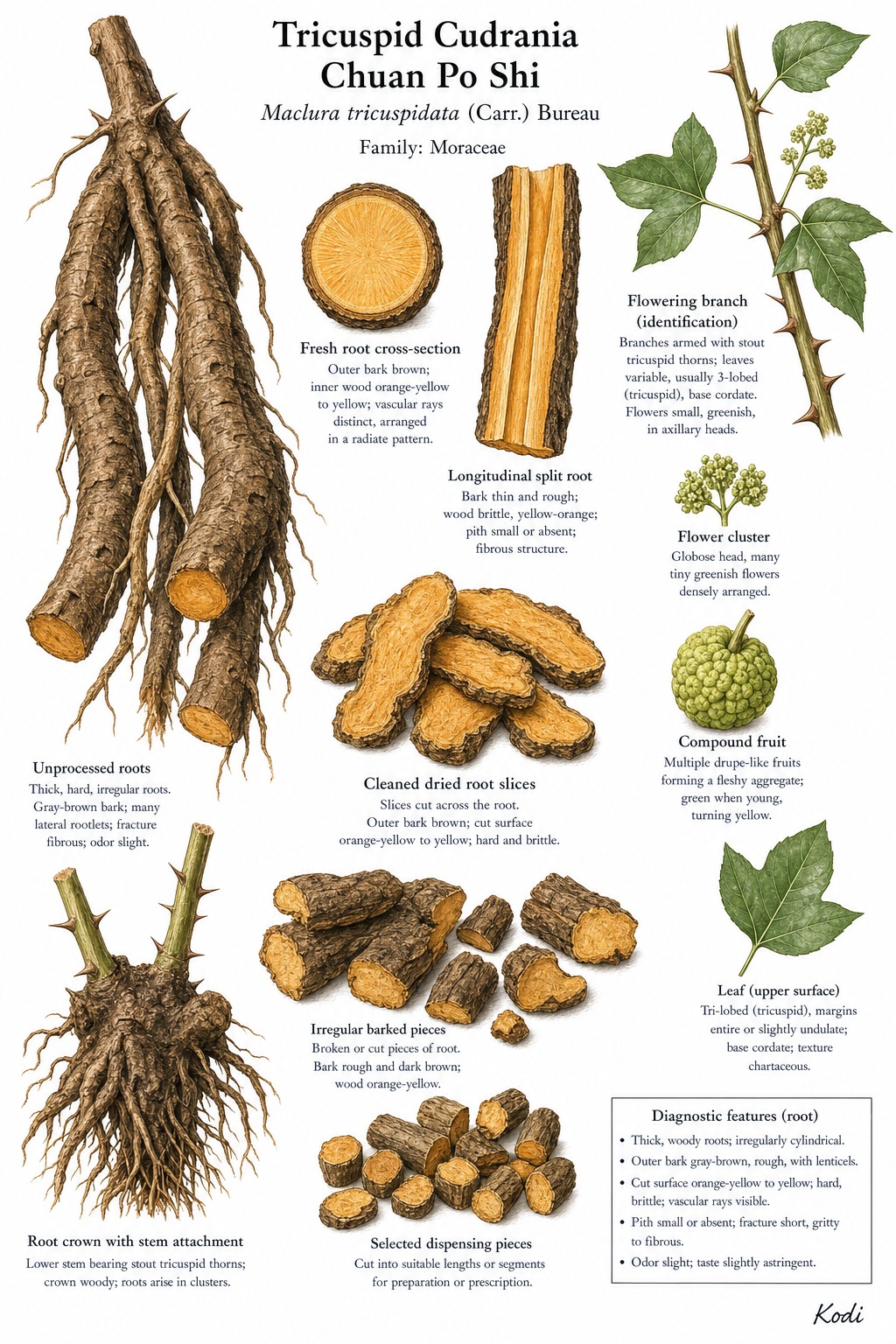
Known in TCM as Chuan Po Shi (穿破石), this bitter, slightly cool herb enters the Liver and Stomach. Traditionally, it dispels wind-damp and unblocks the channels ... Chuan Po Shi is a regional root medicine for rheumatic pain, lower-body soreness, and lingering obstruction with swelling or stiffness, most often applied for jaundice, joint pain, and traumatic injury. Modern research has identified Prenylated among its active constituents.
Part used: Root
Also Known As
Latin: Radix Cudraniae | Pinyin: Chuan Po Shi | Chinese: 穿破石
TCM Properties
- Taste
- bitter
- Temperature
- slightly cool
- Channels
- Liver, Stomach
Traditional Use
Primary Actions
- Dispels wind-damp and unblocks the channels ... Chuan Po Shi is a regional root medicine for rheumatic pain, lower-body soreness, and lingering obstruction with swelling or stiffness.
- Clears damp-heat and relieves jaundice ... southern folk use repeatedly places it in formulas for yellowing disorders, turbid damp accumulation, and heat lodged in the Liver-Gallbladder axis.
- Resolves toxicity and reduces swelling ... it is applied to boils, abscesses, and inflamed lesions when heat, toxin, and local stasis combine.
- Moves Blood and relieves traumatic pain ... the root appears in injury and fracture traditions where bruising, fixed pain, and collateral obstruction need a penetrating root rather than a gentle tonic.
Secondary Actions
- This page follows the local botanical-plate lane on accepted `Maclura tricuspidata`, but regional materia medica can also attach the Chuan Po Shi name to closely related Moraceae roots ... authentication matters.
- Compared with better-standardized national pharmacopoeia herbs, Chuan Po Shi remains a more regional Lingnan and folk-medicine root, so traditional claims should be framed conservatively.
Classic Formulas
- Regional jaundice and hepatitis decoctions with Yin Chen, Ji Gu Cao, or Tu Fu Ling ... common southern pairing logic when damp-heat and swelling dominate.
- Trauma and painful-obstruction combinations with Ji Xue Teng, Niu Xi, or Ru Xiang ... used when bruising, channel blockage, and rheumatic soreness overlap.
- Heat-toxin and swelling formulas with Pu Gong Ying or Jin Yin Hua ... a traditional extension of the root's detoxifying and swelling-reducing role.
Classical References
- Lingnan herb traditions classify Chuan Po Shi among roots that clear heat, dispel dampness, open the collaterals, and reduce painful swelling.
- Older regional herb descriptions also connect it with jaundice, traumatic injury, and stubborn rheumatic pain rather than with mainstream tonic use.
Modern Research
Active Compounds
- Prenylated flavonoids and xanthones ... the best-known bioactive classes discussed across Maclura and historical Cudrania research
- Phenolic acids including protocatechuic, isovanillic, and p-hydroxybenzoic acids ... compounds tied to antithrombotic and antioxidant studies
- Additional polyphenols and antibacterial isoflavones ... supportive constituents in species-level pharmacology work
Studied Effects
- A 2020 review summarized antitumor compounds from Cudrania tricuspidata, showing that the broader species has generated real modern pharmacology interest even though human trials remain sparse (PMID 30582344).
- A 2022 in vitro study examined phenolic acids from Maclura tricuspidata and reported antithrombotic activity alongside hematologic-toxicity evaluation, giving a more mechanistic look at constituent behavior (PMID 35684431).
- A 2021 study reported antibacterial activity of prenylated isoflavones from Maclura tricuspidata, reinforcing that much of the indexed evidence remains species-level and preclinical rather than clinical or root-specific (PMID 34946533).
PubMed References
- Bioactive compounds from Cudrania tricuspidata: A natural anticancer source. (2020)
- In Vitro Antithrombotic, Hematological Toxicity, and Inhibitor Studies of Protocatechuic, Isovanillic, and p-Hydroxybenzoic Acids from Maclura tricuspidata (Carr.) Bur. (2022)
- Antibacterial Activities of Prenylated Isoflavones from Maclura tricuspidata against Fish Pathogenic Streptococcus: Their Structure-Activity Relationships and Extraction Optimization. (2021)
Safety & Interactions
Contraindications
- Cold deficiency patterns without damp-heat, toxin, or stasis
- Pregnancy or attempts to conceive when blood-moving herbs are unnecessary
Cautions
- Direct modern safety data on authenticated Chuan Po Shi root are limited, so concentrated extracts and long-term unsupervised use deserve caution.
- Because the regional name can float across related Moraceae roots, product identity should be verified rather than assumed from the English name alone.
Conditions
- Jaundice Traditional ★★★☆☆ JSON
- Joint Pain Traditional ★★★☆☆ JSON
- Traumatic Injury Traditional ★★☆☆☆ JSON
- Hepatitis Traditional ★★☆☆☆ JSON
Frequently Asked Questions
What is Chuan Po Shi Root used for?
Chuan Po Shi Root is traditionally used to Dispels wind-damp and unblocks the channels ... Chuan Po Shi is a regional root medicine for rheumatic pain, lower-body soreness, and lingering obstruction with swelling or stiffness., Clears damp-heat and relieves jaundice ... southern folk use repeatedly places it in formulas for yellowing disorders, turbid damp accumulation, and heat lodged in the Liver-Gallbladder axis., Resolves toxicity and reduces swelling ... it is applied to boils, abscesses, and inflamed lesions when heat, toxin, and local stasis combine., Moves Blood and relieves traumatic pain ... the root appears in injury and fracture traditions where bruising, fixed pain, and collateral obstruction need a penetrating root rather than a gentle tonic.. Research has investigated its effects on: A 2020 review summarized antitumor compounds from Cudrania tricuspidata, showing that the broader species has generated real modern pharmacology interest even though human trials remain sparse (PMID 30582344).; A 2022 in vitro study examined phenolic acids from Maclura tricuspidata and reported antithrombotic activity alongside hematologic-toxicity evaluation, giving a more mechanistic look at constituent behavior (PMID 35684431)..
What are other names for Chuan Po Shi Root?
Chuan Po Shi Root is also known as Maclura tricuspidata Root, Cudrania Root, Chuan Po Shi. In TCM: 穿破石 (Chuan Po Shi); Radix Cudraniae.
Is Chuan Po Shi Root safe during pregnancy?
The safety of Chuan Po Shi Root during pregnancy has not been established. Consult a qualified healthcare provider before use.
What are the contraindications for Chuan Po Shi Root?
Chuan Po Shi Root should not be used in: Cold deficiency patterns without damp-heat, toxin, or stasis; Pregnancy or attempts to conceive when blood-moving herbs are unnecessary. Consult a qualified healthcare provider before use.