Root of Tatarian Aster
- Chinese
- 紫菀
- Pinyin
- Zi Wan
- Latin
- Radix Asteris
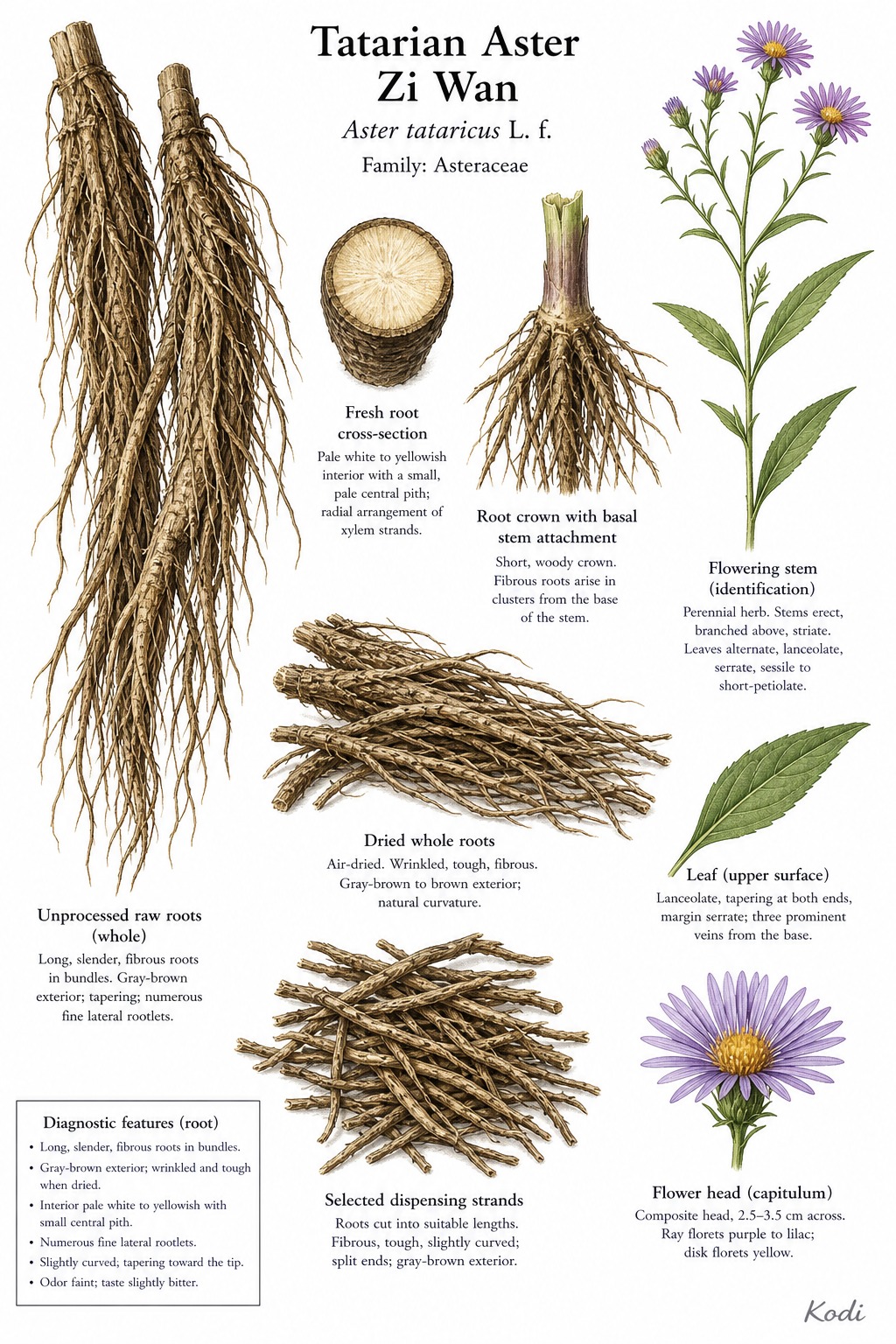
Known in TCM as Zi Wan (紫菀), this bitter and acrid, slightly warm herb enters the Lung. Traditionally, it moistens the Lung and transforms phlegm while stopping cough ... raw Zi Wan is a core cough-lane root for chronic, lingering, or difficult-to-resolve respiratory patterns, most often applied for cough, productive cough, and dry cough. Modern research has identified Shionone-related among its active constituents.
Part used: Root
Also Known As
Latin: Radix Asteris | Pinyin: Zi Wan | Chinese: 紫菀
TCM Properties
- Taste
- bitter, acrid
- Temperature
- slightly warm
- Channels
- Lung
Traditional Use
Primary Actions
- Moistens the Lung and transforms phlegm while stopping cough ... raw Zi Wan is a core cough-lane root for chronic, lingering, or difficult-to-resolve respiratory patterns.
- Directs rebellious Lung Qi downward ... it is used when coughing comes with wheezing, stubborn sputum, or difficulty getting the Lung to descend smoothly.
- Keeps some moistening even while expelling phlegm ... this lets Zi Wan bridge dry-irritative cough and cough with sticky difficult sputum.
Secondary Actions
- This is the raw fibrous-root sibling and should stay clearly separate from the already-live prepared Zi Wan page.
- Compared with the prepared form, the raw root reads a little rougher and more direct in its cough and phlegm lane.
Classic Formulas
- Zhi Sou San ... classic lingering-cough formula in which Zi Wan is one of the core antitussive roots.
- Bai Bu Tang and similar cough prescriptions ... Zi Wan commonly pairs with Bai Bu for stubborn cough with weak Lung descent.
- Mixed phlegm-dryness formulas with Bai Qian, Kuan Dong Hua, or Jie Geng ... common logic when downward movement and expectoration are both needed.
Classical References
- Traditional materia medica places Zi Wan among the key roots that moisten the Lung, transform phlegm, and direct Qi downward.
- The raw and prepared forms overlap, but processing changes texture and handling enough that the two pages should not collapse into one.
Modern Research
Active Compounds
- Shionone-related triterpenes ... hallmark constituents of Zi Wan pharmacology
- Flavonoid and phenolic fractions ... supportive anti-inflammatory and antioxidant compounds
- Root extract fractions associated with expectorant and antitussive activity
Studied Effects
- A 2025 review summarized the botany, phytochemistry, ethnopharmacology, pharmacology, toxicology, and utilization of Aster tataricus, confirming its long-established role as a respiratory root medicine (PMID 40271061).
- A 2024 updated review revisited the morphology, ethnomedicinal uses, phytochemistry, and pharmacological activity of Aster tataricus and reinforced the breadth of the Zi Wan literature (PMID 39166058).
- A 2015 study found expectorant, antitussive, and anti-inflammatory activities from Aster tataricus, aligning closely with the raw root's classical clinical role (PMID 25701752).
PubMed References
- Aster tataricus L. f.: a review on the botany, phytochemistry, ethnopharmacology, pharmacology, toxicology and comprehensive utilization. (2025)
- An updated and comprehensive review of the morphology, ethnomedicinal uses, phytochemistry, and pharmacological activity of Aster tataricus L. f. (2024)
- Expectorant, antitussive, anti-inflammatory activities and compositional analysis of Aster tataricus. (2015)
Safety & Interactions
Cautions
- Evidence for distinctions between raw and prepared Zi Wan is still less standardized than the broader Aster tataricus literature.
- Use carefully if cough is driven by non-Lung patterns or if rough warm roots aggravate dryness rather than relieve it.
Conditions
- Cough Traditional ★★★★☆ JSON
- Productive Cough Traditional ★★★★☆ JSON
- Dry Cough Traditional ★★★☆☆ JSON
- Wheezing Traditional ★★☆☆☆ JSON
- Phlegm Accumulation Traditional ★★☆☆☆ JSON
Frequently Asked Questions
What is Root of Tatarian Aster used for?
Root of Tatarian Aster is traditionally used to Moistens the Lung and transforms phlegm while stopping cough ... raw Zi Wan is a core cough-lane root for chronic, lingering, or difficult-to-resolve respiratory patterns., Directs rebellious Lung Qi downward ... it is used when coughing comes with wheezing, stubborn sputum, or difficulty getting the Lung to descend smoothly., Keeps some moistening even while expelling phlegm ... this lets Zi Wan bridge dry-irritative cough and cough with sticky difficult sputum.. Research has investigated its effects on: A 2025 review summarized the botany, phytochemistry, ethnopharmacology, pharmacology, toxicology, and utilization of Aster tataricus, confirming its long-established role as a respiratory root medicine (PMID 40271061).; A 2024 updated review revisited the morphology, ethnomedicinal uses, phytochemistry, and pharmacological activity of Aster tataricus and reinforced the breadth of the Zi Wan literature (PMID 39166058)..
What are other names for Root of Tatarian Aster?
Root of Tatarian Aster is also known as Raw Zi Wan, Aster Root. In TCM: 紫菀 (Zi Wan); Radix Asteris.
Is Root of Tatarian Aster safe during pregnancy?
The safety of Root of Tatarian Aster during pregnancy has not been established. Consult a qualified healthcare provider before use.