Root of Tali Madder
- Chinese
- 茜草
- Pinyin
- Qian Cao
- Latin
- Radix Rubiae
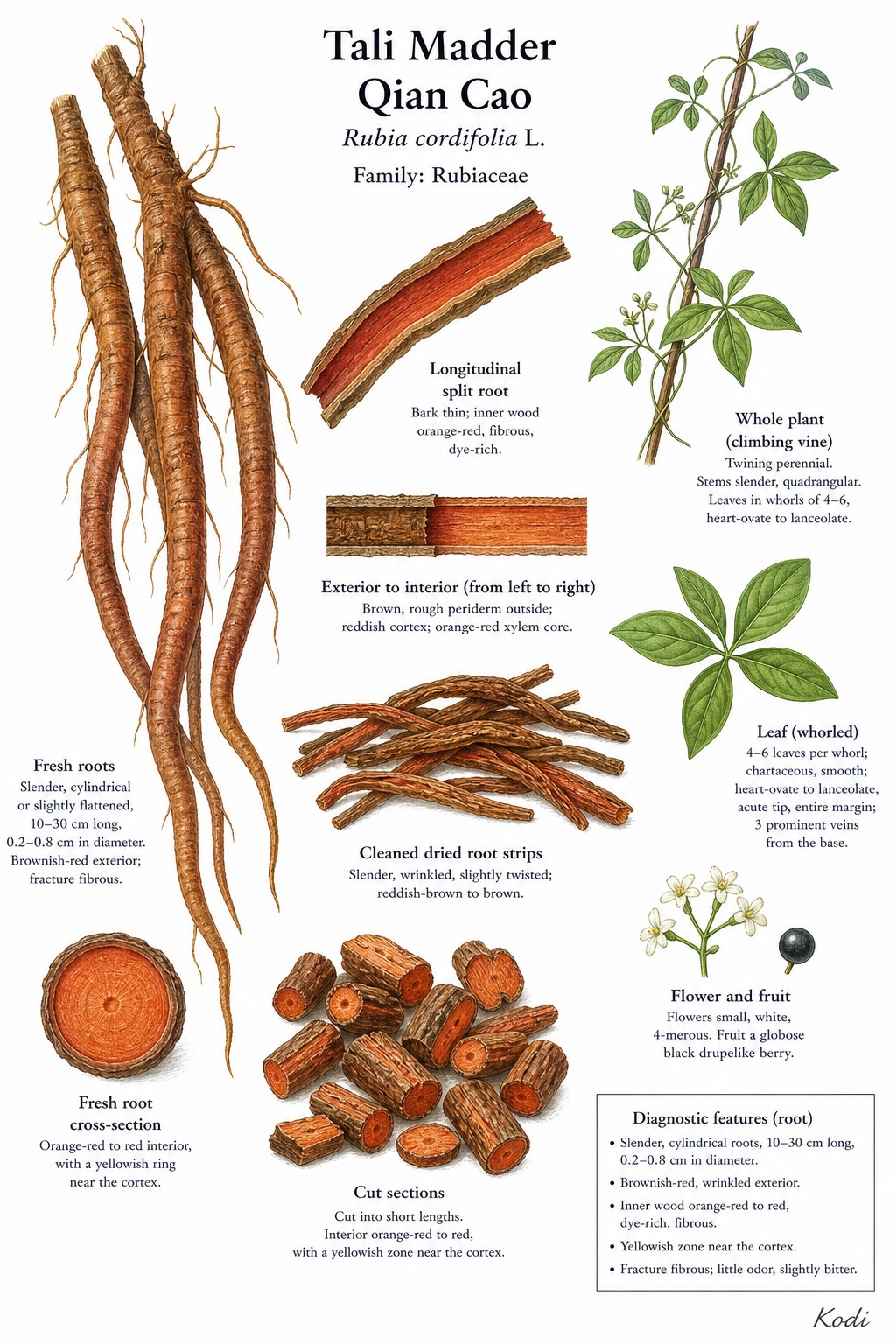
Known in TCM as Qian Cao (茜草), this bitter, cold herb enters the Liver. Traditionally, it cools Blood and stops bleeding ... Qian Cao is used when heat in the Blood leads to hemoptysis, nosebleed tendencies, or uterine bleeding patterns, most often applied for hemoptysis, menstrual irregularities, and amenorrhea. Modern research has identified Anthraquinones among its active constituents.
Part used: Root
Also Known As
Latin: Radix Rubiae | Pinyin: Qian Cao | Chinese: 茜草
TCM Properties
- Taste
- bitter
- Temperature
- cold
- Channels
- Liver
Traditional Use
Primary Actions
- Cools Blood and stops bleeding ... Qian Cao is used when heat in the Blood leads to hemoptysis, nosebleed tendencies, or uterine bleeding patterns.
- Invigorates Blood and dispels stasis ... unlike purely astringent hemostatics, the raw root also treats amenorrhea, trauma, and fixed pain where bleeding and stasis overlap.
- Bridges bleeding and movement logic ... this dual action explains why raw and charred forms are used differently in practice.
Secondary Actions
- The raw root is more Blood-moving, while charred Qian Cao Tan leans more strongly toward restraining bleeding.
- Qian Cao is especially useful when the clinician wants to stop bleeding without trapping old stasis.
Classic Formulas
- Shi Hui San style hemostatic traditions ... Qian Cao Tan appears when upper-body bleeding from Blood heat needs cooling and restraint.
- Amenorrhea and stasis formulas with Tao Ren or Hong Hua ... the raw root is chosen when absent menses and congealed Blood coexist.
- Trauma combinations with San Qi or Ru Xiang ... used when bruising and residual stasis require both movement and cooling.
Classical References
- Traditional herbology emphasizes that Qian Cao can both cool Blood and move Blood, a combination not shared by many other hemostatic roots.
- Processing changes its emphasis, which is why raw and charred forms should not be flattened into one clinical meaning.
Modern Research
Active Compounds
- Anthraquinones such as rubiadin ... major signature constituents of Rubia cordifolia root
- Naphthoquinone and triterpenoid fractions ... recurrent compounds in Qian Cao phytochemistry
- Phenolic constituents relevant to antioxidant, anti-inflammatory, and hepatoprotective research
Studied Effects
- A 2022 comprehensive review summarized traditional uses, phytochemistry, pharmacological activities, and clinical applications of Rubia cordifolia, making it a strong modern overview reference for Qian Cao (PMID 36160419).
- A 2016 review on Rubiae Radix et Rhizoma covered botany, phytochemistry, pharmacology, and toxicology and remains a useful foundation for understanding the root's dual hemostatic and blood-moving profile (PMID 27999402).
- A 2006 study reported hepatoprotective effects of rubiadin, one of the major constituents of Rubia cordifolia, illustrating that modern Qian Cao research extends beyond bleeding and stasis alone (PMID 16213120).
PubMed References
- A comprehensive review of Rubia cordifolia L.: Traditional uses, phytochemistry, pharmacological activities, and clinical applications. (2022)
- A Review of the Botany, Phytochemistry, Pharmacology and Toxicology of Rubiae Radix et Rhizoma. (2016)
- Hepatoprotective effects of rubiadin, a major constituent of Rubia cordifolia Linn. (2006)
Safety & Interactions
Contraindications
- Pregnancy when Blood-moving roots are inappropriate
- Bleeding from deficiency-cold without heat or stasis
Cautions
- Raw Qian Cao moves Blood more strongly than charred Qian Cao Tan, so processed form matters clinically.
- Use cautiously when bleeding is already severe and the pattern does not include obvious heat or stasis.
Conditions
- Hemoptysis Traditional ★★★☆☆ JSON
- Menstrual Irregularities Traditional ★★★☆☆ JSON
- Amenorrhea Traditional ★★☆☆☆ JSON
- Traumatic Injury Traditional ★★★☆☆ JSON
Frequently Asked Questions
What is Root of Tali Madder used for?
Root of Tali Madder is traditionally used to Cools Blood and stops bleeding ... Qian Cao is used when heat in the Blood leads to hemoptysis, nosebleed tendencies, or uterine bleeding patterns., Invigorates Blood and dispels stasis ... unlike purely astringent hemostatics, the raw root also treats amenorrhea, trauma, and fixed pain where bleeding and stasis overlap., Bridges bleeding and movement logic ... this dual action explains why raw and charred forms are used differently in practice.. Research has investigated its effects on: A 2022 comprehensive review summarized traditional uses, phytochemistry, pharmacological activities, and clinical applications of Rubia cordifolia, making it a strong modern overview reference for Qian Cao (PMID 36160419).; A 2016 review on Rubiae Radix et Rhizoma covered botany, phytochemistry, pharmacology, and toxicology and remains a useful foundation for understanding the root's dual hemostatic and blood-moving profile (PMID 27999402)..
What are other names for Root of Tali Madder?
Root of Tali Madder is also known as Qian Cao Gen, Rubia Root. In TCM: 茜草 (Qian Cao); Radix Rubiae.
Is Root of Tali Madder safe during pregnancy?
The safety of Root of Tali Madder during pregnancy has not been established. Consult a qualified healthcare provider before use.
What are the contraindications for Root of Tali Madder?
Root of Tali Madder should not be used in: Pregnancy when Blood-moving roots are inappropriate; Bleeding from deficiency-cold without heat or stasis. Consult a qualified healthcare provider before use.