Qing Mu Xiang Root
- Chinese
- 青木香
- Pinyin
- Qing Mu Xiang
- Latin
- Radix Aristolochiae
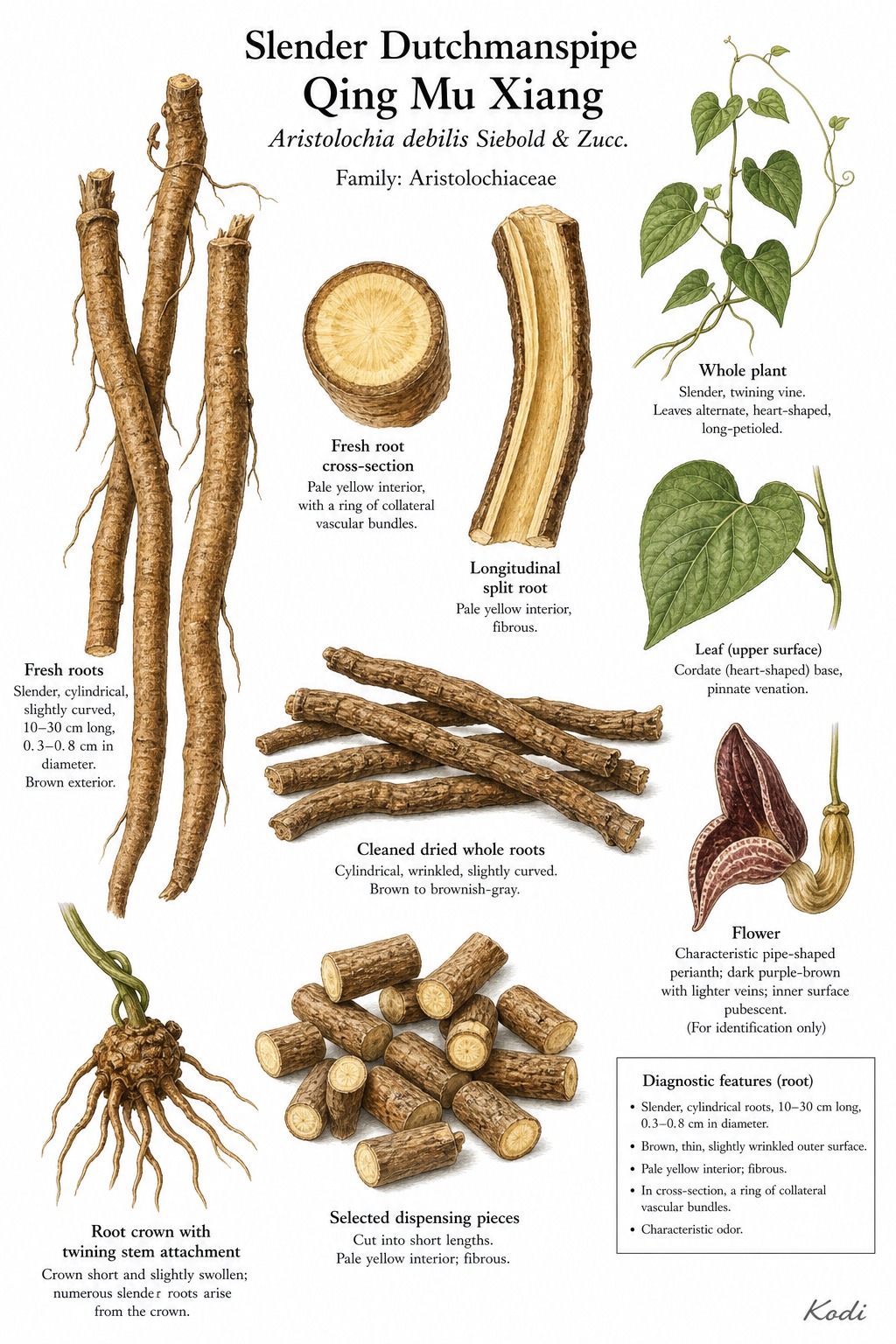
Known in TCM as Qing Mu Xiang (青木香), this bitter and acrid, cold herb enters the Liver and Stomach. Traditionally, it historically moved Qi and relieved pain ... older materia medica traditions used Qing Mu Xiang for abdominal pain, dysenteric discomfort, and some obstructive pain patterns, most often applied for abdominal pain, dysentery, and traumatic injury. Modern research has identified Aristolochic among its active constituents.
Part used: Root
Also Known As
Latin: Radix Aristolochiae | Pinyin: Qing Mu Xiang | Chinese: 青木香
TCM Properties
- Taste
- bitter, acrid
- Temperature
- cold
- Channels
- Liver, Stomach
Traditional Use
Primary Actions
- Historically moved Qi and relieved pain ... older materia medica traditions used Qing Mu Xiang for abdominal pain, dysenteric discomfort, and some obstructive pain patterns.
- Historically reduced swelling and some forms of painful obstruction ... but modern safety understanding has radically changed how the herb must be framed.
- In current practice this page functions mainly as an identification and safety record ... not as a casual recommendation for home use.
Secondary Actions
- Qing Mu Xiang must never be confused with true Mu Xiang from Dolomiaea costus or other non-Aristolochia costus-root lanes.
- This is a toxicity-first historical herb page because aristolochic acids define its modern clinical risk profile.
Classic Formulas
- Older gastrointestinal and pain prescriptions sometimes used Qing Mu Xiang before modern toxicology clarified the risk carried by Aristolochia roots.
- Modern authentication work now treats Qing Mu Xiang mainly as a dangerous substitute to exclude from Mu Xiang supply chains.
Classical References
- Traditional herb records preserved digestive and pain-relief uses for Qing Mu Xiang, but contemporary safety standards require a very different reading of the herb.
- The historical naming confusion with Mu Xiang is clinically important because the two roots do not share the same toxicology.
Modern Research
Active Compounds
- Aristolochic acids ... the defining toxic constituents and the main reason the herb now carries major nephrotoxic and carcinogenic concern
- Aristolactam-related metabolites ... additional compounds of toxicologic interest in Aristolochia species
- Authentication markers used to distinguish toxic Aristolochia material from safer Mu Xiang trade roots
Studied Effects
- A 2022 comparative analysis measured aristolochic acids across Aristolochia medicinal herbs and evaluated their toxicities, reinforcing why Qing Mu Xiang cannot be treated like an ordinary pain herb (PMID 36548776).
- A 2023 zebrafish-model study explored aristolochic-acid-related nephrotoxicity, adding more experimental support to the kidney-risk concern surrounding Aristolochia use (PMID 37804820).
- A 2007 authentication study on Radix Aucklandiae and its substitutes remains directly relevant because distinguishing safe Mu Xiang from Aristolochia substitutes is a practical safety task, not just a taxonomic exercise (PMID 18004716).
PubMed References
- Comparative Analysis of Aristolochic Acids in Aristolochia Medicinal Herbs and Evaluation of Their Toxicities. (2022)
- Investigation of the applicability of the zebrafish model for the evaluation of aristolochic acid-related nephrotoxicity. (2023)
- Authentication of Radix Aucklandiae and its substitutes by GC-MS and hierarchical clustering analysis. (2007)
Safety & Interactions
Contraindications
- Pregnancy
- Kidney disease or any renal vulnerability
- Any unsupervised or prolonged internal use
- Substitution for true Mu Xiang in digestive formulas
Cautions
- Aristolochic acids are linked to serious nephrotoxicity and urothelial cancer risk.
- This herb should be treated as a high-risk historical identification record rather than as a routine self-care digestive root.
- Source confusion with costus-root products is one of the main real-world dangers.
Conditions
- Abdominal Pain Traditional ★★☆☆☆ JSON
- Dysentery Traditional ★★☆☆☆ JSON
- Traumatic Injury Traditional ★★☆☆☆ JSON
Frequently Asked Questions
What is Qing Mu Xiang Root used for?
Qing Mu Xiang Root is traditionally used to Historically moved Qi and relieved pain ... older materia medica traditions used Qing Mu Xiang for abdominal pain, dysenteric discomfort, and some obstructive pain patterns., Historically reduced swelling and some forms of painful obstruction ... but modern safety understanding has radically changed how the herb must be framed., In current practice this page functions mainly as an identification and safety record ... not as a casual recommendation for home use.. Research has investigated its effects on: A 2022 comparative analysis measured aristolochic acids across Aristolochia medicinal herbs and evaluated their toxicities, reinforcing why Qing Mu Xiang cannot be treated like an ordinary pain herb (PMID 36548776).; A 2023 zebrafish-model study explored aristolochic-acid-related nephrotoxicity, adding more experimental support to the kidney-risk concern surrounding Aristolochia use (PMID 37804820)..
What are other names for Qing Mu Xiang Root?
Qing Mu Xiang Root is also known as Root of Slender Dutchmanspipe, Aristolochia Root. In TCM: 青木香 (Qing Mu Xiang); Radix Aristolochiae.
Is Qing Mu Xiang Root safe during pregnancy?
Qing Mu Xiang Root is not recommended during pregnancy.
What are the contraindications for Qing Mu Xiang Root?
Qing Mu Xiang Root should not be used in: Pregnancy; Kidney disease or any renal vulnerability; Any unsupervised or prolonged internal use; Substitution for true Mu Xiang in digestive formulas. Consult a qualified healthcare provider before use.