Root of Scarlet Kadsura
- Chinese
- 黑老虎根
- Pinyin
- Hei Lao Hu Gen
- Latin
- Radix Kadsurae Coccineae
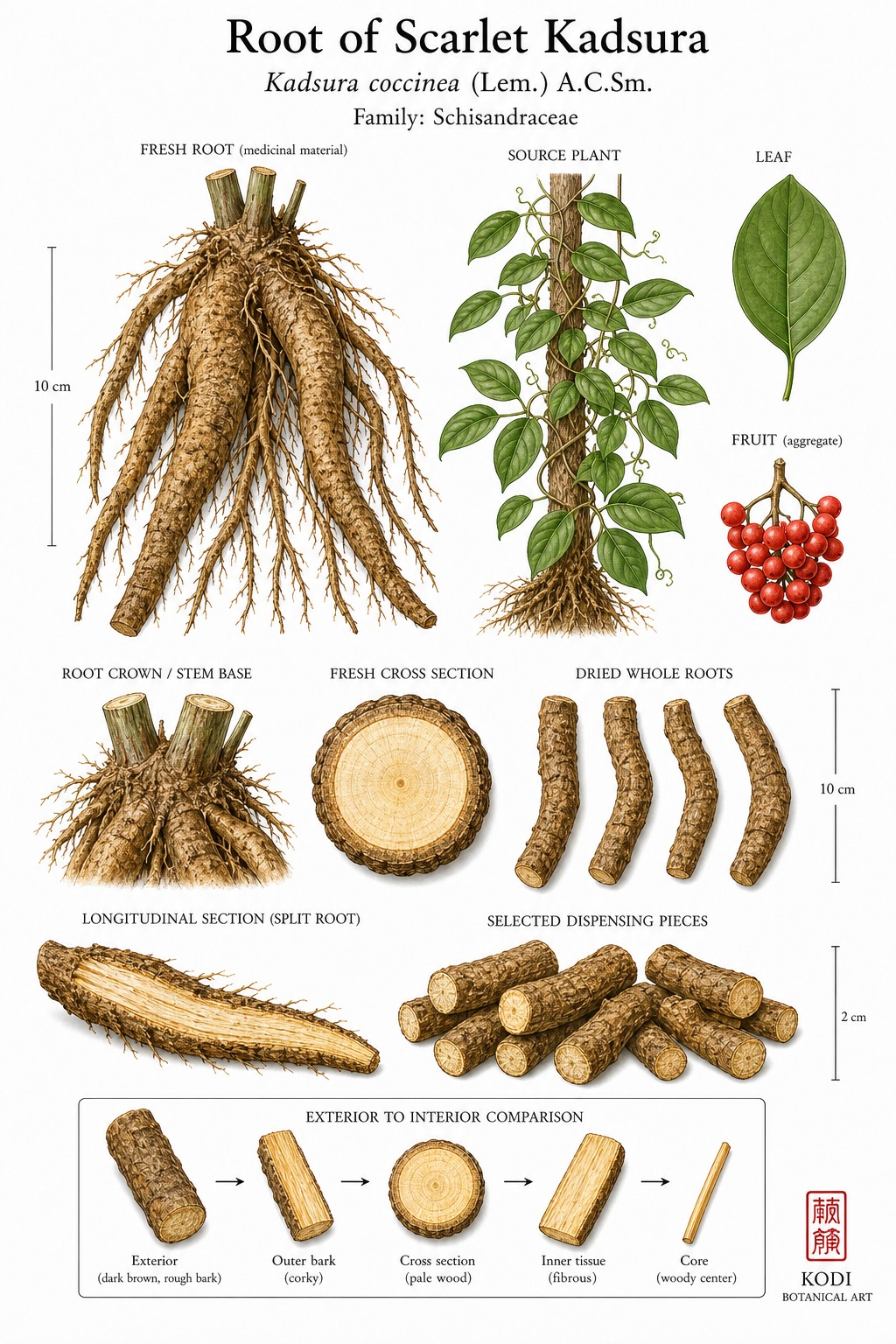
Known in TCM as Hei Lao Hu Gen (黑老虎根), this acrid and slightly bitter, warm herb enters the Spleen, Stomach, Large Intestine, Liver, and Gallbladder. Traditionally, it moves Qi and alleviates pain ... Hei Lao Hu Gen is a regional southern root for distending or fixed pain in the chest, abdomen, flanks, and lower body when stagnation is prominent, most often applied for abdominal pain, chest pain, and rheumatism. Modern research has identified Lignans among its active constituents.
Part used: Root
Also Known As
Latin: Radix Kadsurae Coccineae | Pinyin: Hei Lao Hu Gen | Chinese: 黑老虎根
TCM Properties
- Taste
- acrid, slightly bitter
- Temperature
- warm
- Channels
- Spleen, Stomach, Large Intestine, Liver, Gallbladder
Traditional Use
Primary Actions
- Moves Qi and alleviates pain ... Hei Lao Hu Gen is a regional southern root for distending or fixed pain in the chest, abdomen, flanks, and lower body when stagnation is prominent.
- Invigorates Blood and reduces stasis-related pain ... trauma, bruising, and chronic obstructive pain are common extension uses.
- Dispels wind-damp and frees the collaterals ... the root is also used when rheumatic aching or weakness mixes with stagnation and cold.
Secondary Actions
- This page keeps the focus on the medicinal root rather than the showy fruiting vine that usually dominates ornamental attention.
- Hei Lao Hu Gen behaves more like a southern qi-moving analgesic root than a major classical tonic.
Classic Formulas
- Regional pain-relief decoctions with Yan Hu Suo or Mu Xiang ... common logic when distension and obstruction dominate.
- Trauma and bruising combinations with Ru Xiang, Mo Yao, or San Qi ... used when stasis and pain persist after injury.
- Wind-damp pain pairings with Du Huo or Niu Xi ... a practical strategy when aching limbs and lower-body stagnation overlap.
Classical References
- Southern herbology places Hei Lao Hu Gen among warm acrid roots that move Qi, move Blood, and relieve pain.
- Its traditional identity is strongly regional and pain-focused rather than broadly canonical across all materia medica lineages.
Modern Research
Active Compounds
- Lignans and nortriterpenoids ... major structural families emphasized in Kadsura coccinea chemistry
- Acetylbinankadsurin A and related specialized metabolites ... compounds drawing newer mechanistic interest
- Phenolic and anti-inflammatory fractions ... supportive constituents discussed across genus-level reviews
Studied Effects
- A 2026 review on the genus Kadsura summarized ethnobotany, pharmacology, and molecular pharmacognosy and helps place Hei Lao Hu Gen within a broader but increasingly active research lane (PMID 41890901).
- A 2020 review described Kadsura coccinea as a rich source of structurally diverse and biologically important compounds, explaining why the species attracts disproportionate chemistry interest relative to its regional herb status (PMID 36119004).
- A 2024 study explored the mechanism of acetylbinankadsurin A in liver fibrosis, showing how Kadsura coccinea research is now moving from constituent cataloging toward pathway-level experimentation (PMID 38169205).
PubMed References
- A review on the genus Kadsura: ethnobotany, pharmacology, and molecular pharmacognosy. (2026)
- Kadsura coccinea: A rich source of structurally diverse and biologically important compounds. (2020)
- Network pharmacology combines machine learning, molecular simulation dynamics and experimental validation to explore the mechanism of acetylbinankadsurin A in the treatment of liver fibrosis. (2024)
Safety & Interactions
Contraindications
- Pregnancy if strong Qi- and Blood-moving roots are inappropriate
- Excess heat patterns without cold, stasis, or obstruction
Cautions
- Most modern evidence is preclinical and chemistry-heavy rather than based on standardized human root trials.
- Regional southern herbs can vary in sourcing and processing, so preparation identity matters.
Conditions
- Abdominal Pain Traditional ★★★★☆ JSON
- Chest Pain Traditional ★★★☆☆ JSON
- Rheumatism Traditional ★★★☆☆ JSON
- Traumatic Injury Traditional ★★★☆☆ JSON
- Low Back Pain Traditional ★★☆☆☆ JSON
Frequently Asked Questions
What is Root of Scarlet Kadsura used for?
Root of Scarlet Kadsura is traditionally used to Moves Qi and alleviates pain ... Hei Lao Hu Gen is a regional southern root for distending or fixed pain in the chest, abdomen, flanks, and lower body when stagnation is prominent., Invigorates Blood and reduces stasis-related pain ... trauma, bruising, and chronic obstructive pain are common extension uses., Dispels wind-damp and frees the collaterals ... the root is also used when rheumatic aching or weakness mixes with stagnation and cold.. Research has investigated its effects on: A 2026 review on the genus Kadsura summarized ethnobotany, pharmacology, and molecular pharmacognosy and helps place Hei Lao Hu Gen within a broader but increasingly active research lane (PMID 41890901).; A 2020 review described Kadsura coccinea as a rich source of structurally diverse and biologically important compounds, explaining why the species attracts disproportionate chemistry interest relative to its regional herb status (PMID 36119004)..
What are other names for Root of Scarlet Kadsura?
Root of Scarlet Kadsura is also known as Hei Lao Hu, Scarlet Kadsura Root. In TCM: 黑老虎根 (Hei Lao Hu Gen); Radix Kadsurae Coccineae.
Is Root of Scarlet Kadsura safe during pregnancy?
The safety of Root of Scarlet Kadsura during pregnancy has not been established. Consult a qualified healthcare provider before use.
What are the contraindications for Root of Scarlet Kadsura?
Root of Scarlet Kadsura should not be used in: Pregnancy if strong Qi- and Blood-moving roots are inappropriate; Excess heat patterns without cold, stasis, or obstruction. Consult a qualified healthcare provider before use.