Root of Scandent Schefflera
- Chinese
- 七叶莲
- Pinyin
- Qi Ye Lian
- Latin
- Radix Schefflerae Arboricolae
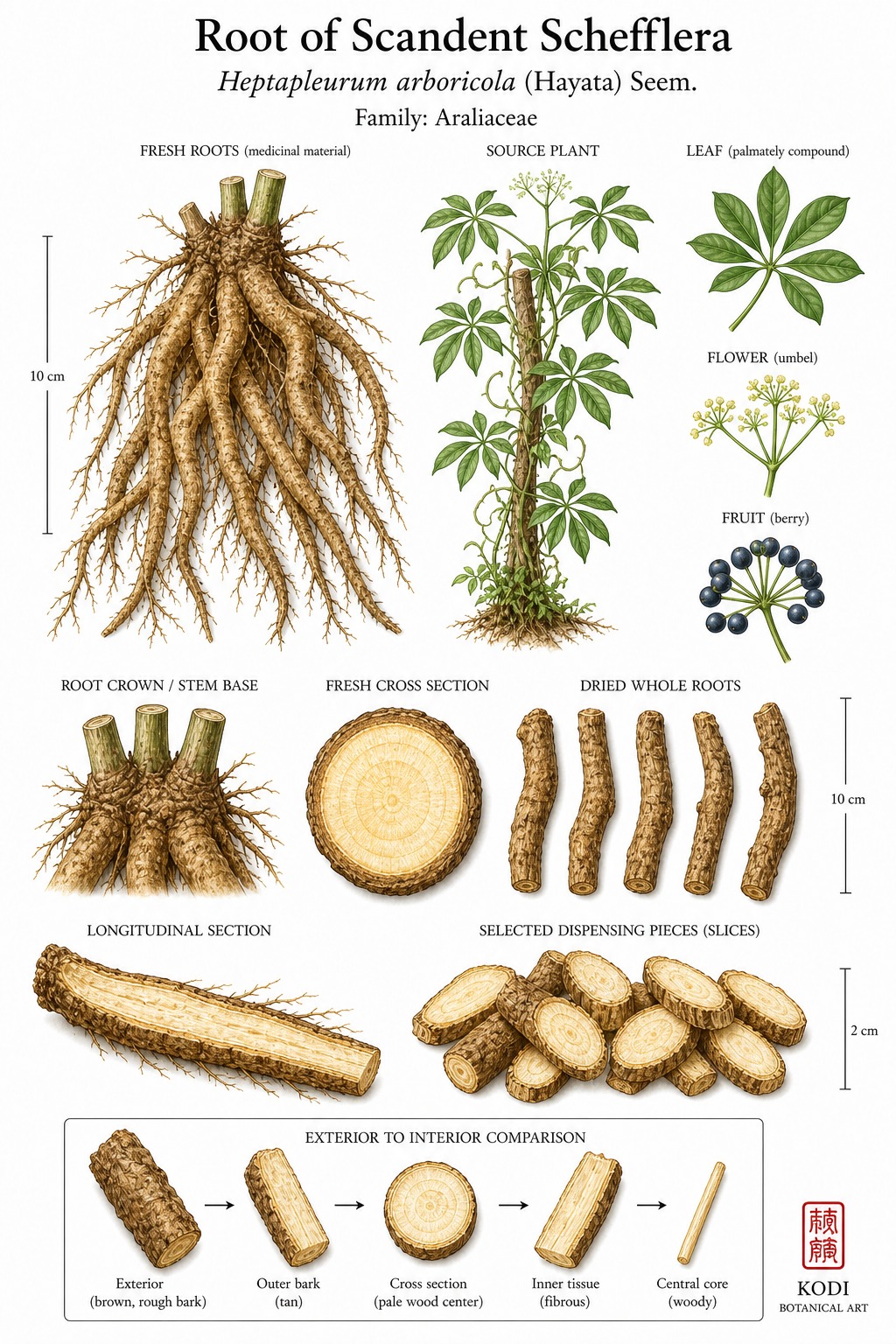
Known in TCM as Qi Ye Lian (七叶莲), this bitter and slightly sweet, warm herb enters the Liver. Traditionally, it dispels wind-damp and alleviates pain ... Qi Ye Lian is used regionally for aching joints, rheumatic obstruction, and heavy painful limbs, most often applied for joint pain, rheumatism, and traumatic injury. Modern research has identified Oleanane-type among its active constituents.
Part used: Root
Also Known As
Latin: Radix Schefflerae Arboricolae | Pinyin: Qi Ye Lian | Chinese: 七叶莲
TCM Properties
- Taste
- bitter, slightly sweet
- Temperature
- warm
- Channels
- Liver
Traditional Use
Primary Actions
- Dispels wind-damp and alleviates pain ... Qi Ye Lian is used regionally for aching joints, rheumatic obstruction, and heavy painful limbs.
- Invigorates Blood and opens the channels ... it is employed when trauma, bruising, or stagnation leave a fixed painful residue.
- Relieves constraining pain beyond the joints ... some traditions extend it to neuralgic, throat, or stomach-area pain when obstruction is the guiding pattern.
Secondary Actions
- This page keeps the accepted Heptapleurum arboricola identity while preserving the inherited medicinal Latin based on Schefflera arboricola.
- The medicinal literature for Qi Ye Lian is more regional and pain-oriented than the ornamental houseplant identity most people now associate with this species complex.
Classic Formulas
- Qi Ye Lian analgesic tablet traditions ... modern Chinese over-the-counter pain formulas built around the herb's channel-opening reputation.
- Wind-damp pain pairings with Du Huo, Wei Ling Xian, or Ji Xue Teng ... common strategy for aching obstructed limbs.
- Trauma and stasis combinations with Yan Hu Suo or Ru Xiang ... used when pain lingers after injury.
Classical References
- Modern Chinese herbology classifies Qi Ye Lian primarily through its pain-relieving, Blood-moving, and wind-damp-dispelling actions.
- Its strongest traditional identity is not tonic or culinary ... it is a practical analgesic vine-root medicine.
Modern Research
Active Compounds
- Oleanane-type triterpenes such as oleanolic-acid-related constituents ... repeatedly reported from Schefflera and Heptapleurum literature
- Phenolic and flavonoid fractions ... supportive antioxidant and anti-inflammatory constituents
- Volatile and metabolite-profile fractions ... explored in newer extract-level screening studies
Studied Effects
- A 2022 study on Schefflera arboricola leaf extract reported anti-inflammatory and hepatoprotective effects in a rat hepatic-encephalopathy model, showing the direction of current experimental interest under the older synonym (PMID 35234557).
- A 2026 study reported anti-Cryptosporidium activity and metabolite profiling for Schefflera arboricola leaf extract, again highlighting that modern evidence is emerging but remains focused mainly on aerial-part extracts rather than the medicinal root itself (PMID 42375426).
- Overall, Qi Ye Lian has stronger traditional pain-use continuity than it has species-specific root pharmacology in PubMed.
PubMed References
Safety & Interactions
Cautions
- Modern evidence is drawn mainly from leaf or whole-plant extracts under the Schefflera arboricola synonym, not from standardized medicinal root preparations.
- Pain-relief products built around Qi Ye Lian vary substantially in concentration and co-ingredients.
Conditions
- Joint Pain Traditional ★★★★☆ JSON
- Rheumatism Traditional ★★★★☆ JSON
- Traumatic Injury Traditional ★★★☆☆ JSON
- Abdominal Pain Traditional ★★☆☆☆ JSON
- Sore Throat Traditional ★★☆☆☆ JSON
Frequently Asked Questions
What is Root of Scandent Schefflera used for?
Root of Scandent Schefflera is traditionally used to Dispels wind-damp and alleviates pain ... Qi Ye Lian is used regionally for aching joints, rheumatic obstruction, and heavy painful limbs., Invigorates Blood and opens the channels ... it is employed when trauma, bruising, or stagnation leave a fixed painful residue., Relieves constraining pain beyond the joints ... some traditions extend it to neuralgic, throat, or stomach-area pain when obstruction is the guiding pattern.. Research has investigated its effects on: A 2022 study on Schefflera arboricola leaf extract reported anti-inflammatory and hepatoprotective effects in a rat hepatic-encephalopathy model, showing the direction of current experimental interest under the older synonym (PMID 35234557).; A 2026 study reported anti-Cryptosporidium activity and metabolite profiling for Schefflera arboricola leaf extract, again highlighting that modern evidence is emerging but remains focused mainly on aerial-part extracts rather than the medicinal root itself (PMID 42375426)..
What are other names for Root of Scandent Schefflera?
Root of Scandent Schefflera is also known as Schefflera Root, Heptapleurum Root. In TCM: 七叶莲 (Qi Ye Lian); Radix Schefflerae Arboricolae.
Is Root of Scandent Schefflera safe during pregnancy?
The safety of Root of Scandent Schefflera during pregnancy has not been established. Consult a qualified healthcare provider before use.