Guang Mu Xiang Root
- Chinese
- 广木香
- Pinyin
- Guang Mu Xiang
- Latin
- Radix Aucklandiae
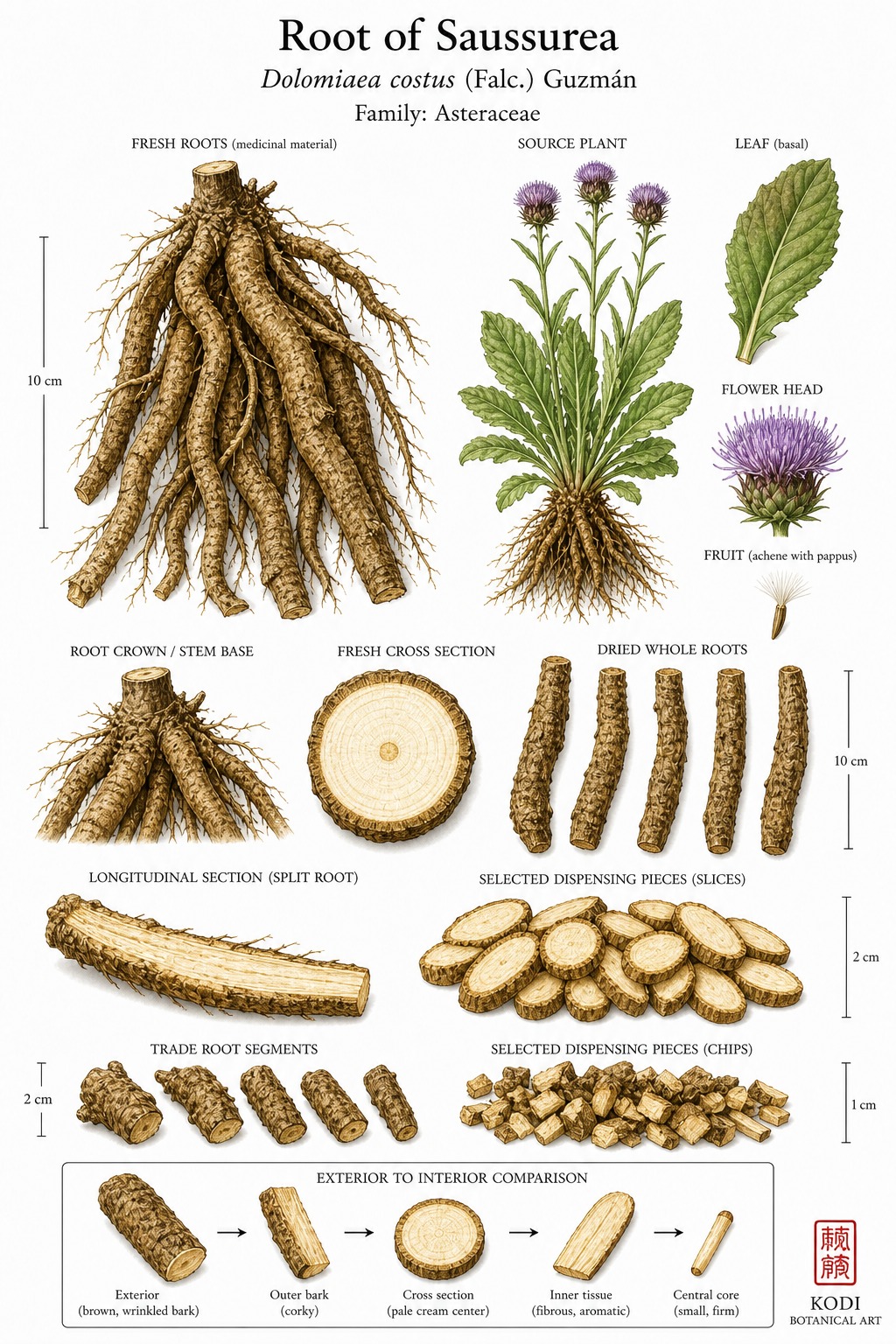
Known in TCM as Guang Mu Xiang (广木香), this acrid and bitter, warm herb enters the Spleen, Stomach, Large Intestine, Triple Burner, and Gallbladder. Traditionally, it moves Qi and alleviates pain in the middle burner ... Guang Mu Xiang is the trade-root-forward imported costus lane for epigastric fullness, abdominal cramping, distension, and food-stagnation discomfort, most often applied for abdominal pain, abdominal distension, and indigestion. Modern research has identified Costunolide among its active constituents.
Part used: Root
Also Known As
Latin: Radix Aucklandiae | Pinyin: Guang Mu Xiang | Chinese: 广木香
TCM Properties
- Taste
- acrid, bitter
- Temperature
- warm
- Channels
- Spleen, Stomach, Large Intestine, Triple Burner, Gallbladder
Traditional Use
Primary Actions
- Moves Qi and alleviates pain in the middle burner ... Guang Mu Xiang is the trade-root-forward imported costus lane for epigastric fullness, abdominal cramping, distension, and food-stagnation discomfort.
- Strengthens the Spleen and promotes digestion ... the aromatic root is often inserted into tonifying or damp-transforming formulas so rich ingredients do not create further stagnation.
- Regulates intestinal Qi and relieves tenesmus ... it is classically valued in dysenteric or diarrhea patterns where painful obstruction and incomplete evacuation dominate.
- Promotes Qi movement through the San Jiao ... beyond digestion, it can be used when constrained Qi creates chest, flank, or lower-abdominal discomfort.
Secondary Actions
- This page should be read as a trade-root-heavy sibling of the main Costus Root record, not as a different therapeutic plant from true Mu Xiang.
- Authenticated sourcing still matters because Guang Mu Xiang, Chuan Mu Xiang, and toxic Qing Mu Xiang have been confused in commerce for a very long time.
Classic Formulas
- Mu Xiang Bing Lang Wan ... accumulation-breaking formula where Guang Mu Xiang drives Qi through the intestines for distension, constipation, and tenesmus.
- Xiang Sha Liu Jun Zi Tang ... Spleen-tonifying formula where Mu Xiang prevents cloying tonics from worsening fullness and nausea.
- Xiang Lian Wan ... damp-heat dysentery pairing in which Mu Xiang regulates intestinal Qi while bitter heat-clearing herbs do the draining.
Classical References
- Traditional herbology treats Guang Mu Xiang as the imported aromatic Qi-regulating root fixed in the pharmacopoeial Mu Xiang lane.
- Historical notes repeatedly warn that trade-name confusion with Aristolochia-based Qing Mu Xiang creates a real safety problem rather than a mere naming quirk.
Modern Research
Active Compounds
- Costunolide ... a major sesquiterpene lactone marker for the costus-root medicinal group
- Dehydrocostus lactone ... another signature sesquiterpene heavily studied in inflammatory and gut-related models
- Saussureamine and volatile-oil fractions ... compounds linked to aromatic digestive and anti-inflammatory interest
Studied Effects
- A 2020 ethnopharmacology review on Aucklandia costus summarized the historical and medicinal significance of the plant and remains one of the best orientation points for the Guang Mu Xiang trade lane (PMID 32730877).
- A 2023 review focused specifically on Dolomiaea costus as a rich source of sesquiterpene lactones, reinforcing why costunolide and related constituents dominate modern Mu Xiang pharmacology (PMID 36625545).
- Dehydrocostus lactone suppressed dextran sulfate sodium-induced colitis through IKKalpha/beta-NF-kappaB and Keap1-Nrf2 signaling, providing a mechanistic bridge to Mu Xiang's traditional bowel-focused use (PMID 35321327).
PubMed References
- Aucklandia costus (Syn. Saussurea costus): Ethnopharmacology of an endangered medicinal plant of the himalayan region. (2020)
- Dolomiaea costus: an untapped mine of sesquiterpene lactones with wide magnificent biological activities. (2023)
- Dehydrocostus Lactone Suppresses Dextran Sulfate Sodium-Induced Colitis by Targeting the IKKα/β-NF-κB and Keap1-Nrf2 Signalling Pathways. (2022)
Safety & Interactions
Contraindications
- Yin deficiency with internal heat
- Lung deficiency with heat
- Severe Qi deficiency or collapse without stagnation
Cautions
- Large doses or prolonged unsupervised use can irritate the gastrointestinal tract and may be too drying for depleted constitutions.
- Authenticated sourcing matters because historical confusion with Qing Mu Xiang from Aristolochia species carries nephrotoxic and carcinogenic implications that do not belong to true Radix Aucklandiae.
Conditions
- Abdominal Pain Traditional ★★★★☆ JSON
- Abdominal Distension Traditional ★★★★☆ JSON
- Indigestion Traditional ★★★★☆ JSON
- Poor Appetite Traditional ★★★☆☆ JSON
- Diarrhea Traditional ★★★☆☆ JSON
- Dysentery Traditional ★★★☆☆ JSON
Frequently Asked Questions
What is Guang Mu Xiang Root used for?
Guang Mu Xiang Root is traditionally used to Moves Qi and alleviates pain in the middle burner ... Guang Mu Xiang is the trade-root-forward imported costus lane for epigastric fullness, abdominal cramping, distension, and food-stagnation discomfort., Strengthens the Spleen and promotes digestion ... the aromatic root is often inserted into tonifying or damp-transforming formulas so rich ingredients do not create further stagnation., Regulates intestinal Qi and relieves tenesmus ... it is classically valued in dysenteric or diarrhea patterns where painful obstruction and incomplete evacuation dominate., Promotes Qi movement through the San Jiao ... beyond digestion, it can be used when constrained Qi creates chest, flank, or lower-abdominal discomfort.. Research has investigated its effects on: A 2020 ethnopharmacology review on Aucklandia costus summarized the historical and medicinal significance of the plant and remains one of the best orientation points for the Guang Mu Xiang trade lane (PMID 32730877).; A 2023 review focused specifically on Dolomiaea costus as a rich source of sesquiterpene lactones, reinforcing why costunolide and related constituents dominate modern Mu Xiang pharmacology (PMID 36625545)..
What are other names for Guang Mu Xiang Root?
Guang Mu Xiang Root is also known as Root of Saussurea, Costus Root, Aucklandia. In TCM: 广木香 (Guang Mu Xiang); Radix Aucklandiae.
Is Guang Mu Xiang Root safe during pregnancy?
The safety of Guang Mu Xiang Root during pregnancy has not been established. Consult a qualified healthcare provider before use.
What are the contraindications for Guang Mu Xiang Root?
Guang Mu Xiang Root should not be used in: Yin deficiency with internal heat; Lung deficiency with heat; Severe Qi deficiency or collapse without stagnation. Consult a qualified healthcare provider before use.