Root of Pubescent Holly
- Chinese
- 毛冬青
- Pinyin
- Mao Dong Qing
- Latin
- Radix Ilicis Pubescentis
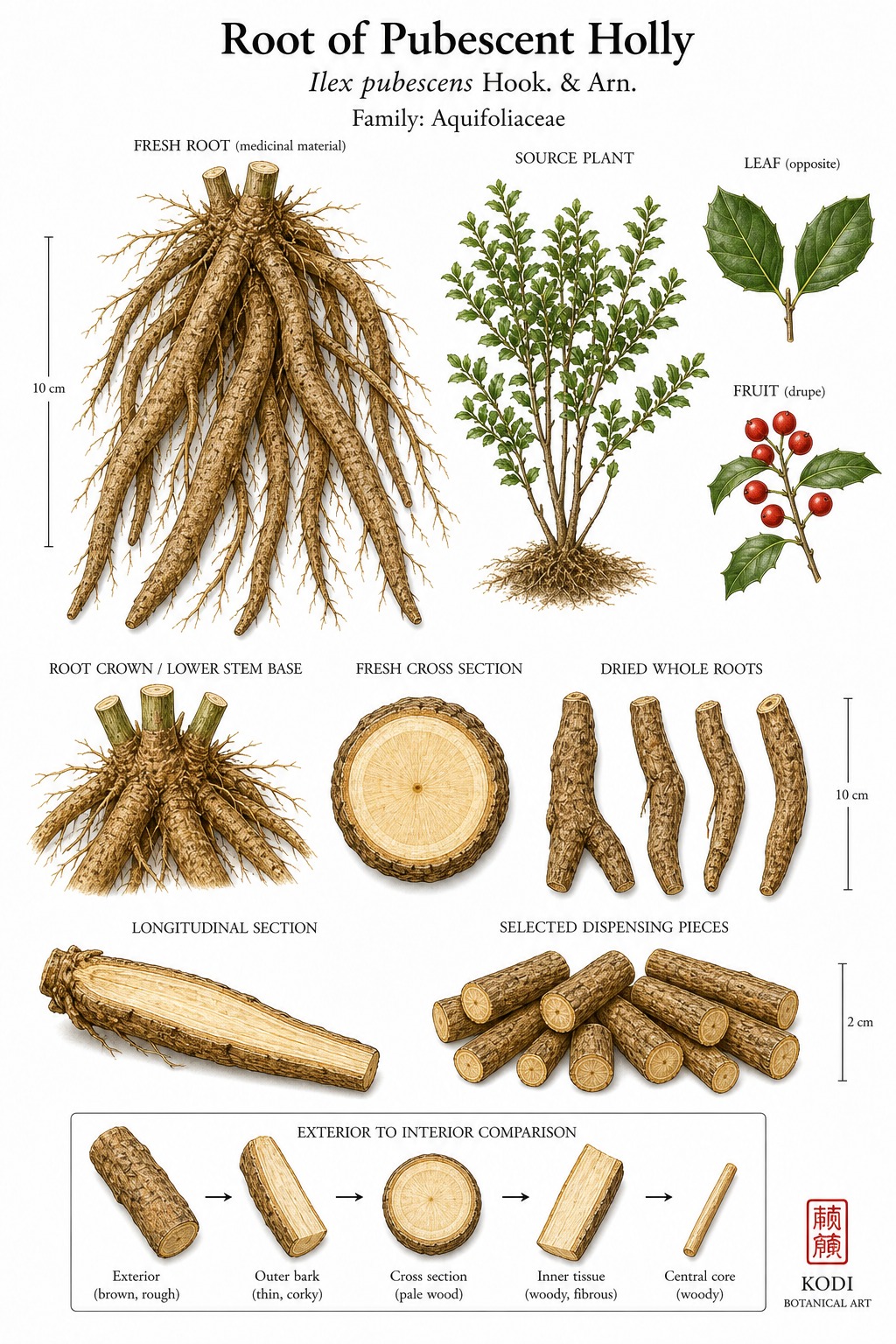
Known in TCM as Mao Dong Qing (毛冬青), this bitter and slightly astringent, slightly cold herb enters the Lung, Large Intestine, and Heart. Traditionally, it clears heat and resolves toxicity ... Mao Dong Qing is used for swollen sore throat, tonsillitis, inflammatory swellings, and other heat-toxic patterns where red painful congestion is obvious, most often applied for chest pain, sore throat, and tonsillitis. Modern research has identified Ilex among its active constituents.
Part used: Root
Also Known As
Latin: Radix Ilicis Pubescentis | Pinyin: Mao Dong Qing | Chinese: 毛冬青
TCM Properties
- Taste
- bitter, slightly astringent
- Temperature
- slightly cold
- Channels
- Lung, Large Intestine, Heart
Traditional Use
Primary Actions
- Clears heat and resolves toxicity ... Mao Dong Qing is used for swollen sore throat, tonsillitis, inflammatory swellings, and other heat-toxic patterns where red painful congestion is obvious.
- Invigorates Blood and unblocks the vessels ... southern Chinese practice also uses the root for chest obstruction, fixed pain, or poor circulation patterns with stasis.
- Reduces swelling after trauma or inflammatory obstruction ... both internal and external traditions treat lingering pain and localized heat signs.
Secondary Actions
- This page stays on the medicinal root of Ilex pubescens rather than a decorative evergreen shrub lane.
- Compared with Gang Mei, Mao Dong Qing is the more cardiovascularly famous holly-root medicine and the less herbal-tea-centered throat herb.
Classic Formulas
- Coronary-obstruction and chest-pain preparations using Mao Dong Qing injections, tablets, or decoctions ... a major modern extension of the herb's Blood-unblocking reputation.
- Heat-toxin throat pairings with Jin Yin Hua, Xuan Shen, or Ban Lan Gen ... common logic when swelling and pain dominate the upper burner.
- Trauma and stasis combinations with San Qi or Yan Hu Suo ... regional strategy when obstruction and pain linger after injury.
Classical References
- Modern Chinese herbology describes Mao Dong Qing as a heat-clearing root that also activates Blood and opens the collaterals.
- Its strongest reputation in contemporary practice is split between inflammatory heat-toxin conditions and vessel-obstruction patterns.
Modern Research
Active Compounds
- Ilex saponins and triterpenoid glycosides ... major constituent families discussed in Mao Dong Qing pharmacology
- Pubescenoside-type triterpenes ... increasingly important compounds in cardiovascular mechanistic studies
- Phenolic and flavonoid fractions ... supportive anti-inflammatory and antioxidant constituents
Studied Effects
- A 2019 review summarized the botany, traditional uses, phytochemistry, pharmacology, and toxicology of Ilex pubescens, establishing a strong modern reference point for Mao Dong Qing's cardiovascular and anti-inflammatory reputation (PMID 31401319).
- A 2025 study found that pubescenoside C upregulated macrophage-derived itaconic acid and attenuated myocardial ischemia-reperfusion injury, giving a concrete mechanistic example of the herb's vessel-oriented research lane (PMID 39357647).
- Overall, modern work on Ilex pubescens is more robust than for many regional roots, but human clinical standardization remains uneven across preparations.
PubMed References
Safety & Interactions
Contraindications
- Cold deficiency patterns without heat or stasis
- Severe loose stool if bitter cold roots aggravate the middle burner
Cautions
- Because Mao Dong Qing is often used in circulation-focused contexts, use extra care alongside anticoagulant or antiplatelet treatment even though herb-specific interaction data remain limited.
- Preparations vary widely across decoctions, injections, and standardized products, so study results are not always directly interchangeable.
Conditions
- Chest Pain Traditional ★★★★☆ JSON
- Sore Throat Traditional ★★★☆☆ JSON
- Tonsillitis Traditional ★★★☆☆ JSON
- Abscess Traditional ★★★☆☆ JSON
- Traumatic Injury Traditional ★★☆☆☆ JSON
Frequently Asked Questions
What is Root of Pubescent Holly used for?
Root of Pubescent Holly is traditionally used to Clears heat and resolves toxicity ... Mao Dong Qing is used for swollen sore throat, tonsillitis, inflammatory swellings, and other heat-toxic patterns where red painful congestion is obvious., Invigorates Blood and unblocks the vessels ... southern Chinese practice also uses the root for chest obstruction, fixed pain, or poor circulation patterns with stasis., Reduces swelling after trauma or inflammatory obstruction ... both internal and external traditions treat lingering pain and localized heat signs.. Research has investigated its effects on: A 2019 review summarized the botany, traditional uses, phytochemistry, pharmacology, and toxicology of Ilex pubescens, establishing a strong modern reference point for Mao Dong Qing's cardiovascular and anti-inflammatory reputation (PMID 31401319).; A 2025 study found that pubescenoside C upregulated macrophage-derived itaconic acid and attenuated myocardial ischemia-reperfusion injury, giving a concrete mechanistic example of the herb's vessel-oriented research lane (PMID 39357647)..
What are other names for Root of Pubescent Holly?
Root of Pubescent Holly is also known as Mao Dong Qing Root, Pubescent Holly Root. In TCM: 毛冬青 (Mao Dong Qing); Radix Ilicis Pubescentis.
Is Root of Pubescent Holly safe during pregnancy?
The safety of Root of Pubescent Holly during pregnancy has not been established. Consult a qualified healthcare provider before use.
What are the contraindications for Root of Pubescent Holly?
Root of Pubescent Holly should not be used in: Cold deficiency patterns without heat or stasis; Severe loose stool if bitter cold roots aggravate the middle burner. Consult a qualified healthcare provider before use.