Root of Przewalsk Gentian
- Chinese
- 龙胆草
- Pinyin
- Long Dan Cao
- Latin
- Radix Gentianae
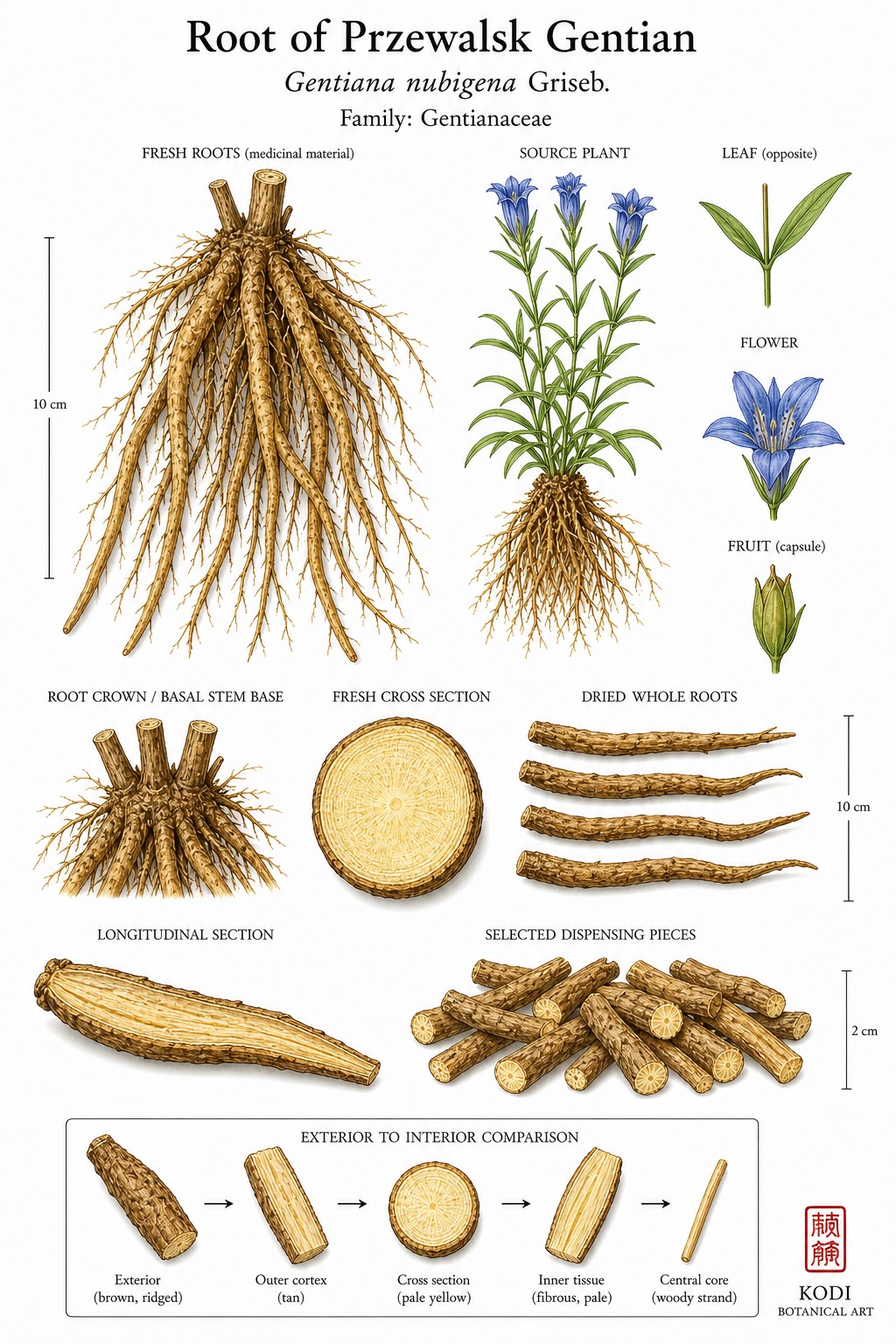
Known in TCM as Long Dan Cao (龙胆草), this bitter, cold herb enters the Liver and Gallbladder. Traditionally, it clears Liver and Gallbladder fire ... Long Dan Cao is the classic bitter-cold gentian root for red hot upward patterns with irritability, dizziness, headache, and fire blazing through the upper body, most often applied for hepatitis, jaundice, and urinary tract infection. Modern research has identified Broader among its active constituents.
Part used: Root
Also Known As
Latin: Radix Gentianae | Pinyin: Long Dan Cao | Chinese: 龙胆草
TCM Properties
- Taste
- bitter
- Temperature
- cold
- Channels
- Liver, Gallbladder
Traditional Use
Primary Actions
- Clears Liver and Gallbladder fire ... Long Dan Cao is the classic bitter-cold gentian root for red hot upward patterns with irritability, dizziness, headache, and fire blazing through the upper body.
- Dries damp-heat in the lower burner ... it is used for bitter heat patterns involving the genital or urinary tract, foul discharge, painful urination, or constrained damp-heat below.
- Resolves heat-toxin patterns linked to intense internal fire ... the herb is sometimes extended to mouth sores, inflamed swelling, or fire-driven irritability when the pattern is clearly excessive.
Secondary Actions
- This record stays on the imported Przewalsk-gentian identity and should not collapse into the already-live Qin Jiao pages, which belong to a different gentian medicinal lane.
- Direct literature on Gentiana nubigena itself is sparse, so the traditional profile here follows the broader Long Dan Cao gentian-root tradition while keeping the species identification explicit.
Classic Formulas
- Long Dan Xie Gan Tang ... the canonical damp-heat and Liver-Fire formula built around Long Dan Cao.
- Dang Gui Long Hui Wan ... heavy fire-draining formula where Long Dan Cao helps cool raging Liver and Gallbladder heat.
- Lower-burner damp-heat prescriptions paired with Huang Qin, Zhi Zi, and Che Qian Zi ... common formula logic when bitter-cold drainage is needed.
Classical References
- Traditional herbology consistently places Long Dan Cao among the strongest bitter-cold roots for clearing Liver and Gallbladder fire.
- The root is classically reserved for real excess heat and damp-heat rather than deficiency, fragility, or cold digestive states.
Modern Research
Active Compounds
- Broader Long Dan Cao and Gentiana literature emphasizes bitter secoiridoids such as gentiopicroside and swertiamarin ... exact profiling for Gentiana nubigena itself remains limited
- Iridoid glycosides and xanthone-related phenolics ... recurrent constituent families across medicinal gentians
- Authentication markers drawn from genus-level Gentiana research ... important because market roots are often discussed by medicinal group rather than by exact species
Studied Effects
- A 2025 review of Gentiana on the Mongolian Plateau summarized ethnobotany, traditional applications, phytochemistry, pharmacology, and toxicology, giving useful broader context for bitter gentian roots when exact-species literature is thin (PMID 40057145).
- A 2024 review on gentiopicroside outlined how this hallmark gentian secoiridoid is being studied across inflammation, metabolism, and organ-protective pathways in the wider Gentiana literature (PMID 37632552).
- A 2023 review on gentiopicroside's pharmacological significance reinforced that much of the modern Long Dan Cao evidence base is compound-level or genus-level rather than built from Gentiana nubigena alone (PMID 38201274).
PubMed References
- A comprehensive and systemic review of the Gentiana: Ethnobotany, traditional applications, phytochemistry, pharmacology, and toxicology in the Mongolian Plateau. (2025)
- Regulatory mechanisms of Gentiopicroside on human diseases: a brief review. (2024)
- Gentiopicroside-An Insight into Its Pharmacological Significance and Future Perspectives. (2023)
Safety & Interactions
Contraindications
- Spleen and Stomach deficiency with loose stool
- Yin deficiency without clear excess heat
- Cold patterns misread as damp-heat
Cautions
- This is a very bitter cold root and can quickly aggravate weak digestion if the excess-heat pattern is wrong.
- Published modern evidence often pools multiple medicinal gentian species, so not every result can be assigned specifically to Gentiana nubigena.
Conditions
Frequently Asked Questions
What is Root of Przewalsk Gentian used for?
Root of Przewalsk Gentian is traditionally used to Clears Liver and Gallbladder fire ... Long Dan Cao is the classic bitter-cold gentian root for red hot upward patterns with irritability, dizziness, headache, and fire blazing through the upper body., Dries damp-heat in the lower burner ... it is used for bitter heat patterns involving the genital or urinary tract, foul discharge, painful urination, or constrained damp-heat below., Resolves heat-toxin patterns linked to intense internal fire ... the herb is sometimes extended to mouth sores, inflamed swelling, or fire-driven irritability when the pattern is clearly excessive.. Research has investigated its effects on: A 2025 review of Gentiana on the Mongolian Plateau summarized ethnobotany, traditional applications, phytochemistry, pharmacology, and toxicology, giving useful broader context for bitter gentian roots when exact-species literature is thin (PMID 40057145).; A 2024 review on gentiopicroside outlined how this hallmark gentian secoiridoid is being studied across inflammation, metabolism, and organ-protective pathways in the wider Gentiana literature (PMID 37632552)..
What are other names for Root of Przewalsk Gentian?
Root of Przewalsk Gentian is also known as Long Dan, Gentian Root. In TCM: 龙胆草 (Long Dan Cao); Radix Gentianae.
Is Root of Przewalsk Gentian safe during pregnancy?
The safety of Root of Przewalsk Gentian during pregnancy has not been established. Consult a qualified healthcare provider before use.
What are the contraindications for Root of Przewalsk Gentian?
Root of Przewalsk Gentian should not be used in: Spleen and Stomach deficiency with loose stool; Yin deficiency without clear excess heat; Cold patterns misread as damp-heat. Consult a qualified healthcare provider before use.