Qian Jin Ba Root
- Chinese
- 千斤拔
- Pinyin
- Qian Jin Ba
- Latin
- Radix Et Caulis Flemingiae
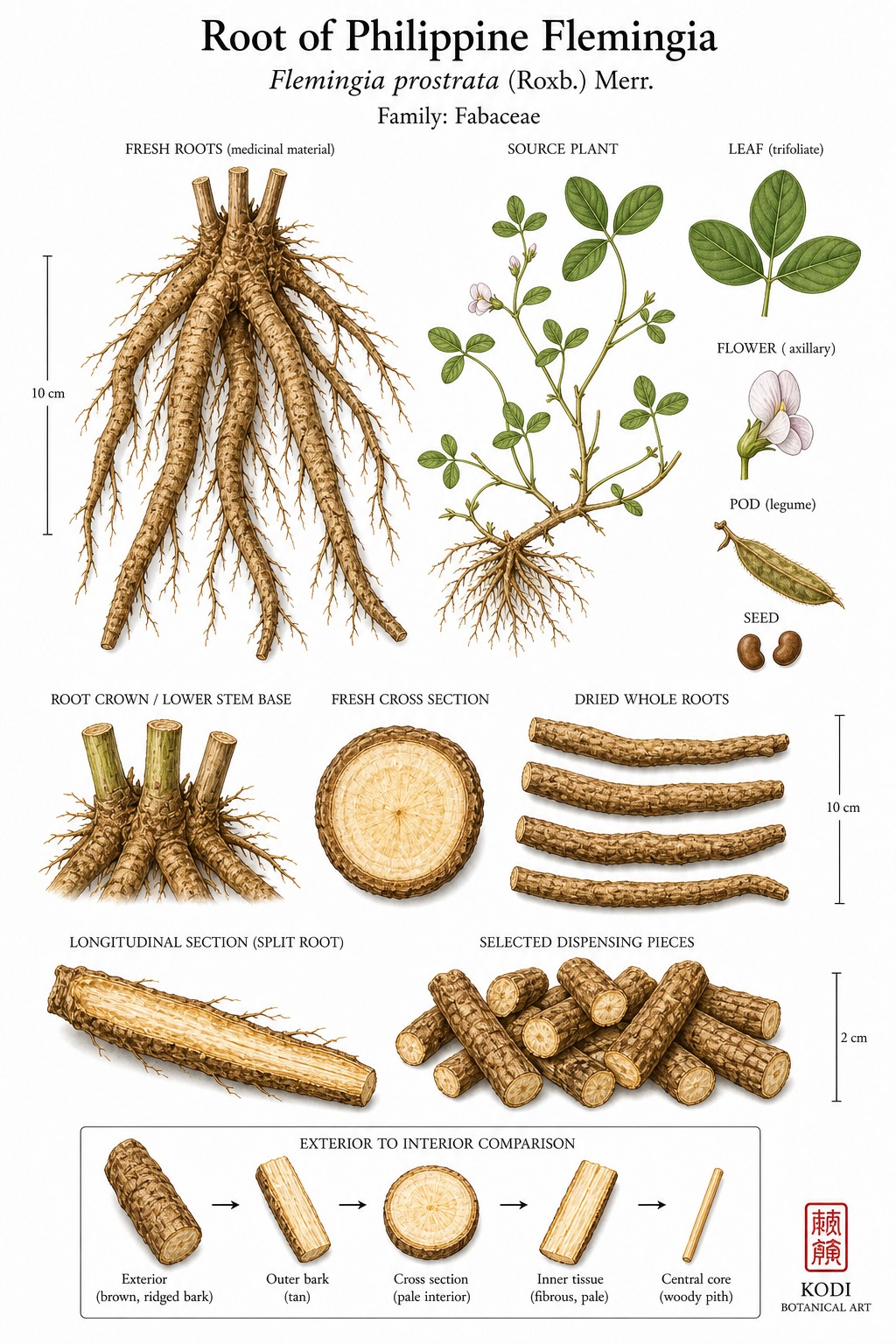
Known in TCM as Qian Jin Ba (千斤拔), this sweet and slightly bitter, neutral herb enters the Liver and Kidney. Traditionally, it dispels wind-damp and relieves painful obstruction ... Qian Jin Ba is a southern Chinese root medicine for chronic aching joints, sore low back, and weakness with damp obstruction, most often applied for low back pain, joint pain, and rheumatism. Modern research has identified Prenylated among its active constituents.
Part used: Root
Also Known As
Latin: Radix Et Caulis Flemingiae | Pinyin: Qian Jin Ba | Chinese: 千斤拔
TCM Properties
- Taste
- sweet, slightly bitter
- Temperature
- neutral
- Channels
- Liver, Kidney
Traditional Use
Primary Actions
- Dispels wind-damp and relieves painful obstruction ... Qian Jin Ba is a southern Chinese root medicine for chronic aching joints, sore low back, and weakness with damp obstruction.
- Strengthens sinews and bones ... it is used when musculoskeletal pain combines with tired legs, reduced endurance, or recurrent low-back weakness.
- Invigorates Blood and reduces swelling after trauma ... regional practice extends the herb to bruising, strain, and lingering obstruction after injury.
Secondary Actions
- This record is anchored to the accepted Flemingia prostrata identity even though older medicinal naming may still use Moghania or other inherited market labels.
- Standardized modern pharmacology for Qian Jin Ba remains much thinner than for major pharmacopoeial herbs, so the page stays close to conservative regional musculoskeletal use.
Classic Formulas
- Regional wind-damp pain decoctions with Du Huo, Ji Xue Teng, or Niu Xi ... common southern pairing logic for weak painful limbs.
- Trauma and strain combinations with Ru Xiang, Mo Yao, or Yan Hu Suo ... used when pain has a stasis component.
- Low-back support pairings with Du Zhong or Xu Duan ... traditional strategy when soreness and weakness are chronic rather than acute.
Classical References
- Southern materia medica traditions place Qian Jin Ba among roots that strengthen the waist and knees while dispelling damp painful obstruction.
- Because naming and species boundaries have shifted over time, authenticated source material is especially important for this herb.
Modern Research
Active Compounds
- Prenylated flavonoids and isoflavonoids ... major specialized metabolites reported from the species complex
- Phenolic constituents ... supportive compounds relevant to anti-inflammatory and antioxidant interest
- Flemiphilippinin-type constituents ... notable molecules highlighted in newer pharmacology papers
Studied Effects
- A 2025 comparative chloroplast-genome study on Flemingia prostrata and Flemingia macrophylla underlined the need for careful authentication among morphologically similar medicinal roots traded in southern China (PMID 40901553).
- A 2025 study reported that flemiphilippinin A induced paraptosis in lung cancer cells, illustrating that newer mechanistic work is beginning to emerge from this otherwise sparse evidence lane (PMID 40716126).
- Overall, the modern literature remains limited and still lags far behind the herb's long-standing regional musculoskeletal use.
PubMed References
- Comparative analysis of complete chloroplast genomes of Flemingia prostrata and Flemingia macrophylla, two commonly used medicinal plants in southern China. (2025)
- Flemiphilippinin A induces paraptosis in lung cancer cells via c-Myc-driven endoplasmic reticulum stress and CHOP-mediated mitochondrial dysfunction. (2025)
Safety & Interactions
Cautions
- Human safety literature for authenticated Flemingia prostrata root remains relatively sparse compared with better-known official herbs.
- Because Qian Jin Ba names may be applied loosely in commerce, avoid assuming all market material has identical chemistry.
Conditions
- Low Back Pain Traditional ★★★☆☆ JSON
- Joint Pain Traditional ★★★☆☆ JSON
- Rheumatism Traditional ★★★☆☆ JSON
- Traumatic Injury Traditional ★★★☆☆ JSON
- Kidney Deficiency Traditional ★★☆☆☆ JSON
Frequently Asked Questions
What is Qian Jin Ba Root used for?
Qian Jin Ba Root is traditionally used to Dispels wind-damp and relieves painful obstruction ... Qian Jin Ba is a southern Chinese root medicine for chronic aching joints, sore low back, and weakness with damp obstruction., Strengthens sinews and bones ... it is used when musculoskeletal pain combines with tired legs, reduced endurance, or recurrent low-back weakness., Invigorates Blood and reduces swelling after trauma ... regional practice extends the herb to bruising, strain, and lingering obstruction after injury.. Research has investigated its effects on: A 2025 comparative chloroplast-genome study on Flemingia prostrata and Flemingia macrophylla underlined the need for careful authentication among morphologically similar medicinal roots traded in southern China (PMID 40901553).; A 2025 study reported that flemiphilippinin A induced paraptosis in lung cancer cells, illustrating that newer mechanistic work is beginning to emerge from this otherwise sparse evidence lane (PMID 40716126)..
What are other names for Qian Jin Ba Root?
Qian Jin Ba Root is also known as Root of Philippine Flemingia, Flemingia Root, Moghania. In TCM: 千斤拔 (Qian Jin Ba); Radix Et Caulis Flemingiae.
Is Qian Jin Ba Root safe during pregnancy?
The safety of Qian Jin Ba Root during pregnancy has not been established. Consult a qualified healthcare provider before use.